
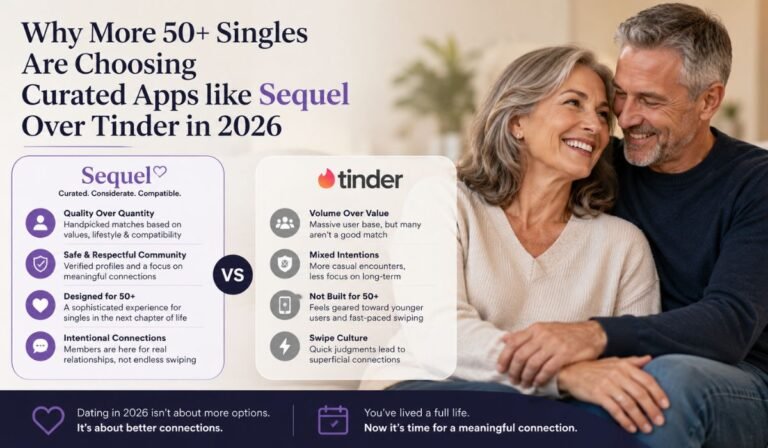
Not every dating app was built with the 50+ community in mind. Considering the growing number of mature adults stepping back into dating after a long relationship, a divorce, or simply a lengthy pause, that realization tends to arrive quickly.
In 2026, there is a quiet but significant shift. People over 50 are leaving general-purpose platforms and moving toward something more intentional. Apps designed specifically for their stage of life, expectations, and standards are gaining popularity. The 50-plus dating market has grown steadily over the past 5 years, and so has the appetite for platforms to offer a secure and convenient way of building connections.
The question is no longer “should I try online dating?” Most mature adults already have. The real question is: “Which app can cater to their needs and demands?”
Swipe Left on Swiping and Look for a Good Alternative to Tinder
Tinder favors speed. The model is simple. Swipe right if you’re interested, swipe left if you’re not, and keep moving. For a generation in their twenties with a high tolerance for digital noise, that made some sense. For mature adults who have spent decades building real lives, it tends to be exhausting within the first hour.
The complaints from the 50-plus community are remarkably consistent. They are sick and tired of profiles with almost no information, random matches, silly conversations, and serious safety risks. And beneath all of that, they have to deal with a persistent sense that the platform was never designed for someone like them.
There is also the trust problem. General dating platforms have long struggled with fake accounts, bots, and misleading profiles. For someone stepping into online dating for the first time, or returning to it after many years away, encountering a fake profile early on is not just frustrating. It can be enough to abandon the whole idea entirely.
This is what people are increasingly calling “Tinder fatigue” among mature adults. It is not reluctance to date, but a completely reasonable response to a service aimed at a younger audience.
What Does Real Curation Mean?
The word “curated” gets used freely in tech, usually to mean very little. In the context of dating apps, it should mean something specific. This is an environment where the quality of every interaction has been actively protected.
A top-notch alternative to Tinder for people over 50 does several things differently. It starts with verification. Not the basic “confirm your email” variety, but a process that genuinely establishes each profile as a real person. It continues with the profile itself, which should give users enough room to express who they actually are. And it extends to community design: what goals are people here for, what kind of conversations does the platform encourage, and who is paying attention when something goes wrong.
For the 50-plus collective specifically, a few things are non-negotiable. Safety cannot be a footnote. Simplicity matters because a cluttered interface is a problem no one needs. And the people you encounter should, broadly, be there for the same reasons you are.
The better alternatives to Tinder understand this. They were built around it. And in 2026, the gap between those platforms and the general-purpose apps has never been more visible.
Sequel Dating App – Perfect Fit for the 50+ Community

Sequel was created with the core idea that active agers do not need more matches. They need better ones.
From the moment you sign up, you choose your Dating Goal. Marriage, long-term relationship, companionship, friendship, or something more open-ended are among the options. The Sequel app uses that data to build your entire feed, so the people you see are looking for the same thing as you. It sounds like a simple fix, but it eliminates one of the most consistent frustrations of mainstream dating apps. On Sequel, you won’t face a mismatch of expectations between two people who have somehow ended up in the same search results.
Profiles are more detailed here. Alongside the standard information, users fill in values, lifestyle details, and “Little Joys”, which are the specific personal details that tend to start real conversations. You can mention your favorite decade of cinema or something particular about the way they like to spend a Sunday. These are not mandatory fields designed to pad out a page, but the details that give another person something genuine to respond to.
There is also no mutual match requirement. A feature called Instant Chat lets you message anyone on the platform directly, without waiting for them to approve you first. For people who are clear about what they want and have no interest in passive games, it changes the dating dynamic considerably.
Verification on the Sequel dating app goes further than most. Profiles undergo a two-stage process. First, there is an AI scan for synthetic content and inconsistencies, then a human review by a moderation specialist when AI detects something strange. Profiles that pass the human stage receive a visible verification badge.
Fake photos and heavily filtered images are banned outright. The Sequel app’s position on this is clear. People come here for a real connection, not a spruced-up version of one. That tends to resonate with the 50+ community.
Security runs quietly in the background throughout. Data is protected in transit with TLS 1.2 and 1.3 encryption. Profiles are only visible to registered members. An anti-fraud engine monitors behavior in real time, flagging anything unusual for immediate human review. An in-app reporting system lets any member flag suspicious actions quickly and easily.
The Sequel app also offers a detailed search across more than 10 customizable parameters – age, height, education, values, lifestyle, attitudes to family, religious beliefs, etc. Your answers are saved between sessions, so you are not repeating yourself every time you open the app.
Tinder vs. Sequel App: Which Option to Choose
| Tinder | Sequel App | |
| Built for | 18-35 demographics | 50+ community |
| Profiles | Photo-led, minimal detail | In-depth: values, goals, Little Joys, ice-breaker questions |
| Verification | Basic | AI scan + human review |
| Messaging | Mutual match required | You can message anyone directly |
| Dating intentions | Not defined | Set at sign-up (Marriage, Serious Dating, Companionship, Friendship) |
| Fake profile protection | Limited | AI detection, human moderation, and zero tolerance for fake profiles |
| Safety infrastructure | Standard reporting | Anti-fraud engine, human moderation team |
| How recommendations work | Location and age | Goals, values, in-app behavior, and profile completeness |
| Community | General population | Curated 50+ collective |
The Right Chapter Deserves the Right Platform

None of the provided information suggests that Tinder is a bad product. For the audience it was built for, it works OK. But the 50-plus community is not that audience. The sooner that is widely accepted, the better the options will be created.
As a purpose-built alternative to Tinder, Sequel is one of the more serious attempts to address what this group truly needs. It is not trying to be the biggest dating platform on the market. It is just meant to be the right one for people at a specific, and rather good, point in their lives.
If you are over 50 and thinking about getting back into dating, the platform you choose matters more than people often assume. The right one will make it easier and more enjoyable to build connections with like-minded people.
That is exactly what the Sequel app does.
