
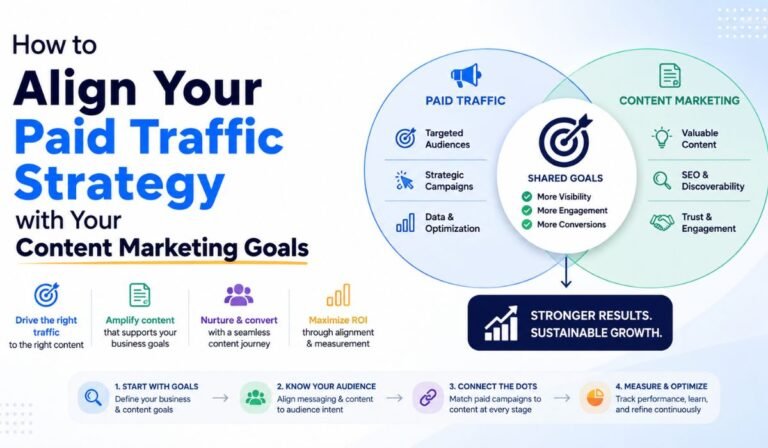
Why Paid Traffic and Content Marketing Need to Work Together
While organic search is the highest quality traffic, its greatest weakness is that it’s dependent on aggregate factors that take a long time to influence. It’s not that you shouldn’t invest in acquiring organic visits; however, you need to approach them essentially as a bi-product of your content production rather than a primary goal.
Stop Sending Paid Traffic to Product Pages
Many paid campaigns have the same basic structure to them: put up an ad, send people to a product page, track how many of them bought something. For certain types of products and offers, that process is fine. But if you don’t already know how to find the people who haven’t heard of you, or who aren’t ready to convert immediately, and won’t respond to a sales pitch, well, you’re leaving a substantial chunk of potential customers on the table.
If you’re putting time into producing editorial content, blog posts, guides, comparison articles, then just driving that paid traffic directly to a checkout page is wasting your hard work and ad money. Those are destinations that are still super-relevant in the early buying cycle, and if you’re a B2B company, right up until the last sales call.
You can’t use that content as effectively when you know what you’re trying to reach out to is top-of-funnel, and probably isn’t ready to take any kind of buying action. In those cases, you’re far better to set the destination as a content page that gives that visitor what they genuinely found interesting enough to click in the first place.
Match the Format to the Funnel Stage
Native ads are an effective solution for editorial content, as the format is consistent with the reading experience. For example, when a reader is scrolling through a news site or content platform and sees a recommended article that looks and reads like the rest of the content on the page, they are more likely to click on it and engage with it. This is not a hack, and it’s not a trick. It’s all about relevance.
Choosing the best native ads network comes down to whether the publishers in their inventory match the style and the subject of your content. If the publisher’s audience and your content’s voice don’t align, trust is immediately broken. The right network is the one that makes your content look native to the environment it is served in.
Push notification traffic is effective if you are using it to retarget users who have visited your site before, or to sign up people for a specific event. It’s less effective as an introduction to your brand. Popunder is high volume, low cost, and broad reach. It’s right if you have content with broad mass appeal (such as a quiz, a tool, or a viral style post) and you are looking for broad reach rather than pinpoint precision.
Use Organic Winners as Your Paid Traffic Foundation
Before you invest in distribution, see what’s already performing well on its own. Your analytics will tell you which blog posts have solid engagement, a low bounce rate, and/or the highest conversions from organic traffic. Those will be your paid distribution guinea pigs.
This is important because you’re not taking a flyer on an unproven piece of content with ad money. You already know the content works. Paid traffic simply scales what you know to be effective. Spending money to send people to a post no one wants to read for free is just buying data you didn’t need to buy.
Grab 5 of your top organic performers by conversion or engagement. Set up native campaigns that send people to those posts. Then monitor the micro-conversions, newsletter signups, content downloads, time on page, because that’s the ROI for content-focused campaigns. You’re not going to get a direct buy out of every session. You’re not supposed to.
Paid Traffic Has Organic SEO Benefits Too
Another benefit that is often overlooked is that by driving paid traffic to your content, particularly native and push traffic from relevant sources within context, you create real user engagement signals. The time users spend on your page increases. People start sharing your post. And some of those visitors will link to your post from their websites; you don’t even need to prompt them.
Search engines notice those signals. A thoroughly promoted post will achieve ranking results more rapidly than the same content left to slowly attract links by itself. Paid distribution won’t exclude the necessity of creating links, but it will shorten the process as your content will be exposed to people who are likely to engage and share it.
This implies that your content marketing budget and your paid distribution budget are, in fact, aiming at the same goal, organic authority, even if they are two separate items on your budget sheet.
Measure What Actually Matters
Track the actions that indicate interest in your content’s message: email signups, PDF downloads, scroll depth, and session duration. If you measure last click purchases against paid content and they outperform paid, you’ll know you’re under spending on distribution.
