
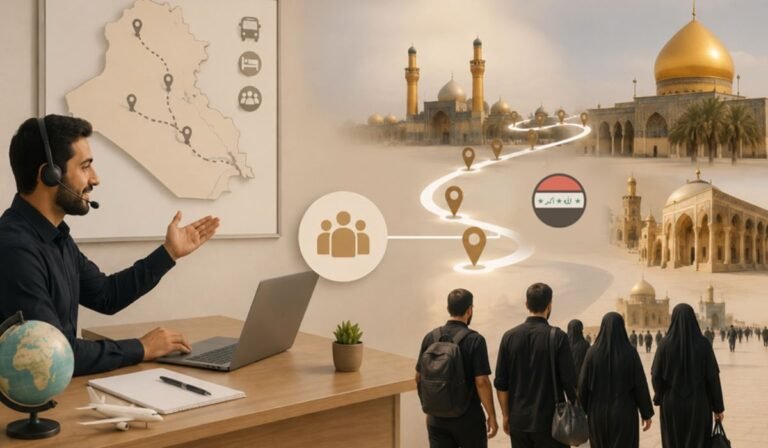
Planning an Iraq Ziyarat without assistance often appears simple at first, but the reality quickly proves otherwise once you begin arranging the journey. Flights to Najaf are limited from most departure cities, visa requirements can change with little or no notice, and hotels near the holy shrines are frequently booked months in advance during peak commemoration periods. Coordinating ground transport between Karbala, Najaf, Samarra, and Kadhimiya also demands local knowledge that standard navigation tools cannot reliably provide for first-time pilgrims. Alongside these logistical challenges is the emotional significance of the journey itself, which can make the administrative burden feel even more complex and overwhelming before any bookings are confirmed. This combination of factors is exactly why experienced travel agencies are no longer just a convenience for Iraq Ziyarat pilgrims, but an essential support system for ensuring the journey is completed.
What Makes Iraq Ziyarat Planning More Complex Than Regular Travel?
Iraq Ziyarat is not a standard international trip with a hotel, a flight, and a list of tourist attractions to tick off in order. It is a spiritually significant journey that involves multiple cities, multiple shrine visits, specific prayer timings, and logistical realities on the ground that change depending on the time of year and the commemoration calendar.
A pilgrim planning independently must coordinate international and sometimes domestic flights, secure visas that require precise documentation, book accommodation in cities where availability near the shrines is genuinely limited, and arrange ground transport that is safe, reliable, and navigated by someone who understands the routes between holy sites intimately rather than approximating them from a general map.
Each of these tasks is manageable individually. Together, across a journey that typically spans five to ten days and multiple cities, the coordination burden becomes the thing that most independent planners describe as the most stressful part of a journey that was supposed to be spiritually restorative.
How Do Travel Agencies Handle End-to-End Pilgrimage Coordination?
A specialist Iraq Ziyarat travel agency handles the entire coordination layer so the pilgrim arrives in Iraq with nothing left to manage except the spiritual purpose of being there. That is a more significant service than it sounds when the alternatives are considered honestly.
Flight and Visa Coordination
Securing flights to Najaf involves navigating limited route options from most departure cities and managing connections that do not create unreasonably long transit times for pilgrims who may be elderly, unwell, or travelling with young children. Visa documentation for Iraq requires specific paperwork submitted through particular channels that vary depending on the pilgrim’s nationality and departure country.
A specialist agency manages both simultaneously. They know which visa application routes produce the fastest approvals, which flight combinations work best for specific departure cities, and how to handle complications that arise during the application process without the pilgrim needing to restart the entire process independently when something goes wrong.
Accommodation Near the Shrines
- Limited availability: Hotels within walking distance of the shrines in Karbala and Najaf are genuinely scarce during Ashura, Arbaeen, and other major commemoration periods. Agencies with established relationships with local accommodation providers secure rooms months in advance that individual pilgrims could not access independently at any price.
- Quality assurance: Not all accommodation near the shrines meets a standard that makes a demanding pilgrimage itinerary comfortable for most travellers. Agencies with on-the-ground experience know which properties are reliable and which ones consistently disappoint pilgrims who booked based on photographs alone.
- Group coordination: For pilgrims travelling in family groups or community parties, coordinating accommodation that keeps the group together requires negotiation and planning that agencies handle as a standard part of their service.
What Does Ground Transport Actually Involve Between Shrine Cities?
The journey between Karbala, Najaf, Samarra, and Kadhimiya is not a straightforward road trip. The distances are manageable, but the transportation requires local knowledge, reliable vehicles, and drivers who understand the pilgrimage schedule and the timing constraints that shrine visits and prayer times create throughout each day.
An agency provides dedicated transport with drivers who know the routes, understand the significance of each site, and can navigate the access restrictions and crowd management measures that apply during peak pilgrimage periods. For pilgrims who have not travelled to Iraq before, that ground support is the difference between a journey that flows smoothly from site to site and one that loses hours to confusion, wrong turns, and transport arrangements that fall through at the worst possible moment.
If you want to understand what a well-organised Iraq Ziyarat itinerary actually looks like on the ground, this guide covering key tips for a smooth Iraq Ziyarat is worth reading before you finalise any planning decisions for the journey.
How Do Agencies Support Pilgrims With Special Requirements?
Not every pilgrim arrives in Iraq in the same physical condition or with the same level of mobility. Elderly pilgrims, those with health conditions, and families with young children all require adjustments to the standard itinerary that individual planning struggles to accommodate without significant additional effort and local knowledge.
- Mobility support: Agencies arrange wheelchair access, ground-floor accommodation, and vehicles suitable for pilgrims who cannot manage long walking distances between shrine entrances and the areas accessible by transport.
- Medical awareness: Knowing where medical facilities are located near the shrines, which hospitals have English-speaking staff, and how to handle a health emergency during the journey requires local knowledge that a travel agency accumulates through experience across many previous pilgrim groups.
- Flexible pacing: An agency can adjust the itinerary around the needs of the group rather than following a rigid schedule that does not account for the physical demands of multiple shrine visits in a single day across Iraqi summer heat.
Why Does Working With a Specialist Agency Matter More Than a General Travel Agent?
A general travel agent can book flights and hotels to Iraq. A specialist Iraq Ziyarat agency knows that the first visit to the shrine of Imam Husayn requires time that no standard itinerary slot captures adequately. They know which prayer times affect shrine access and when the crowds make certain visits more meaningful or more difficult, depending on what the pilgrim is seeking from that specific moment of the journey.
That depth of knowledge comes from having accompanied pilgrims through the same journey many times before and from maintaining relationships with local guides, accommodation providers, and ground transport operators who make the difference between a journey that functions smoothly and one that requires constant troubleshooting from the moment of arrival. For pilgrims considering their first Iraq Ziyarat or wanting to improve on a previous experience, Zaair’s Iraq pilgrimage packages are built around exactly this kind of end-to-end specialist support rather than a generic travel booking service that happens to cover Iraq as one destination among many.
Conclusion
Iraq Ziyarat is one of the most spiritually significant journeys a pilgrim can undertake and one of the most logistically demanding to plan well without specialist support. Travel agencies that specialise in this specific journey remove the coordination burden entirely so the pilgrim can be fully present for the spiritual purpose of the trip from the moment they arrive. The visa, the flights, the accommodation, the transport, and the ground logistics are handled by people who have done this many times before. The pilgrim’s only responsibility is to show up ready for the journey itself.
