
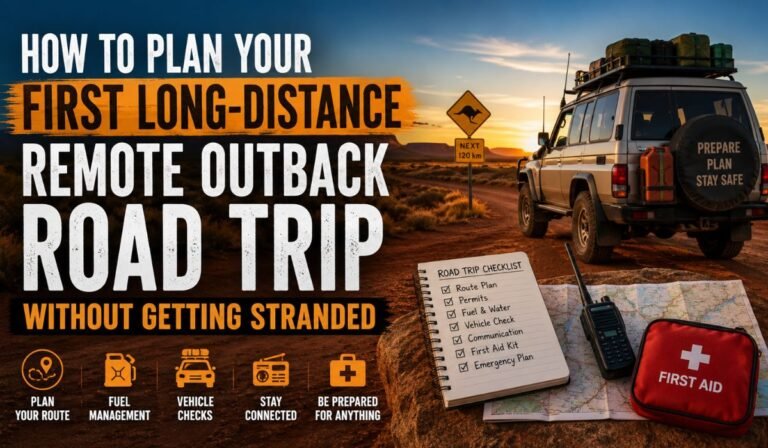
The Outback is unforgiving, vast beyond comprehension and potentially lethal. Sounds a bit like something you read on a box of cigarettes, but it’s an important overture. This guide isn’t written, designed or intended for people who already know what they’re doing. If you’ve driven the Outback twelve times and you can tell July by how red the dirt gets, then this isn’t for you.
Know What Kind of Trip This Actually is
A long-distance Outback road trip isn’t a camping holiday with some extra dust. It’s a self-contained logistics operation where every failure point, fuel, water, tyres, communication, vehicle mechanics, compounds into something serious within hours. The Stuart Highway cuts through the Red Centre and gives first-timers a useful mental model: even on a well-travelled sealed highway, service gaps stretch to 250 kilometres or more. Venture off it onto unsealed tracks and those gaps double or triple. The mindset shift you need before planning anything else is this: every resource you consume has to be carried with you, and there’s no delivery service when you run short.
Build the Right Vehicle and Towing Setup
This is the part most first-timers don’t appreciate. An all-wheel-drive vehicle is vastly mechanically different from a full four-wheel-drive with low-range gearing and actual ground clearance. AWD systems give you traction on a slippery road. Low-range 4WD gives you torque at low speeds across rocky creek crossings, deep sand, and washed-out tracks. If your vehicle doesn’t have a true low-range transfer case and a minimum of 200mm of ground clearance, certain tracks are mechanically impassable.
The trailer itself also plays a significant role. Conventional road trailers cannot endure the kind of punishment that corrugations cause. The severe, continuous ridges that form on non-sealed roads can shake suspension, lights, and coupling hardware meant for conventional roads to pieces within a few hundred kilometres. An Outback towing setup demands a heavy-duty chassis, independent suspension, and an articulating coupling such as a DO35 hitch instead of a standard 50mm ball to prevent the stresses from destroying your tow bar. The DO35 allows the trailer to move physically independently of the vehicle as it negotiates severely uneven road surfaces without imposing torsional stresses on the hitch or tow bar that a conventional coupling would. Towing a purpose-built camper trailer that is designed to be taken off road on Outback tracks will help in that water tanks, fuel, and recovery gear are already carried extremely low on the trailer, rather than being carted up high on roof racks and blowing out your vehicle’s centre of gravity and axle ratings.
Always know your GCM, Gross Combination Mass. This is the maximum legal and safe weight of your towing vehicle and trailer combined. Overloading beyond GCM doesn’t just risk a fine; it compromises braking, steering response, and the structural integrity of your chassis on rough roads. The Outback is not the place to discover you’ve been running over weight.
A bull bar is not optional if you’re covering any distance at dawn, dusk, or night. Kangaroos, emus, and feral cattle are common on roadsides and move unpredictably. A bull bar won’t prevent the collision but it does protect your radiator, which in the Australian summer heat is the difference between a dented vehicle and a dead one. Summer temperatures in the central Outback regularly exceed 40°C for weeks at a time, a destroyed cooling system in those conditions becomes life-threatening very quickly, which is also why the advice to stay with your vehicle if it breaks down exists. A visible, stationary vehicle is far easier to locate from the air than a person walking.
Calculate Your Fuel Before You Pick Your Route
The fuel planning seems obvious. Everyone knows they burn more fuel when they’re towing a loaded trailer in 45-degree heat over 500km of corrugated dirt tracks than they do cruising along an aircond highway at the posted limit. Yet for some unknown reason, most people figure out how far their vehicle can travel on a liter of fuel, mark a few dots on a map and call those distances fuel points. They’re not. Your vehicle’s best-case fuel efficiency isn’t what you need to be calculating your fuel range from, it’s the worst.
Firstly, calculate a point of no return. That’s easy enough. It’s halfway between two potential fuel stops. If you can’t cover the distance from that point to the next bowser with a 20% buffer in your tank, you’re screwed. So plan to carry a few extra jerries. Some stations do run dry, especially later in the season or if there’s been an interruption in supply, so you always want to have enough fuel left over to get you through. Most Outback travelers would be lost without one or two jerries rattling around in the back. If you’re short on water, take three or four extra jerries of water instead. They’ll keep in the back of the Ute and come in handy for all sorts of things.
Power Management and Communication
A fridge that runs on 12-volt power seems like an odd thing to have on a truck, but it’s not so much a comfort as a safety requirement. Short of refrigeration, you very quickly start to suffer food-borne infections that become life-threatening long before your trip is over. Milk that’s bad before you even started driving in the morning is a solid clue that the day’s building blocks were unlikely to be edible long enough to fuel your drive. You can’t carry the food you’ll need to last weeks in the Outback without a fridge.
If you’re going to run a fridge continuously, you need a dual-battery system and a smart DC-to-DC charger to suit. A smart DC-to-DC charger regulates the charge cycle properly, protects your engine’s starting battery from being drained, and works whether power is coming from solar panels or the alternator while you drive.
For communication, mobile networks disappear well before the interesting country begins. A PLB, Personal Locator Beacon, is a non-negotiable item for any remote travel. It’s a satellite-based distress device that, when activated, sends your GPS coordinates to emergency services with no subscription required. Garmin inReach devices and Starlink setups add two-way messaging and real-time tracking, which are valuable, but the PLB is your baseline. Know how to contact the Royal Flying Doctor Service if you need to, it’s the primary emergency aeromedical provider across remote Australia, and knowing their contact procedures before you need them is a basic preparation step, not an afterthought.
Driving Technique on Unsealed Roads
The Outback penalizes individuals who believe that dirt roads can be used as if they were highways. If you travel at high speeds on a washboard road, the vibration damage inflicted on your vehicle and trailer increases dramatically, speed is not as counter-intuitive as it sounds, some washboard roads actually all but smooth out at approximately 80 kilometres an hour, but at that speed you have nothing in reserve if a tyre blows or you meet an animal. On washboard surfaces especially, tyre pressure should be adjusted when you leave sealed bitumen and re-inflated when you return. Lower tyre pressures spread the contact patch, absorb more corrugation impact, and significantly enhance traction in sand. Make sure you carry a quality pressure gauge and deflator so you can make the necessary alterations intentionally, rather than guessing them.
When you are driving in convoy, or even following another vehicle on a dirt road, the dust rule applies more than you might expect. Hang back until you can’t see that vehicle in front and give that dust cloud a moment or three to fully settle before you start to close the distance. A blinding dust cloud from the vehicle ahead, combined with an oncoming car attempting to overtake, creates a head-on collision scenario that happens fast and with no warning. It’s the main cause of both single vehicle and multiple vehicle crashes on unsealed Outback roads.
Finally, ensure that you have a strict “no travel at dawn or dusk” policy. This is when native wildlife and feral animals are most likely to be near and on the road. Low light angle means drivers pick up oncoming animals at a reduced rate and the highest number of native wildlife and feral camels and horses, in particular, are moving. The dawn and dusk periods are unreasonably dangerous as a result. Plan to finish driving well before the lackluster light show starts and to begin after full sunrise.
Daily Inspection Routine
Every morning, prior to departure, spend fifteen minutes under the hood and under the truck. Split or swelling radiator hoses? Loose suspension bolts? Leaking shock absorbers? Any grass or debris packed against the exhaust system? Dry grass packed against a hot exhaust is a vehicle fire. And it accumulates much faster than you’d think when traveling through spinifex country. A cracked radiator hose caught pre-departure is a ten-minute fix; same hose, 80 klicks from your last camp, on a 43-degree day, is a drama.
Check your dust sealing. The fine red bulldust of the Australian interior gets in everywhere, camera bags, medical kit, food, electronics. Every compartment not sealed with a good gasket will be full of red powder within a day. This is important not just for equipment reliability, but for your health, as the ingestion of dust and particularly of fine dust particles is a serious long-term health risk on extended trips.
Before You Go
Let a responsible person, who is not part of your trip, know all the details of your intended trip, your route and scheduled overnight stops, your anticipated check-in calls, and what to do and who to call if you don’t check in within a specified number of hours of your latest expected time. The most important step you’ll ever take costs nothing, weighs nothing, doesn’t occupy any space in your pack. This is your ultimate backstop plan, the one that keeps working when everything else has failed.
The Outback is one of the most extraordinary places you will ever put yourself. The preparation is not intended to put you off, it’s intended to get you there.
