
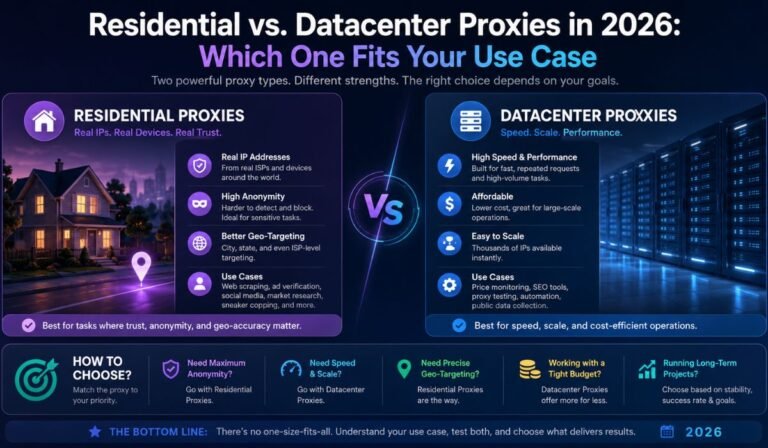
The first really tough decision people normally face when buying proxies is between a datacentre proxy and a residential proxy. The problem is if you pick the wrong one, you might just find yourself getting blocked on all requests or end up overpaying for something you just don’t need at the end of the day.
This guide is going to walk you through how both actually work, where each one excels, and most importantly how you work out which one is best suited to the task at hand.
How Each Proxy Type Actually Works
Datacenter Proxies
A datacenter proxy runs on a server in a hosting facility. When you send a request over one of them, your traffic travels through that server and you will end up with an IP address from a hosting company, like Amazon, Google Cloud or your proxy company server. The IPs are generated in bulk on hardware in a data center, and are fast and cheap. The drawback is that it’s simple for websites to discover which IP addresses are from data centers, making these proxies much more easily identified and blocked.
Residential Proxies
Residential Proxy is an IP address from a genuine home Internet connection that is linked to a classic ISP for example Comcast, Deutsche Telekom or BT. When you’re using one, your traffic goes through a real residential line, to the website, it will seem like a regular human using a home line. It’s harder to notice, but it’s slower and more expensive, as the provider needs to obtain and keep access to all those real connections.
Speed, Cost, and Detection Risk Compared
Speed
Datacenter proxies win on speed, no contest. They are based on high-performance servers connected to high-speed lines, so they provide low latency and high throughput, typically exceeding 1 Gb/s. Residential proxies are slower as they pass through a real home connection, which has different quality. While for most jobs it is not so critical, for high-volume, time-sensitive work, datacenter is better.
Cost
Datacenter is much more affordable. Datacenter IPs are available for $1 to $2 per month per IP, and residential traffic costs $1 to $8 per gigabyte, typically. If you plan to move a lot of data, the cost gap adds up fast, which is why people often start with datacenter and only buy residential proxies when a target forces them to.
Detection Risk
Residential wins here. As the ranges of datacenter IPs are public, they are easy for website identification and blocking. Residential IPs act and appear like real users, so they pass through most anti-bot systems. A datacenter proxy may be blocked in minutes, whereas a residential proxy runs for hours on a protected site.
Use Cases Where Datacenter Proxies Still Win
When speed and low cost are the primary considerations, then a datacenter proxy may well be the most viable option. This is where they really excel:
- Poor or no anti-bot measures for websites: Using a residential proxy if the site does not have any decent anti-bot measures in place then it’s just a waste of money.
- SEO rank tracking: It is a relatively low-risk activity and datacenter can do it without a significant expenditure of money and time.
- Checking server uptime and infrastructure: If you’re only checking on your own servers and services, that’s no time to be wasting on a proxy that’s going to pretend to be a real user, you need speed and reliability.
- Automated testing: If you’re only testing your own apps or websites then it’s clear that a datacenter proxy is your best choice here as it doesn’t need to appear as a real human IP.
- Jobs that involve a lot of data, and you need to keep costs down: If you’re moving large amounts of data and you’re targeting easy targets, then datacenter is the way to go.
- Any job where speed is crucial: Whether it’s collecting real-time data, or just making sure things happen fast, datacenter’s faster connections will be a major advantage.
Use Cases Where Residential Is the Only Real Choice
These are the cases where residential is worth every extra cent:
- Scraping heavily protected sites: Big retailers, search engines, and travel sites flag datacenter IPs on the first request. Residential IPs look like real shoppers and get through where datacenter IPs can’t.
- Social media account management: Instagram and TikTok ban accounts that use datacenter IP addresses in a flash. Residential IPs appear as real users accessing from home, ensuring longer account longevity.
- Ad verification: To understand how ads will look to real users in a particular country or city, you’ll need to use a local, authentic-looking IP. That is not something that Datacenter can do.
- Localized market research: If you are looking for prices, search results, or product availability in a particular locality, you will get the same type of results as a real user in that locality.
- Sneaker and limited drop sites: These are designed to prevent bots and datacenter IPs are instantly filtered. Typically, the only way in is via residential or mobile proxies.
Hybrid Strategies That Combine Both Effectively
Start Cheap, Escalate When Needed
Use datacenter proxies for all jobs, they are inexpensive and quick. When you begin to get blocked, use residential for that target. You will only have to pay the residential rates if and when you need to, rather than use them for everything.
Split Traffic by Target Difficulty
Sort your targets into easy and hard. Use datacenter for easy (small sites, basic data, your own infrastructure, etc.) and use residential for hard ones (search engines, big retailers, social platforms, etc.). One workflow, two proxy types, costs kept low.
Use Datacenter for Testing, Residential for Production
If you are developing and testing a scraper, use cheap datacenter IPs for your development and testing, and save on the costly residential traffic. Once it works, switch to residential for the real job.
Layer Them in Large Operations
This is usually the case with large scraping operations, which maintain a datacenter proxy pool as the primary, and a pool of residential proxies as the fallback for the requests that are challenged. When a request to a datacenter fails, a good setup will switch back to residential only.
Final Thoughts
To be honest, there is no ‘right’ answer to the residential vs datacentre debate – what works for the job is what matters. Datacentres are quick and cost-effective – perfect for easy targets where there isn’t much to deal with. Residential proxies, on the other hand, are slower and more expensive ,but they can get into places that datacentres just can’t reach.
The real skill it’s learning when to use each one and combining them when it makes sense. Match the proxy to the job, keep your costs low, and pay for the stealth features if the target is going to demand it from you.
