
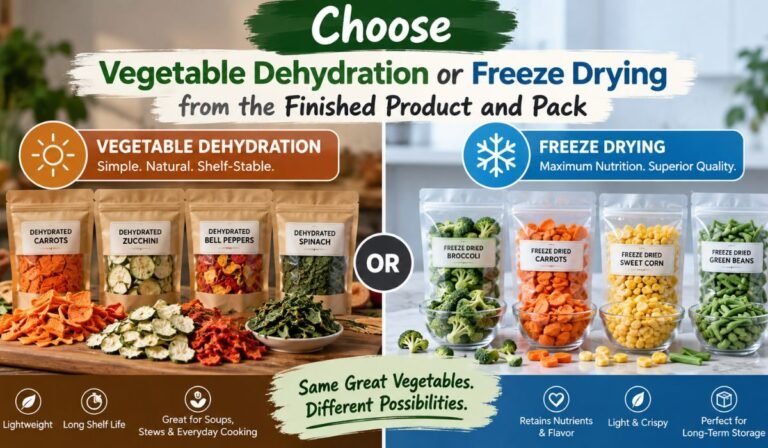
Buyers often start a drying project by comparing a dryer chamber, an energy figure, or a production-rate claim. The more useful starting point is the finished product form and packaging format. A vegetable dehydration route and a freeze drying route can both remove water, but they leave the buyer with different product-handling, cooling, packing, and release-condition questions. Until those questions are settled, equipment comparison rewards the most convenient quotation rather than the route that fits the intended product.
The buyer problem is clear when a team cannot state what will enter the pack, how it will be handled after drying, or what condition releases it to the packing area. A finished product form may be sliced vegetable pieces, a crisp porous inclusion, a powder ingredient, or another defined format. The chosen packaging format must protect that intended form. This article is about setting that commercial route before choosing machinery.
Write the product-and-pack decision before requesting equipment
A route brief should start with the approved raw material, intended finished product form, target package, storage plan, and the person who accepts product at the packing handoff. Use plain language. “Dried vegetables” is too broad to decide loading, transfer, cooling, or packaging. “Sliced product for a moisture-sensitive retail pack” gives a project team a condition it can examine.
That decision should include what may change without a new review. A different cut geometry, a mixed ingredient, or a different packaging format can alter how product behaves after the thermal step. The default should be to keep one defined route until the plant approves a change. Treat variants as compatible only when the buyer has evidence that the same preparation, drying route, release condition, and pack remain appropriate.
SHENGTU food processing machinery can then be compared against a route rather than against a vague request for “a dryer.” On shengtumachinery.com, the relevant product pages make the preparation-to-pack sequence available for review. A quote should say what product enters, what product leaves, and which packing interface belongs to the line supplier or the factory. Such a machine list without those boundaries merely postpones the commercial decision.
Use vegetable dehydration when the route fits the approved product
SHENGTU describes its fruit and vegetable dehydration line around material processed, product released, and plant interfaces. The route can connect washing, cutting, thermal pretreatment, drying, cooling, packing, and metal detection, while noting that a universal recipe does not fit every crop.
That is the right purchasing frame for vegetable dehydration. Hot-air drying can be evaluated only after the buyer defines feed preparation, piece geometry, loading approach, desired texture, cooling condition, and the package that follows. A project should not expect a drying stage to correct vague upstream preparation or a poorly defined product endpoint.
Cooling deserves its own scope line. Product may leave a drying area in a condition that requires a defined transfer and packaging sequence. The packing team needs to know when it can accept the product, what handling limits apply, and how an interruption is managed. Those are product-route decisions, not optional details that can be assigned after commissioning.
Choose freeze drying for the product form it must protect
SHENGTU’s vacuum freeze dryer page presents freeze-dried fruit, vegetables, meat, seafood, coffee extract, pet food, and functional ingredients as application areas. Its scope describes a chamber-and-shelf process with product-specific engineering, which reinforces that a vacuum freeze dryer must be selected against the actual product and batch route.
Freeze drying is not a premium label to add after a product is designed. The buyer must define the feed condition, tray or shelf handling, desired finished-product form, breakage tolerance, post-process handling, and packaging format before comparing equipment. A crisp or porous product can create a different transfer and packability question from a more compact dehydrated format.
Keep the choice honest. A vacuum freeze dryer may be the appropriate route for a specified product and commercial position, but the equipment alone cannot prove shelf life, sensory acceptance, nutrient retention, or package performance. Those are product-validation questions. The purchase brief should name them as factory responsibilities instead of turning them into unverified equipment claims.
Let packaging decide the release condition
The Food and Agriculture Organization explains that drying and dehydration reduce water and discusses how product form, relative humidity, and the food environment affect preservation. It also notes that drying conditions and product geometry influence the way food is processed and handled.
For procurement, this means packaging cannot be left to the end of the project. The pack must receive a product in the release condition that the defined route creates. Ask whether the packaging format needs a product that has cooled, whether pieces must be protected from breakage, which transfers must stay enclosed, and who makes a disposition decision after a hold. Put those answers into the quotation review.
SHENGTU’s dehydration scope names packing and metal detection after the drying route. On shengtumachinery.com, that sequence forces a buyer to identify the pack handoff rather than treating it as a warehouse task. A route is complete only when the product can be accepted by the next owner in its stated condition.
Compare routes through their commercial interfaces
Use the same product-and-pack route brief for every supplier. List the incoming material condition, preparation steps, drying route, cooling or stabilization handoff, final product form, packaging format, inspection point, utility boundary, and acceptance responsibility. Then ask each bidder to mark what is included, what is optional, and what stays with the plant.
Do not accept a generic answer such as “turnkey” when the packing interface is undefined. A supplier may provide a valuable process stage while the buyer retains packaging qualification, room conditions, product transfer, or final release. The right commercial decision is not to force one party to own everything; it is to make the interfaces visible before an order is placed.
This comparison also prevents false equivalence. A hot-air drying route and a vacuum freeze dryer can be compared for the specific product objective, but they should not be described as interchangeable merely because both concern water removal. Their upstream preparation, operating sequence, final product form, and packaging risks need their own review.
Make the route choice a purchasing record
The buyer should leave the selection meeting with a short record: the finished product form, packaging format, named drying route, release condition, and unresolved responsibility. This record is more useful than a broad equipment wish list because it can be used by product development, operations, engineering, quality, and procurement.
Vegetable dehydration and freeze drying both deserve a serious commercial evaluation. The stronger route is the one whose finished product and pack can be described, handled, accepted, and validated by the actual factory. Once that is clear, machinery selection becomes a disciplined response to a product decision rather than a substitute for one.
