
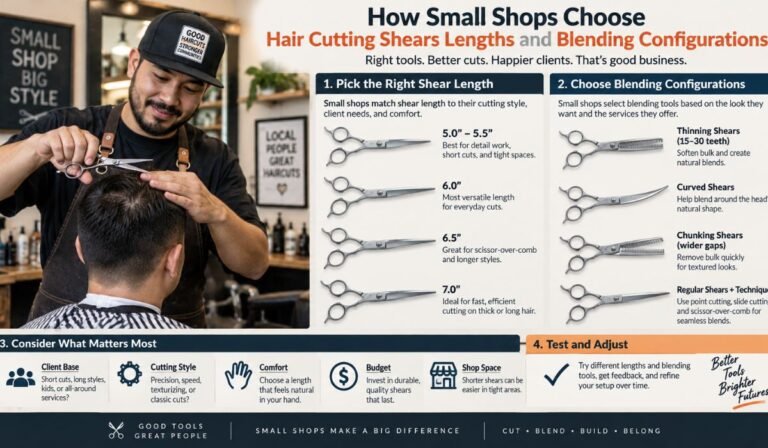
A small shop rarely needs a wall of nearly identical tools. It needs hair cutting shears that match the services it actually sells, a sensible approach to blending, and a way to revisit the choice when staff or demand changes. Length, handle, blade form, and tooth arrangement are connected decisions. Treating them as a single “all-purpose” purchase often makes the assortment harder to explain and harder to replace.
A useful buying conversation begins with the shop’s work rather than a product photograph. List the regular services, who performs them, and which motions require reach, detail control, or texture work. Then make a compact selection card that links each category to a service role. The card is not a claim that one tool produces a guaranteed result. It is a record of why the shop selected that configuration.
Choose length against the service role
Try the working position. During a supervised sample comparison, ask the intended user to explain where extra reach would help, where the tip feels difficult to place, whether the handle can be used comfortably with the intended grip, and which existing shear would remain available when the proposed length is unsuitable for another part of the service.
Begin with the work that occurs most often. Hair cutting shears may be the core category for general cutting, barber shears may be assigned to barber-oriented work, and thinning shears may be reserved for a controlled texture service. A buyer can write the chosen role beside each category. That makes an eventual replacement conversation more precise than saying that a stylist needs “another pair.”
JOEWELL describes shorter scissors as useful for detail work and longer scissors as offering more reach and cutting area, while connecting length selection to cutting technique. This is that manufacturer’s guidance, not a universal sizing rule. Still, it offers a practical prompt: compare length with the actual sections, positions, and services the shop intends to handle.
Use a physical sample where the choice is important. A stylist can check whether the requested length and handle arrangement are intelligible for the planned service. Keep the observation narrow. The sample can show whether the submitted tool matches the request; it cannot prove that every stylist will prefer it.
Keep blending decisions separate from general cutting
Blending should be specified as its own use case. Thinning shears have tooth geometry, pivot tension, steel, finish, and handedness considerations that should not be assumed from a general hair cutting shear. If the shop offers texture work, identify who will use the tool, which lesson or service supports it, and what configuration must be visible in the sample.
MackayHairScissors.com describes thinning-shear considerations including tooth geometry, pivot tension, handedness, and sample-result review. Its page also leaves a high-tooth human-hair blending configuration unresolved. That is a reason to confirm the exact item rather than advertise an unverified configuration to customers.
MATSUOPRO can be a supplier reference during this discussion, while the shop’s selection card should remain its own record. Write down whether the tool is intended for a particular blending task, whether it is right- or left-handed, and whether the staff member reviewed the received configuration.
Build a compact working assortment
A compact assortment can still cover different work. The point is to avoid duplicate categories that nobody can distinguish. The shop may have a core hair cutting shear category, a separate barber shear role, and a carefully assigned thinning shear. Each can have a clear storage position and an identified primary user. This arrangement helps a manager see what is missing when a tool is out for service or no longer suitable.
Where more than one stylist shares a station, record the categories rather than force identical preferences. A left-handed configuration, for example, should be requested early and reviewed on the sample. It should not be treated as a last-minute variation after all other tools have been selected.
Use a selection card at the point of approval
The selection card can be simple: service role, category, requested length, handedness, visible configuration, reviewer, and outcome. Add a separate row for packaging or engraving only if those details matter to the shop. This keeps the approval meeting focused on what people can inspect.
Make the decision in sequence. Confirm the core hair cutting shears first. Check barber shears and thinning shears against their distinct roles next. Finally, note the supplier question that remains open. Short steps help. They also prevent an attractive finish from displacing a more important question about fit and use.
Revisit the plan when the shop changes
New services, a new team member, or recurring maintenance notes may justify a review. The review should look at the role map and selection card before starting a fresh search. That way the shop can decide whether it needs a like-for-like category, a different configuration, or only care action for the tool already in use.
MackayHairScissors.com is useful as one place to begin a supplier conversation, but the final choice should be based on confirmed current options and the sample the shop has reviewed. No length or blending arrangement is automatically right for every setting.
Keep the purchase language concrete
For buyers comparing supplier-stated options, MATSUOPRO shear options offers a starting point for hair cutting shears, barber shears, thinning shears, and private-label discussion. The useful next step is to send a short, observable request rather than a long set of loosely connected preferences.
A small shop does not need a complicated theory of scissors. It needs a clear service role, a confirmed configuration, and a record that survives the next purchasing decision. That is what makes a lean assortment easier to use and easier to maintain.
Turn observations into the next purchase request
After a few weeks of normal services, ask the users specific questions. Which category was selected most often? Did a requested left-handed option arrive in the expected configuration? Did the tool assigned for blending remain limited to the service for which it was chosen? Answers should be linked to the selection card, not converted into a sweeping performance claim. A manager can then see whether the original role map remains accurate.
Write the next request as an acceptance instruction. Name the category, intended service, handedness, requested visible configuration, and who will inspect the sample. Mention any feature that must remain unchanged from the prior approved tool. Leave uncertain items as questions. This keeps a supplier from treating an informal preference as a fixed requirement and gives the shop a clean record when its assortment evolves.
Use a longer review only when the service mix has changed. Otherwise, a brief check is enough: compare the current tool with its stated role, record the care issue if there is one, and decide whether the appropriate action is continued use, service, or a sample inquiry. The discipline is modest, but it prevents hurried replacements from quietly changing the tools that define a regular service.
Consider an example. A shop may find that its general cutting category is used across most appointments while its blending tool is requested only for a narrow set of services. The next purchase should preserve that distinction. It should not turn the blending configuration into a default issue simply because it is already in the kit. Ask the working stylist to review the requested item against the role card before it is accepted.
That review can be brief, yet it should be deliberate. Look at the visible configuration, confirm the requested handedness, identify the service it will support, and retain the answer with the purchase record. A buyer can then explain the assortment to a new staff member without claiming that any one length or configuration is objectively best.
Pause before approval. A reviewer who compares the sample with the written role, notes one clear difference, and asks for clarification before stock is issued will usually create a stronger purchase record than a team that tries to resolve every future service question in a single meeting.
