
Remote-first companies face a paradox that office-first companies do not. The flexibility that makes them attractive to talent is also the condition that makes operational discipline harder to maintain. When the team can work from anywhere at any time, the informal coordination mechanisms that office environments provide, the shoulder tap, the whiteboard session, the ambient awareness of what colleagues are working on, disappear, and the operational discipline that they were performing without anyone having designed it explicitly has to be replaced with deliberate infrastructure. The remote-first companies that scale well are not the ones that try to replicate office coordination mechanisms in digital form. They are the ones that recognize that remote work requires a fundamentally different operational design, one where coordination is structural rather than social, documentation is continuous rather than periodic, and visibility is built into every tool rather than assumed from physical proximity. That design is built on project management tools
that make remote-first operational discipline as natural as the flexibility that remote-first work is supposed to provide.
that make remote-first operational discipline as natural as the flexibility that remote-first work is supposed to provide.
 A single operational record every remote team member trusts with Lark Base
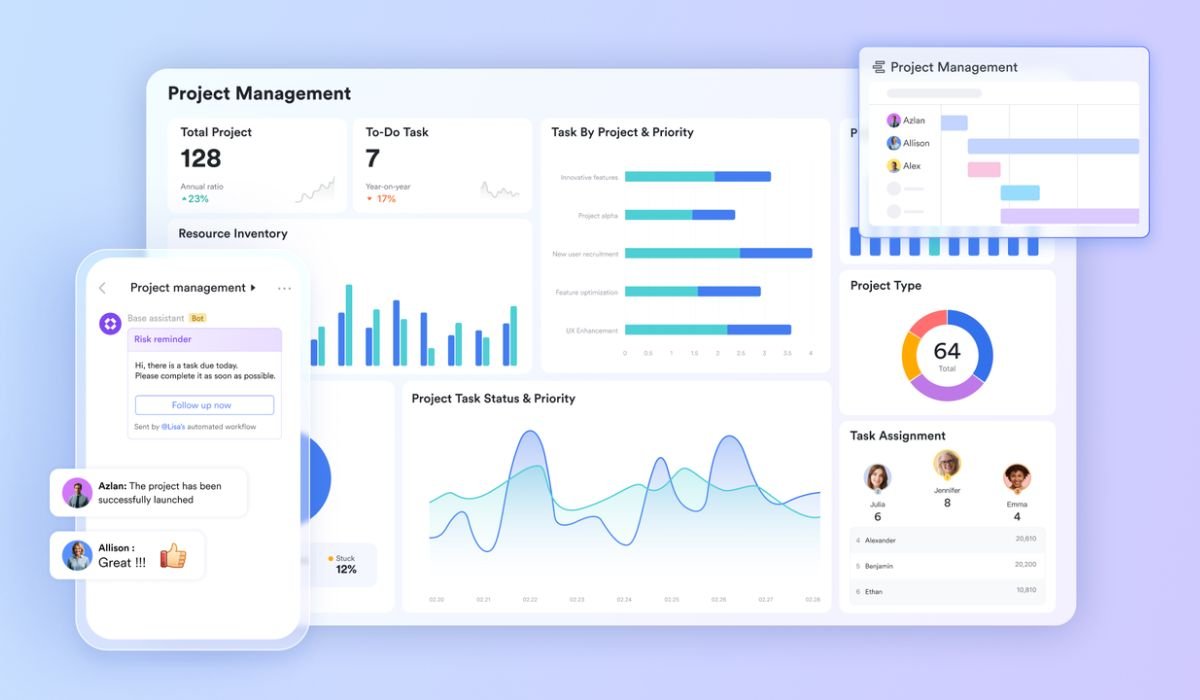 A single operational record every remote team member trusts with Lark Base
The office-first team maintains a shared understanding of operational status through ambient awareness: the project board on the office wall, the conversation overheard at the next desk, the impromptu update delivered to the coffee machine. The remote-first team has none of these, and without a deliberately designed substitute, every team member builds their own picture of the operational status from the partial information available to them. The pictures diverge, and the operational discipline that shared understanding requires begins to break down.
- “Real-time cross-Base sync” ensures that operational data from every team member’s work is reflected in the shared operational picture simultaneously, regardless of where they are working or what time zone they are in.
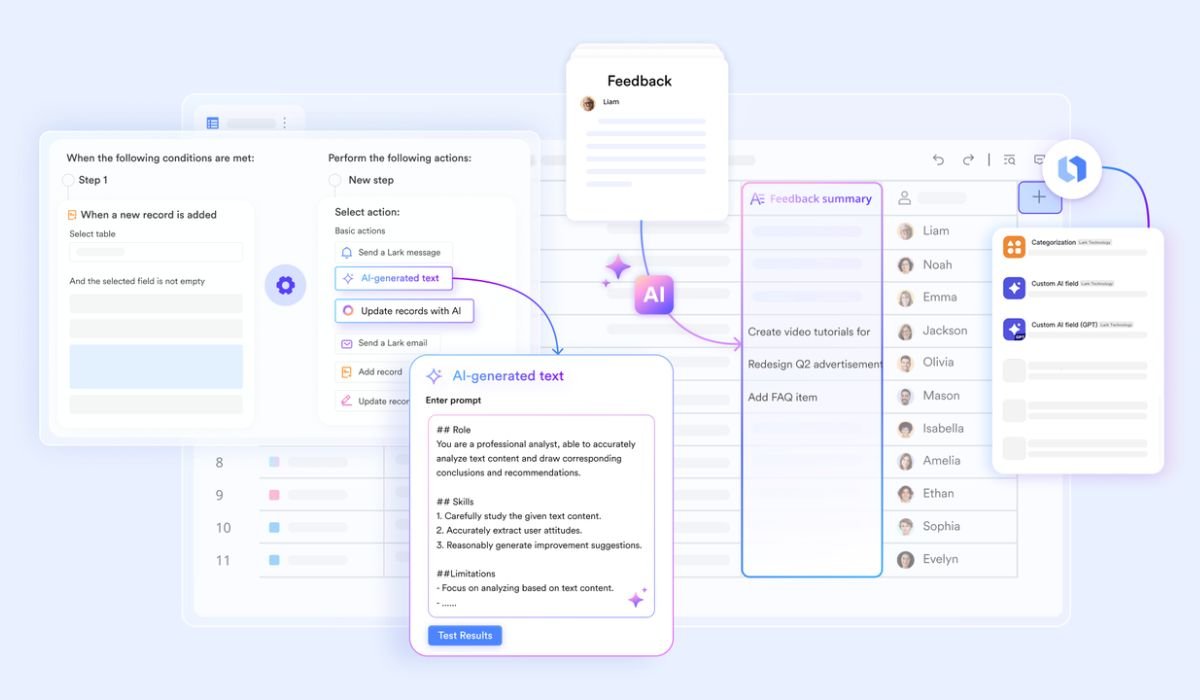 “Real-time cross-Base sync” ensures that operational data from every team member’s work is reflected in the shared operational picture simultaneously, regardless of where they are working or what time zone they are in.
- Personal task views allow every remote team member to manage their individual work priorities through the same shared database that gives leadership their organizational overview, so the individual and the organizational picture are always derived from the same source rather than existing in separate systems that diverge.
- Shared dashboards present the same live operational picture to every remote team member simultaneously, so the shared understanding of organizational status that office environments create through ambient awareness is replicated through a shared data view that requires no physical proximity.
- Automation workflows trigger notifications to every relevant party when operational data changes, so the real-time updates that an office team would receive through ambient awareness reach the remote team through the system rather than depending on team members to proactively share status changes.
Knowledge that does not require a colleague to find with Lark Wiki
The remote-first team that relies on colleagues to transfer knowledge is a remote-first team that is rebuilding the office’s informal knowledge infrastructure in a distributed format. Every question answered by a colleague is a question that should have been answerable through the knowledge base, and every knowledge request is an interruption tax paid by the person who knows and the person who needs to ask.
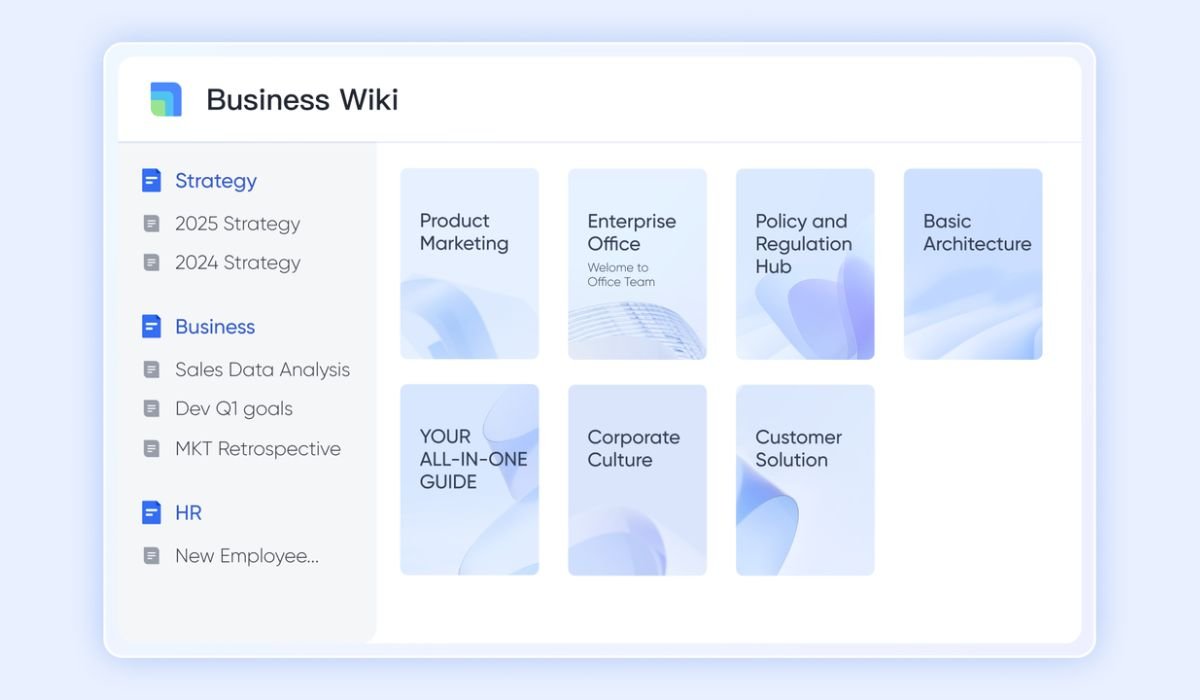 “Advanced Search” with powerful filters allows every remote team member to find any piece of organizational knowledge without interrupting a colleague, so the knowledge base serves the team rather than requiring the team to serve as the knowledge base.
- “Rich Content” pages carry the full operational reference for any topic in a single navigable location, so the remote team member who needs context for their work finds everything relevant in one place rather than assembling it from multiple sources that each require separate access.
- “Permission Settings” ensure that the knowledge base grows with the organization while maintaining appropriate access control for sensitive content, without requiring a dedicated administrator to manage permissions as the remote team expands.
- “Migration” from Word, and other formats allows the knowledge that accumulated before the structured knowledge base was built to be brought into the current system, so the remote team’s knowledge base is complete from the start rather than growing from scratch.
Communication that maintains team cohesion across time zones with Lark Messenger
The remote-first team that communicates well solves one of the hardest problems in distributed work: maintaining the social fabric and the operational coherence that proximity creates without any of the physical mechanisms that proximity provides. Communication tools that prioritize real-time availability over structural organization produce communication that is fast for people who happen to be online at the same moment and slow for everyone else.
- “Scheduled Messages” allow remote team members across different time zones to communicate on a schedule that respects every participant’s working hours rather than creating an implicit expectation of real-time response that only the team members in the dominant time zone can sustainably meet.
- Lark Messenger includes administrative controls such as restricted mode, which can limit actions like forwarding, copying, screenshotting, or recording messages within group chats. While this is not designed for time zone-based notification management, it helps teams create more controlled communication environments that support distributed collaboration.
- “Real-time Auto Translation” across 24 languages allows the globally distributed remote-first team to communicate in a single environment without language barriers creating communication asymmetries that compound time zone asymmetries into significant operational disadvantages for parts of the team.
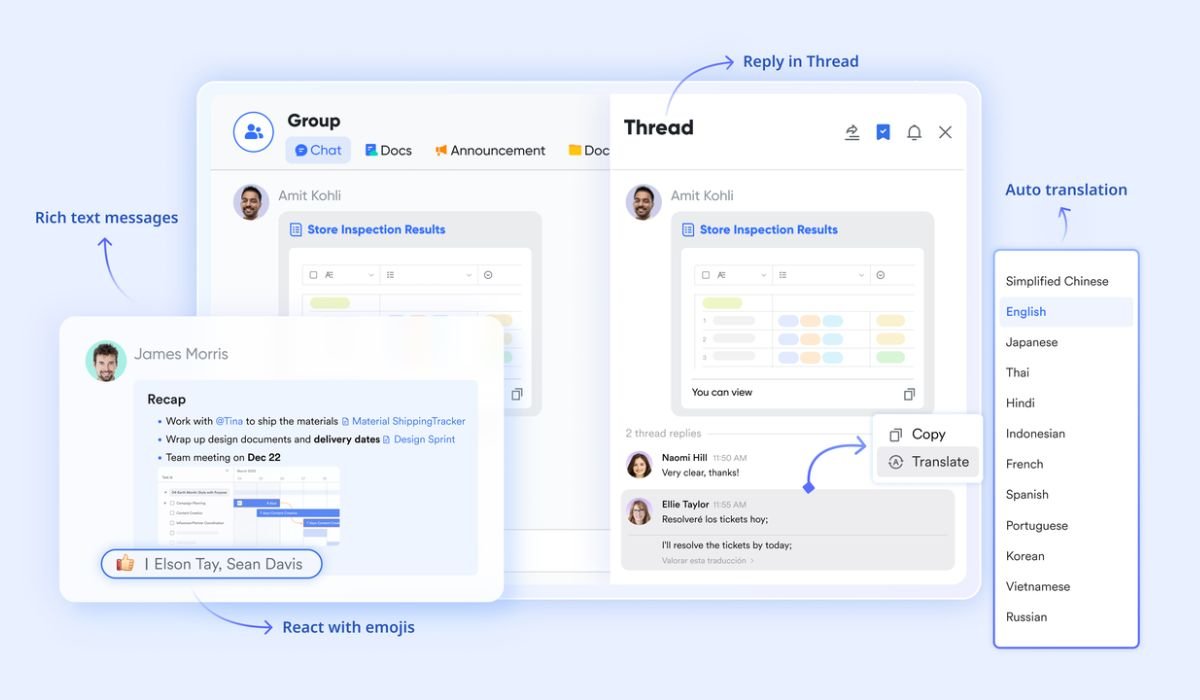 “Scheduled Messages” allow remote team members across different time zones to communicate on a schedule that respects every participant’s working hours rather than creating an implicit expectation of real-time response that only the team members in the dominant time zone can sustainably meet.
Documentation that creates operational discipline without administrative overhead with Lark Docs
Remote-first operational discipline requires documentation habits that office environments never need because the office’s ambient information sharing takes the place of explicit documentation for many categories of organizational knowledge. Building those habits without creating the administrative overhead that makes documentation feel like an additional job requirement rather than a natural part of the work is the central documentation challenge for remote-first companies.
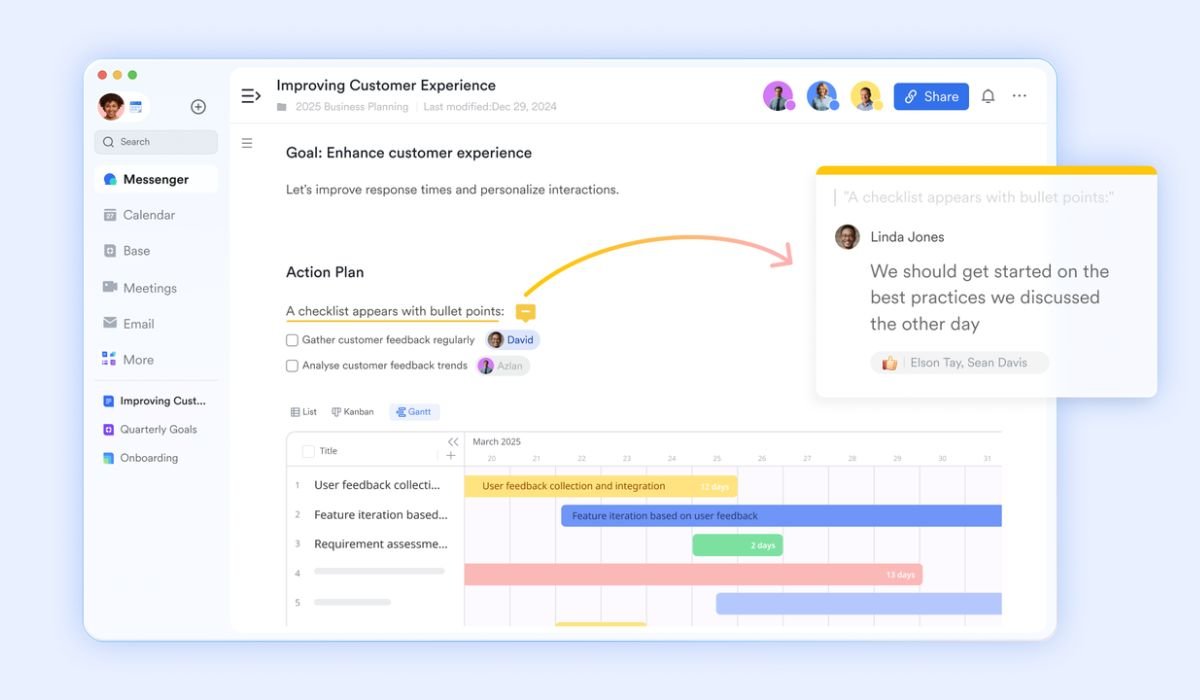 Real-time co-editing makes documentation simultaneous with the work it documents rather than a subsequent task that gets deferred indefinitely, so the remote-first team documents by doing the work rather than by doing the work and then documenting it separately.
- Document templates for recurring document types ensure that the documentation discipline of the remote-first organization is built into the structure of the tools rather than depending on individual team members to remember and apply documentation standards consistently.
- “@mention” within documents creates action assignments at the point of documentation, so the remote team member who produces a planning document simultaneously creates the to-do list that the plan requires rather than leaving the action creation as a separate subsequent step that may happen in a different tool or may not happen at all.
Goal alignment that travels with the remote team wherever they are with Lark OKR
The office-first team maintains strategic alignment through proximity to leadership: the overheard priority conversation, the visible leadership behavior, the ambient awareness of what the organization is treating as most important. The remote-first team has none of these mechanisms, and without a deliberate substitute, the individual team member’s sense of strategic priority is determined by the last explicit communication they receive from their manager rather than by continuous access to the organizational direction.
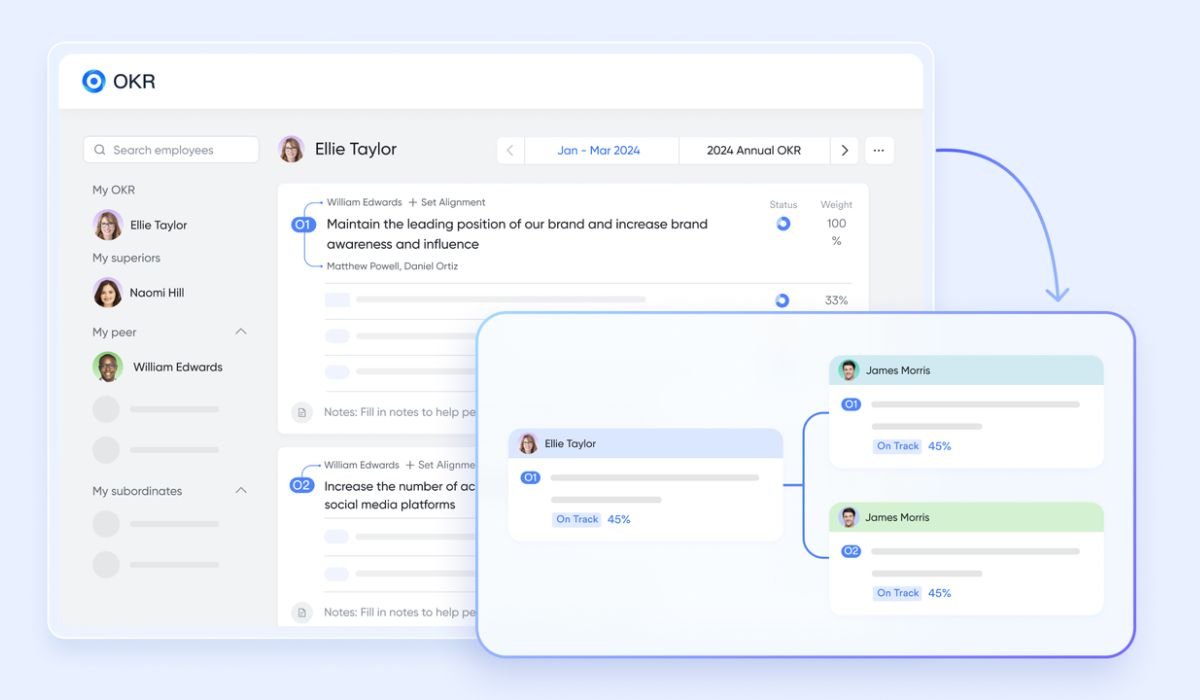 Lark OKR gives team members visibility into relevant objectives and key results based on their access permissions, helping distributed teams stay aligned on priorities regardless of location or time zone. Because progress updates are reflected in real time, teams can reference current goals more easily without relying entirely on delayed status updates or repeated alignment meetings.
- Individual key results connected to team objectives create the personal strategic orientation that remote team members need to make good independent decisions without escalating every ambiguous situation to their manager, so the strategic alignment that office proximity provides through ambient awareness is provided to the remote team through structural visibility.
- Real-time key result progress visible to every team member ensures that the remote organization’s strategic execution is as transparent to each team member as it is to the leadership team, creating the shared awareness of collective progress that motivates and directs individual effort in a way that periodic reporting cycles cannot achieve.
Bonus: Why remote-first companies lose operational discipline at scale
Remote-first companies that are operationally disciplined at twenty people lose that discipline at sixty, not because the team becomes less disciplined but because the informal coordination systems that maintain discipline at twenty people cannot handle the complexity of sixty. The documentation that was maintained through individual effort at small scale cannot be maintained by individual effort at large scale. The shared understanding that was maintained through frequent communication at a small scale cannot be maintained through the same frequency of communication at a large scale when the number of relevant conversations grows faster than the team’s total communication capacity.
Tools like Notion and Confluence improve the documentation layer. Zoom and Google Meet improve the synchronous communication layer. Asana and monday.com improve the task tracking layer. But none of these tools creates the unified operational picture, the continuous knowledge base, the globally inclusive communication environment, and the live strategic visibility that remote-first operational discipline at scale requires. Teams evaluating Google Workspace pricing often realize that collaboration software alone does not create the operational structure remote-first companies need at scale. Many end up adding separate tools for project management, documentation, approvals, communication, and planning—creating a fragmented system that requires ongoing maintenance and adds coordination overhead. Lark brings these workflows into one operational environment, helping remote teams scale with more consistency and less complexity.
Conclusion
Scaling a remote-first company without losing operational discipline requires building the infrastructure that office environments provide through physical proximity, deliberately and systematically, in digital form. A connected set of productivity tools that creates a shared operational picture, maintains a continuously current knowledge base, supports globally inclusive communication, makes documentation a natural byproduct of work, and provides live strategic visibility is how remote-first companies preserve the operational discipline that drives their performance as they scale beyond the point where informal coordination can sustain it.
