
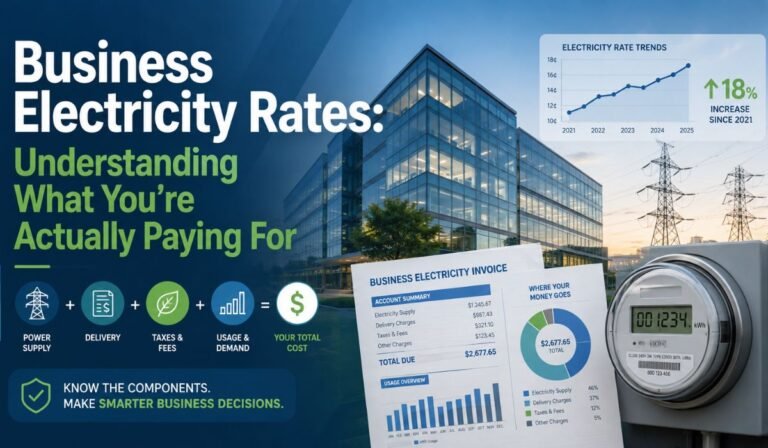
Most business owners could tell you roughly what they pay for electricity each month, but far fewer could explain exactly why that figure is what it is. Business electricity rates are built from several layered components, and understanding what actually makes up a bill is the first step toward knowing whether a business is genuinely getting a competitive deal or simply accepting whatever number appears on its statement.
What Actually Makes Up an Electricity Rate
A business electricity rate is rarely just a single number reflecting the cost of the power itself. It typically includes a unit rate for the actual electricity consumed, a standing charge that applies regardless of usage, network and distribution costs tied to getting electricity from the grid to a specific premises, and various environmental and policy levies that suppliers are required to pass through to customers. Together, these components determine the true cost of a contract, and two contracts with similar headline unit rates can still result in noticeably different total bills once the rest of the structure is accounted for.
This layered structure is part of why comparing electricity rates properly takes more effort than glancing at a single quoted figure. A rate that looks attractive at first glance can turn out to be less competitive once standing charges and other fixed elements are factored into the full picture.
Why Rates Vary So Much Between Businesses
Business electricity rates are not standardised the way many people assume. Usage volume, contract length, payment method, meter type, and a business’s specific location all influence the rate a supplier is willing to offer. Two businesses with broadly similar operations can end up on meaningfully different rates simply because one negotiated a longer contract term or has a different consumption profile than the other.
This variability is exactly why comparing options across multiple suppliers matters so much, rather than assuming a rate offered to one business will automatically be competitive for another. What counts as a good rate depends heavily on the specific circumstances of the business receiving the quote.
The Renewal Trap Many Businesses Fall Into
One of the most common ways businesses end up paying more than necessary is by allowing a contract to renew automatically, or by accepting a renewal offer without comparing it against the wider market first. Suppliers generally have little incentive to proactively offer their most competitive rate to an existing customer at renewal, since the assumption built into most renewal pricing is that the business will not bother shopping around.
Businesses that make a habit of comparing business electricity rates at every renewal point, rather than treating the renewal notice as a formality, consistently put themselves in a stronger position to negotiate or switch to better terms. This single habit, more than almost anything else, tends to separate businesses that manage energy costs well from those that quietly overpay year after year.
How a Broker Helps Cut Through the Complexity
Given how many variables affect a final rate, working with an established energy broker has become a practical solution for businesses that do not have the time or expertise to compare offers across the market themselves. A broker with visibility into current rates from the UK’s major suppliers can quickly identify where a business stands relative to the wider market and flag opportunities for savings that would otherwise go unnoticed.
This is particularly valuable for businesses with more complex usage patterns or multiple premises, where a simple online comparison tool may not capture the nuances that affect pricing. A broker familiar with how different suppliers structure their offers for these situations can often surface options a business would not find through a basic search.
Treating Rate Reviews as an Ongoing Practice
The businesses that manage their electricity costs most effectively tend to build rate reviews into their regular operating rhythm, checking in around each renewal point rather than waiting until a bill becomes noticeably painful. This proactive approach, more than any single negotiating tactic, is what keeps electricity costs from quietly climbing over successive contract terms, and it means a business is never caught off guard by a renewal that assumes it will not bother checking the market.
Why Multi-Site Businesses Need a More Coordinated Approach
Businesses running several premises face an added layer of complexity, since each site may sit on a different contract, with a different supplier, signed at a different point in time. Without a coordinated review, it becomes very easy for individual sites to drift onto uncompetitive rates while the wider business has no consolidated view of the total impact across its full portfolio of premises.
Bringing all of a business’s electricity contracts under a single coordinated review, rather than managing each site’s renewal separately, tends to reveal savings opportunities that would otherwise be missed. This is another area where broker support proves genuinely useful, since aligning multiple renewal dates and supplier relationships manually is difficult to manage well without dedicated time and market visibility.
Frequently Asked Questions
What actually makes up a business electricity rate? A rate typically combines a unit charge for electricity used, a standing charge, network and distribution costs, and various environmental levies, all of which together determine the true cost of a contract.
Why do electricity rates vary so much between different businesses? Usage volume, contract length, payment method, meter type, and location all influence the rate a supplier offers, meaning a competitive rate for one business may not be competitive for another with different circumstances.
Why is accepting a renewal offer without comparison often a costly habit? Suppliers generally have little incentive to offer their best rate to an existing customer at renewal, since renewal pricing typically assumes the business will not shop around before accepting.
How does working with a broker help with rate comparisons? A broker with visibility across major UK suppliers can quickly assess whether a current or offered rate is competitive and identify savings opportunities that would be difficult to find independently.
