
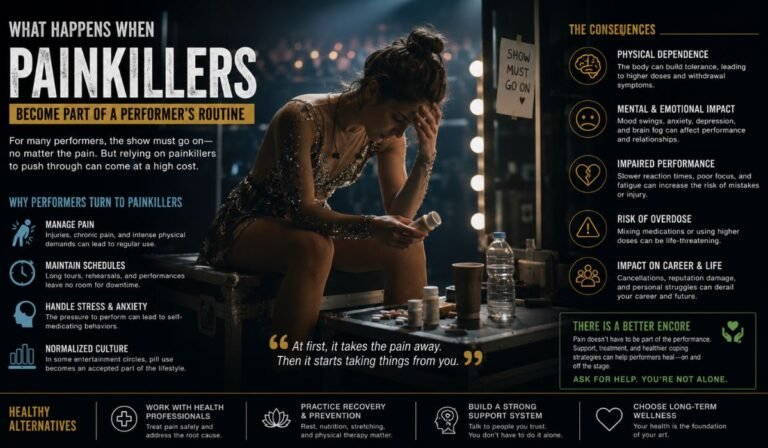
Performing looks glamorous from the outside. The lights, the costumes, the applause, the press photos, the red carpets. Even stunt work has a certain myth around it, as if every fall, crash, jump, and fight scene comes from pure grit and movie magic.
But behind the finished scene, bodies take the hit.
Actors stand for hours under hot lights. Dancers repeat the same move until their muscles shake. Stunt doubles get thrown into walls, dragged across floors, strapped into rigs, and asked to do it again because the camera missed the angle. Even “small” injuries can stack up. A bruised rib here. A strained shoulder there. A twisted knee that never quite feels the same again.
So when painkillers enter the picture, it often starts in a practical way. Someone needs to get through the day. Someone has a call time at 5 a.m. Someone can’t afford to be replaced.
And honestly, that’s where the story gets complicated.
The show must go on, but the body keeps receipts
The entertainment industry loves toughness. People praise performers for pushing through pain, staying professional, and “not making a fuss.” In many workplaces, that sounds familiar. But on set, the pressure can feel sharper because the whole machine depends on timing.
A delay costs money. A missed shoot can affect dozens of people. A lead actor with an injury can throw off an entire production schedule. A stunt performer who says they’re not ready risks losing the next job to someone who says they are.
That doesn’t mean people are careless. Many productions have medics, safety teams, coordinators, and insurance rules. Still, pain is tricky. It doesn’t always show up on an X-ray. It doesn’t always look serious from the outside. A performer can smile during rehearsal while their back is screaming.
Painkillers can seem like a simple answer. Take something, finish the scene, go home. The problem is that “just for today” can quietly become “just for this week,” then “just for this job,” then part of the routine.
It’s not dramatic at first. That’s the point. It’s quiet.
When medication becomes part of the costume
Actors already build routines around performance. Warmups, vocal exercises, makeup, hair, wardrobe, blocking, fight choreography, emotional prep. A pill can slide into that routine almost too neatly.
It becomes another step before set.
Coffee. Script. Costume. Painkiller.
For stunt performers, the pattern can feel even more normal because soreness is almost expected. There’s a difference between being a bit stiff and being injured, of course, but that line can blur after years of physically demanding work. If everyone around you is limping, icing a shoulder, or joking about needing a new spine, pain starts to feel like the price of admission.
Here’s the thing: medication itself is not the villain. Pain treatment matters. People deserve relief. The danger begins when someone starts relying on painkillers not just to heal, but to perform, cope, and stay employable.
That’s a different relationship.
It can also become emotional. A performer may fear that without medication, they’ll lose their edge, miss a role, or look weak. That fear can be louder than the pain itself. And when work is freelance or contract-based, the fear has teeth.
The slippery part is how normal it can feel
Addiction stories are often told like big turning points. A public incident. A collapse. A headline. A scandal. But many people don’t enter dependence through chaos. They enter through routine.
They take something after an injury. It works. They take it again after another long day. It still works. Soon the body expects it. The mind expects it too.
Then tolerance builds. The same amount does less. The person needs more relief or more frequent doses. They may start watching the clock, counting pills, or planning their day around when they can take the next one.
And because performers are trained to hide discomfort, people around them may not notice.
That’s the strange cruelty of performance. A person can be struggling and still deliver a clean take. They can hit their mark, say the line, land the fall, smile at the crew, and look fine.
Fine is not always fine.
For some, the problem moves beyond physical pain. Painkillers can numb more than the knee, the shoulder, or the lower back. They can soften anxiety, exhaustion, loneliness, or the strange emotional drop that comes after intense work. A role ends. The applause fades. The body hurts. The phone gets quiet. Medication can become a buffer against all of it.
Professional support such as Therapy For Addiction Recovery is part of the wider conversation because dependence is rarely just about the substance. It’s also about pressure, identity, fear, and the private ways people learn to survive demanding work.
Stunt work has its own pain language
Stunt doubles live in a world where physical risk is part of the craft. They train like athletes, plan like engineers, and perform like actors. A good stunt looks wild but is usually built with math, rehearsal, pads, cables, timing, and trust.
Still, the body absorbs impact.
A stunt performer might walk away from a scene looking unbothered because that’s part of the job. But repeated impact has a memory. So do old injuries. A neck issue from one production can meet a hip injury from another. Suddenly, one job carries the ghosts of five previous jobs.
This is where painkillers can become a quiet workplace tool. Not officially. Not proudly. Just practically.
Some performers don’t want to report every ache because they don’t want to seem difficult. Some worry that being honest will affect casting. Some have been around long enough to know that productions move fast and replacements exist.
That pressure doesn’t create addiction by itself, but it creates the kind of environment where risky habits can hide in plain sight.
And yes, this touches actors too. Stage performers push through ankle pain during eight shows a week. Film actors repeat emotionally heavy scenes for hours. Action stars train while injured because the body they present on screen is part of the role. Even voice actors can deal with strain, fatigue, and the pressure to keep delivering when rest would be smarter.
Different bodies. Same message: keep going.
Fame can make the problem harder to name
For well-known performers, painkiller dependence carries another layer: image. Public figures often have teams, contracts, fans, and reputations wrapped around them. Admitting a problem can feel risky.
People may wonder whether future roles will disappear. They may fear gossip, judgment, or headlines that turn a health issue into entertainment. And if the performer is known for being strong, athletic, funny, glamorous, or in control, addiction can feel like a direct threat to the brand.
That word, brand, sounds cold. But it matters. In entertainment, public identity is often part of the paycheck.
So people hide. They explain away symptoms as exhaustion. They call it stress. They call it recovery from an old injury. They keep working because work creates cover.
The irony is painful. The more successful someone looks, the harder it can be for others to see what’s happening.
You know what? This doesn’t only happen to celebrities. It happens to working actors, background performers, dancers, crew members, stunt teams, and touring performers who don’t have the safety net of huge savings or global fame. In fact, less famous performers may face even more pressure to say yes to every job.
Recovery has to account for the work, not ignore it
Addiction treatment can’t treat performers like they exist outside their profession. Their work has unique triggers: pain, travel, irregular sleep, rejection, adrenaline, long gaps between jobs, body image pressure, and the constant feeling that someone else is waiting to take their place.
That’s why recovery conversations need room for real life. A performer doesn’t just need to stop misusing medication. They need to rebuild how they handle pain, fear, fatigue, and uncertainty. They need to learn what their body can safely do and what it can’t. That can be hard when your career rewards the exact opposite message.
Outpatient care can matter here because some people need support while still managing parts of daily life. Programs connected to services such as Fresno inpatient rehab show how treatment conversations often include both structure and the realities of returning to work, family, and routine.
For performers, that return can be delicate. A set can feel familiar and risky at the same time. The smell of stage makeup, the buzz of a call sheet, the ache after rehearsal, the casual “you good?” from someone on crew. All of it can bring back old patterns.
That doesn’t mean the industry is hopeless. It means honesty has to become less costly.
The quiet story deserves more attention
Painkiller dependence among performers isn’t always loud. It doesn’t always arrive with tabloid drama or a career-ending incident. Sometimes it starts with a sore back and a long shoot. Sometimes it starts with a stunt that went almost right. Sometimes it starts with the simple wish to not let people down.
That’s what makes it serious.
The entertainment industry sells fantasy, but the people making it live in real bodies. Those bodies bruise, tear, ache, and age. They need rest. They need care. They need more than applause after a risky scene.
When painkillers become part of a performer’s routine, the question isn’t just “How did this happen?” It’s also “What made this feel necessary?”
Because behind every polished scene is a person trying to keep up. And sometimes, keeping up comes at a cost no audience can see.
