
When trying for a baby, there is a notion that has prevailed for as long as one can remember: once a couple is ready, it will happen naturally and without much difficulty. The thing is, that is not always how things play out. Pregnancy is one of those things that seems simple on paper, but even the smallest issues can make it much more complicated.
The moment you notice that months have passed without so much as a positive pregnancy test, you and your partner might begin to wonder whether you simply need more time or should seek help right away. For most couples, the question then is not if you should explore the world of fertility treatments, but instead, when you should consider them. So, keeping that in mind, let us guide you through some signs that it is time to take the next step in your fertility journey.
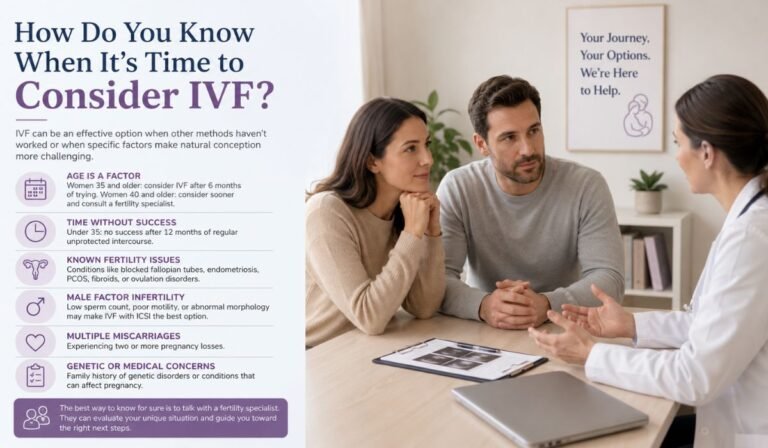
Have you been trying to get pregnant longer than what’s recommended?
While something like IVF should not be considered as a last resort, you still need to consider how long you have been trying to conceive without success before seeking help. If you are under the age of 35 and have been trying for a baby for at least 12 months with no success, then it is high time to seek fertility tests. If you are over 35, that timeline shortens to six months due to the natural decline of fertility with age. From a medical standpoint, this means that couples should not make the mistake of simply trying for a baby indefinitely. Yes, patience has its place in this whole process, but fertility is one area where time matters more than most people realise. The sooner you can unearth a potential issue that is hampering your efforts, the more treatment options you will have and the higher your chances of success will be. Another thing you should note is that a fertility assessment does not automatically mean that you need to undergo IVF. In a lot of cases, if your case is not too complicated, there is a good chance that your fertility doctor may only recommend a few simple interventions to get things done. At the same time, should your test reveal fertility challenges that are too significant to overcome on your own, the most effective route going forward will pass through an IVF.
Is your age becoming a factor affecting your fertility?
As mentioned just now, there is a certain biological timeline that most women trying to get pregnant will have to follow. While healthy pregnancies can occur at any age, the fact remains that your egg quantity and quality will begin to decline over time, slowly after 30 and much more quickly after 35. This will naturally affect your chances of conception and the outcomes of your fertility treatment. More importantly, if you are in your late 30s or early 40s and trying to get pregnant, it is better to consult an IVF clinic in London from the get-go rather than seeking help later, as time is of the essence here.
Have you been diagnosed with a fertility condition?
Sometimes, no matter how long you try, your efforts will simply not bear any fruit. This may be the case because either you or your partner is already struggling with a health condition that is preventing the pregnancy from happening in the first place. For instance, moderate to severe endometriosis can also significantly reduce your natural conception chances. The same applies to conditions such as diminished ovarian reserve, severe ovulation disorders, or certain genetic disorders where embryo testing may be needed. Whatever your situation, undergoing IVF may be your best option for success at the moment. If you already know you have one of these challenges, there is often little benefit in spending years hoping for things to improve on their own. Instead, you can seek the help of a fertility specialist to determine whether IVF will prove beneficial for your case.
Can male factor infertility also benefit from an IVF?
A common misconception that a lot of people have is that fertility is just a woman’s health issue, but in reality, the male factor in fertility contributes nearly as much to the percentage of fertility struggles among people. From low sperm count, poor sperm movement, or abnormal sperm shape, there are a lot of things that can reduce the likelihood of successful conception from the men’s side. That being said, most mild cases are generally treated with simple lifestyle changes or treatments such as IUI, and only the more significant sperm issues are what push a fertility specialist to recommend IVF, sometimes alongside ICSI – a procedure in which a single sperm is injected directly into an egg to further assist the fertilisation process.
Do multiple pregnancy losses also warrant an IVF?
There are very few experiences in life that are as emotionally damaging as recurrent miscarriages. If you are someone who was able to conceive multiple times but has not been able to carry your pregnancy successfully, the best thing you can do for yourself is to investigate whether IVF can play a role in helping you find success. The thing is, repeated pregnancy losses do have links to chromosomal abnormalities within the embryos. When that is the case, procedures like IVF combined with genetic testing can help identify embryos that have the highest likelihood of developing into healthy pregnancies.
Should you get an IVF if other treatments did not help?
When you first go in for fertility treatment, you will be asked to go on this journey in stages. People are generally asked to begin with medication that can stimulate ovulation first. Others may try intrauterine insemination before moving on to more advanced treatments. Sometimes simpler approaches are enough to produce results, but at other times they may not be. In such situations, IVF is often the only logical next step because it offers more control over the fertilisation process, embryo development, and embryo selection. Unlike IUI, where fertilisation still takes place inside the body, IVF will instead allow your fertility doctor to closely monitor every stage of the process to ensure a higher chance of success.
Finding the right support at the right time
Look, at the end of the day, there is no single moment when IVF will suddenly become the right choice for you. There will likely be a lot of signs that will come together to give you the green signal long before things become desperate. If you can notice these signs and act on time, you will only improve your chances of success, but one of the most important things that you can remember, that you can keep in mind right now, is that IVF is not a sign that you have failed. You and your partner have failed. At the end of the day, it is simply another medical tool that will help you achieve pregnancy.
If you have been struggling to conceive, carry the pregnancy successfully, or have found yourself questioning what to do next, start by seeking help from a good fertility doctor near you. They will give you the answers you need, the options that are available at your disposal, and, most important of all, the path that you need to take moving forward.
