
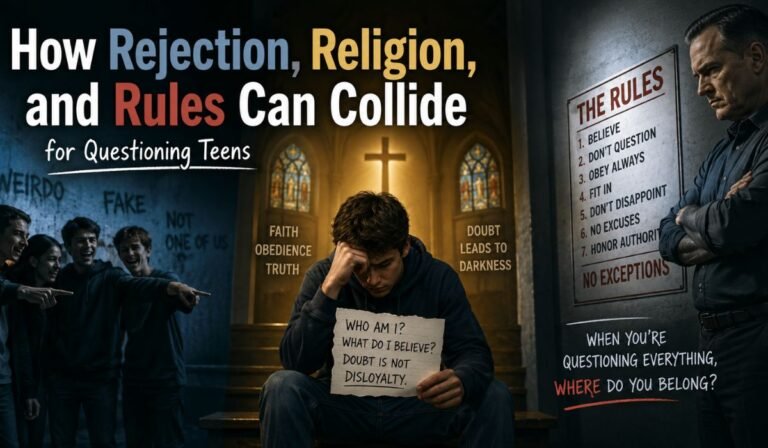
For many teenagers, identity questions do not arrive neatly. They show up in the middle of homework, church services, family dinners, group chats, and quiet nights when everyone else is asleep. A teen may not even have the language yet. They just know something feels different. Something inside them does not match the script everyone around them seems to understand.
That is hard enough on its own.
But when rejection, religion, and strict family rules all meet in the same room, that private confusion can become something heavier. It can turn into fear. Shame. Silence. A kind of emotional lockdown.
And honestly, that is where the real damage often begins.
When Home Feels Like a Courtroom
Home is supposed to be the first safe place. Not perfect. No home is perfect. But safe enough to ask messy questions. Safe enough to say, “I don’t know who I am yet.” Safe enough to be a teenager without feeling like every thought is evidence in a case against you.
For questioning teens, that is not always the reality.
Some grow up in homes where love feels conditional. They hear comments about “normal” boys, “proper” girls, marriage, faith, obedience, and reputation long before they understand their own identity. They learn the family rules by watching faces. A pause at dinner. A joke that cuts too close. A warning about “those people.” A sermon that follows them home.
Nobody has to say, “You will be rejected if you are different.” Teens are smart. They read the room.
You know what? Many of them read it too well.
So they edit themselves. They change how they walk, speak, dress, laugh, or text. They delete search histories. They hide accounts. They rehearse answers before simple questions. Who are you talking to? Why do you like that show? Why are you acting different?
What looks like secrecy is often survival. A teen is not always trying to rebel. Sometimes they are trying to avoid losing the people they love.
Faith, Fear, and the Weight of Belonging
Religion can be a source of comfort, family tradition, and meaning. For many people, faith gives structure to life. It offers ritual, community, music, prayer, memory, and a sense of being held by something larger than one bad day.
But when belief becomes a weapon, teens feel it in their bones.
A questioning teen may still love their faith. That part often gets missed. They may love the hymns, the holidays, the grandparents who taught them prayers, the quiet peace of a familiar place of worship. They may want to belong. They may want to believe they are loved by God and loved by their family at the same time.
The conflict begins when they are told those things cannot coexist.
That split can feel brutal. Imagine being asked to choose between your inner truth and your place at the family table. Imagine hearing that acceptance means betrayal, or that honesty means sin, disgrace, or rebellion. It is not just a debate about beliefs. For a teenager, it becomes a question of survival and attachment.
And teens are still developing. Their brains are still learning how to process risk, belonging, rejection, and long-term fear. So when adults frame identity questions as moral failure, the teen does not simply hear an opinion. They hear a warning: love can be removed.
That kind of warning sticks.
Some teens respond by becoming perfect. Perfect grades. Perfect manners. Perfect attendance at church. Perfect silence. Others push back loudly because silence has started to feel like suffocation. Neither reaction means the teen is fine. One burns inward. The other burns outward.
Both are smoke signals.
Rules Can Protect, But They Can Also Trap
Every family has rules. Curfews, phone limits, school expectations, dress codes, chores. Teens often complain about them, because of course they do. That is part of the job description.
But rules become dangerous when they stop guiding behavior and start policing identity.
There is a difference between “Be home by 9” and “Don’t act like that.” There is a difference between “Focus on school” and “You are embarrassing this family.” The first sets a boundary. The second attacks the person.
Questioning teens often live under rules that are never written down but always enforced. Don’t talk about sexuality. Don’t question gender roles. Don’t bring shame to the family. Don’t make people uncomfortable. Don’t ask hard questions. Don’t tell anyone outside the house.
That last one is a big one.
Secrecy protects the family image, not the teen. It keeps problems looking tidy from the outside while the young person carries the whole storm alone. Teachers may see a quiet student. Friends may see someone who jokes a lot. Relatives may say, “They’re just going through a phase.”
Meanwhile, the teen is managing a private crisis with no training, no map, and no real break.
This is where emotional distress can start to look like something else. Irritability. Sleep problems. Skipping meals. Panic before family events. Sudden drops in grades. Too much time online. Too little time with anyone. A teen may seem moody, but underneath the mood is a nervous system working overtime.
When family conflict, shame, and identity stress pile up, some young people need support that treats the whole picture, not just the visible behavior. Programs connected to Massachusetts behavioral health treatment often focus on the overlap between mental health, stress, and daily functioning, which matters when a teen’s emotional world has become too heavy to carry alone.
Conversion Pressure Is Not “Just Concern”
Here’s the thing: not all rejection looks like shouting or being kicked out.
Sometimes it sounds calm. “We’re only trying to help.” “You’ll thank us later.” “This is for your soul.” “You’re confused.” “You need guidance.” “We found someone you can talk to.”
For some LGBTQ+ and questioning teens, that “help” comes with pressure to change, suppress, or deny who they are. It can come through formal conversion therapy, informal religious counseling, family discipline, or constant correction at home.
The language may sound soft. The impact is not.
When a teen is told their identity is broken, sinful, fake, or dangerous, they learn to distrust themselves. That is a painful lesson. It can affect how they form relationships, how they handle conflict, how they see their body, and how they imagine the future.
A teen who feels trapped between identity and acceptance may start asking questions no young person should have to ask. Will my parents still love me? Will God hate me? Will I lose my home? Will everyone find out? Is there something wrong with me?
Those questions do not stay in the head. They move into the body. Tight chest. Upset stomach. Shaky hands. Headaches. Exhaustion. A blank stare in class because the mind is somewhere else entirely.
And yes, some teens still function. That is the part adults miss. They turn in assignments. They smile in photos. They attend family gatherings. They say “I’m fine” with Oscar-level skill.
But functioning is not the same as being okay.
The Online World: Lifeline or Pressure Cooker?
A lot of questioning teens turn to the internet first. Not because the internet is perfect, because it is not. It can be chaotic, loud, dramatic, and full of strangers giving life advice with too much confidence.
Still, for a teen who feels alone, an online space can feel like oxygen.
They may find words for what they feel. They may see people who survived the same kind of fear. They may learn that confusion is not failure. They may discover that identity is not always a lightning bolt moment. Sometimes it is a slow sunrise.
But there is a flip side.
Online communities can also create pressure to label yourself quickly, explain yourself perfectly, or perform certainty before you actually feel it. A teen who already feels watched at home may feel watched online too, just in a different way.
So the digital world becomes both a refuge and a maze. TikTok, Reddit, YouTube, Discord, Instagram, private chats, anonymous accounts. Some spaces offer language. Some offer comfort. Some add noise.
That is why the emotional context matters. A teen who has support at home can explore identity questions with more room to breathe. A teen who fears rejection may cling to any space that offers acceptance, even if that space is not always healthy.
This is not about blaming the internet. It is about understanding why teens go there. They are looking for mirrors. They are looking for proof that they are not the only one.
The Quiet Cost of Being “Good”
There is a particular kind of pain that comes with being the “good kid.”
The good kid does not cause trouble. The good kid respects elders. The good kid follows religious rules. The good kid keeps family matters private. The good kid does not make life harder for parents who are already stressed.
So when the good kid starts questioning their identity, the pressure doubles.
They are not only trying to understand themselves. They are trying not to disappoint everyone. They may feel guilty for having thoughts they never chose. They may feel responsible for the family’s sadness, anger, or fear. That is too much weight for young shoulders, but many carry it anyway.
This can create a strange emotional split. Outside, they look calm. Inside, they are negotiating every word. They may delay coming out, avoid dating, overfocus on school, or become the family helper who never asks for help.
It can look mature. It can even look admirable.
But sometimes maturity is just anxiety wearing a clean shirt.
Support systems matter here. Not every teen needs the same kind of care, and not every family conflict turns into a crisis. Still, when rejection and identity stress affect mental health, families often need more than good intentions. A resource like a Northern Illinois recovery center reflects the broader need for structured support when emotional pain, coping habits, and family strain begin to overlap.
What Teens Hear Beneath the Words
Adults often focus on what they meant.
“I didn’t mean to hurt them.”
“I was only stating my beliefs.”
“I just want what’s best.”
“I’m scared for their future.”
Intent matters, sure. But impact matters too.
A questioning teen hears the meaning beneath the sentence. When adults say, “We don’t agree with that lifestyle,” the teen may hear, “We don’t agree with you.” When adults say, “Don’t tell anyone,” the teen may hear, “You are shameful.” When adults say, “This is against our values,” the teen may hear, “You are outside the circle now.”
That translation may not seem fair to adults. But for teens, belonging is not an abstract idea. It is food, shelter, safety, rides to school, birthday dinners, inside jokes, holiday photos, and the sound of someone saying goodnight.
Rejection threatens all of that.
And the fear of rejection can hurt even before rejection happens. A teen may spend years preparing for a disaster that never fully arrives, or one that arrives in small pieces. A cold silence. A blocked conversation. A parent who stops making eye contact. A sibling who jokes too sharply. A religious leader who turns private pain into a lesson.
Small cuts still bleed.
Why This Collision Feels So Personal
Identity, religion, and family rules are not small topics. They are tied to memory, culture, loyalty, and love. That is why the clash feels so intense. Nobody is arguing over a hairstyle or a playlist. They are arguing over what kind of person a teen is allowed to become.
For the teen, the question is: Can I be honest and still be loved?
For the family, the question is often: Can we hold our beliefs and still protect this child?
Those questions are not easy. They sit in the chest. They make people defensive. They make conversations go sideways fast.
But the teen is the one with the least power in the room. That matters. Adults have authority, money, housing, transportation, and social control. Teens often have emotion, secrecy, and hope. Maybe one trusted friend. Maybe a hidden note in their phone. Maybe a late-night search that says, “Am I normal?”
That imbalance changes everything.
When adults respond with rejection, threats, or forced change, the teen does not experience it as a “difference of opinion.” They experience it as danger from the people they depend on.
A Softer Ending, Because Teens Deserve One
Questioning teens do not need every answer right away. They do not need a perfect label by Friday. They do not need to turn their inner life into a family debate, a religious argument, or a public announcement before they are ready.
They need room.
Room to think. Room to feel awkward. Room to change language. Room to ask questions without being treated like a problem to solve.
Rejection, religion, and rules collide most painfully when adults forget the teenager at the center of it all. Not an issue. Not a scandal. Not a test of family values. A person. A young person, still becoming, still listening closely to every word said around them.
And maybe that is the part worth sitting with.
A teen can survive confusion. Confusion is part of growing up. But shame is different. Fear is different. Rejection is different.
When belief systems, family expectations, and identity questions clash, the goal should not be to win the argument. The goal should be to make sure the teen does not disappear inside it.
