
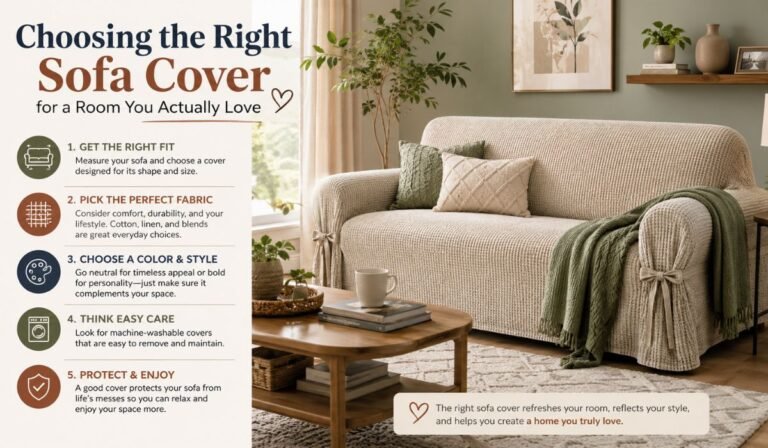
Most people buy a sofa and expect it to last indefinitely in exactly the state it arrived in. In practice, that is rarely how it goes. The fabric fades, the colour starts to feel dated, or the sofa survives a house move, a pet, and several years of daily use, looking noticeably worse for wear. At that point, the obvious response is to replace it, but that is not always the most sensible one.
A slipcover solves this problem directly. It allows you to change the appearance of a sofa entirely without touching the frame, the cushions, or the structure underneath. Done well, it can make a tired piece of furniture look genuinely new. Done really well, it can make it look better than it did when you first bought it.
Why Fabric Choice Matters More Than Most People Realise
The fabric of a sofa does not just affect how it looks. It affects how the room sounds, how comfortable the seating feels on bare skin in warm weather, how much pet hair it collects, and how easy it is to maintain over time. These are practical considerations that matter every day, and they are worth thinking through carefully before making a choice.
Tightly woven fabrics such as microfibre and dense cotton blends tend to resist pilling and staining better than looser weaves. Linen has a natural, lived-in quality that improves with washing but can wrinkle visibly in a way that some people find charming and others find frustrating. Velvet looks rich and photographs beautifully, but shows marks from hands and pets more readily. Boucle is having a sustained moment in interior design right now, with its textured surface adding depth to a room in a way that flat fabrics cannot.
The advice from upholstery specialists at Real Homes, which you can read in their guide on how to choose upholstery for your home, is to always consider how a fabric will perform rather than just how it looks. The most beautiful fabric in the showroom is not necessarily the right choice for a sofa that gets used every day.
Slipcovers as a Long-Term Investment
There is a common assumption that slipcovers are a temporary fix, something you use while saving up for a better sofa. That assumption is outdated. Well-made slipcovers designed for specific frames are cut to fit precisely, finished properly at the seams, and made from fabrics that wash and wear as well as any fixed upholstery.
The real advantage of a slipcover is that it separates two decisions that usually get made together: the decision about the sofa’s structure, and the decision about its surface. If you have an IKEA frame that fits your space and seats comfortably, there is no good reason to replace it just because the fabric needs changing. Replacing only the cover makes far more sense, economically and practically.
If you are looking to protect your IKEA sofa with a stylish slipcover, the key is to choose a fabric that suits how the sofa is actually used rather than just how you would like it to look. A sofa in a busy family room needs a washable cover in a forgiving weave. A sofa in a quieter sitting room can handle something more delicate.
Getting the Fit Right
The biggest single difference between a slipcover that looks good and one that looks makeshift is fit. A cover that is slightly too large will bunch and ride up. A cover that is slightly too small will pull tight at the corners and create visible tension lines. Neither of these problems has anything to do with the quality of the fabric: they are purely the result of a cover that was not made for the specific frame.
This is why covers designed specifically for a particular sofa model are worth the additional cost compared to universal options. IKEA sofa frames are well-documented in terms of their dimensions, which means that covers made to fit them can be cut accurately. The result is a fitted appearance that looks like the fabric was always part of the piece.
Tucking technique also matters. Even a well-fitted cover benefits from being pushed firmly into the gaps between the seat cushion and the armrests. This anchors the cover and prevents it from shifting with use. Some covers come with tucking strips or foam rolls to help with this, and they are worth using.
Colour and the Room Around the Sofa
Changing a slipcover is also an opportunity to reconsider the colour story of the room. A sofa is usually the largest piece of furniture in a living space, which means its colour has an outsized influence on the atmosphere of the room. Changing it can shift the mood of the entire space even if nothing else changes.
Neutral covers in warm off-whites, clay tones, and soft greys remain the most versatile choice because they work with a wide range of walls, floors, and accessories. Deeper tones such as forest green, slate blue, or warm terracotta make a stronger statement but can be equally livable in the right room. The important thing is to consider the cover in the context of the light the room receives. A deep green that looks rich and enveloping in natural light can feel heavy and absorbing under artificial light in the evening.
If you are unsure, starting with a neutral and adding colour through cushions and throws is the more forgiving approach. Cushion covers are significantly cheaper to replace than sofa covers, which means you can experiment with colour at lower risk and change your mind without a major investment.
Washability as a Practical Requirement
One of the most useful features a sofa cover can have is the ability to be machine-washed. Fixed upholstery can be spot-cleaned, professionally cleaned, or gradually allowed to accumulate whatever the household throws at it. A removable, washable cover can be taken off and laundered, which means the sofa can be returned to a genuinely clean state rather than just a surface-clean one.
This matters more in some households than others, but it is worth factoring into the decision even if you do not have children or pets. Sofas absorb dust, skin cells, and general household smells over time, and a washable cover makes it straightforward to address that in a way that fixed upholstery simply cannot match.
