
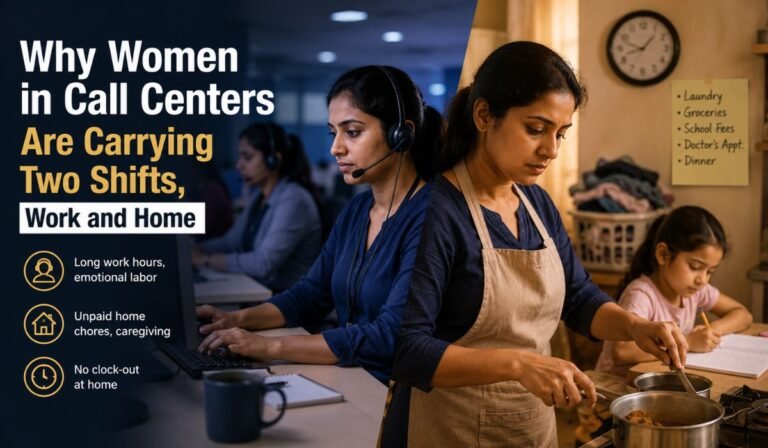
Call center work already asks a lot from the body and brain. The headset goes on, the screen lights up, the queue starts moving, and every second has a number attached to it. Handle time. After-call work. Quality score. Attendance. CSAT. Even bathroom breaks can feel like a tiny negotiation with the clock.
For many women in BPO roles, though, the shift does not really end when they log out.
They leave one queue and enter another. Dinner. Laundry. Children’s homework. Elder care. Groceries. Bills. A partner asking where something is. A younger sibling needing school money. A parent needing medicine. The work badge comes off, but the second shift begins almost right away.
That is the quiet weight many women in call centers carry. Paid work on one side, unpaid work on the other. Both are real. Both take energy. And both can chip away at sleep, stress levels, and mental health when there is no real pause between them.
The headset comes off, but the work keeps talking
Call center work is often described as “desk work,” as if sitting makes it easy. Anyone who has worked a difficult customer service queue knows better.
You can sit for nine hours and still feel wrung out. You listen to angry voices, repeat scripts, fix problems you did not create, and stay calm when someone on the other end refuses to be calm. That takes control. It takes emotional labor. It also takes acting, in a way. Your voice has to sound patient even when your stomach is growling or your head is pounding.
Now add the reality many women face at home.
A mother on a night shift may finish work at sunrise, ride home through traffic, and still have to prepare breakfast. A daughter working in tech support may spend her “rest day” bringing a parent to a clinic. A single mom may sleep in broken pieces because childcare, school schedules, and rotating shifts never line up neatly.
Honestly, it is not one job plus home life. It is one job plus another job that nobody clocks.
And here’s the thing. The second job often has no attendance bonus, no paid leave, and no supervisor who says, “You’ve done enough today.”
Sleep becomes the first thing women sacrifice
Sleep is usually the first thing to go because it feels flexible. It is not. But it feels that way when everything else is urgent.
A woman on a graveyard shift may tell herself she will sleep after one quick chore. Then one chore becomes three. Wash uniforms. Cook rice. Answer messages from school. Clean up the kitchen. By the time she lies down, the neighborhood is awake, the room is warm, and her brain is still buzzing from calls.
BPO schedules can make this worse. Rotating shifts disturb the body’s rhythm. Night work flips normal routines upside down. Split rest days make recovery feel incomplete. And for women with caregiving duties, the sleep window is often narrow and fragile.
The result is not just tiredness. It is a fog that follows people around.
Small mistakes start happening. A forgotten bill. A missed school message. A sharp reply to a child. A slow response during a customer call. Then guilt enters the picture, and guilt has a nasty way of keeping people awake too.
Sleep loss also changes mood. It can make stress feel louder. It can make ordinary problems feel personal. That is not weakness. That is the body asking for rest while life keeps saying, “Not yet.”
Stress does not stay at the office
There is a strange kind of stress that comes from being polite for a living.
You cannot snap back at a rude caller. You cannot roll your eyes into the phone. You cannot say, “I am also exhausted, please stop shouting.” So you swallow the reaction and keep your voice steady. That skill is useful, sure. But it has a cost.
Many women leave their shift still carrying the tone of the calls. The angry customer is gone, but the body has not caught up. Shoulders stay tight. The jaw stays clenched. The mind keeps replaying one bad interaction.
Then home asks for softness.
A child wants attention. A partner wants conversation. A parent wants help. The woman who spent the whole shift managing other people’s frustration now has to manage the emotions of the household too.
That is where the double load becomes heavy. Not dramatic, not always visible, but heavy.
Some workers cope with coffee, energy drinks, nicotine, sleep aids, or alcohol. Not everyone falls into harmful patterns, of course. But when stress is constant and rest is scarce, quick relief can start to look normal. In wider conversations about dependence and recovery, resources like Detox in Washington show how substance use can become tied to routines that began as survival habits rather than reckless choices.
That detail matters because many women are not “partying” their way into burnout. They are functioning. They are reporting to work. They are paying bills. They are showing up for family. From the outside, everything looks fine.
Inside, the system is overheating.
The invisible manager at home
One reason this load is so draining is mental planning. Not just doing chores, but remembering them.
Who has a dentist appointment? What time is the electric bill due? Is there enough laundry soap? Did the baby finish the antibiotics? Does the school need a printed form? What food can be cooked fast before the next shift?
This invisible planning often falls on women, even when they also work full-time. It is project management without the title. A household ticketing system with no dashboard.
Call center agents already live inside systems. Tickets, CRM notes, escalation paths, call logs. Then they go home and run another system in their head.
You know what? That is exhausting in a very specific way.
It is not only physical labor. It is memory labor. It is emotional labor. It is being the person who notices what needs doing before anyone else notices. And because this work is expected, it often gets treated as normal rather than heavy.
That is the contradiction. Women are praised for being strong, organized, and dependable, but those same traits can trap them in a role where they are never fully off duty.
Mental health gets squeezed into the margins
When life becomes one long handoff between work and home, mental health gets pushed to the edge.
There may be no time to process sadness. No time to name anxiety. No time to admit, even privately, “I’m not okay.” A woman can become skilled at moving through the day while feeling detached from herself. Take the call. Cook the meal. Check the child’s notebook. Pay the bill. Sleep for four hours. Repeat.
That rhythm can look responsible from the outside. But inside, it can create loneliness.
Not the obvious kind of loneliness where nobody is around. This is the other kind. The kind where everyone needs you, but few people ask how you are doing. The kind where your phone is full of messages, but none of them say, “What do you need?”
Women in call centers often become the shock absorbers of two environments. At work, they absorb customer frustration. At home, they absorb family pressure. The body keeps score. So does the mind.
Over time, this can show up as irritability, crying spells, panic, numbness, headaches, stomach issues, or a constant sense of dread before a shift. Some women call it being tired. Some call it stress. Some do not call it anything because naming it makes it feel too real.
And yet, naming it matters.
It makes the problem visible.
The paycheck matters, so quitting is not simple
It would be easy to say, “Just leave the job,” but that misses the point.
For many women, call center work is not a random career stop. It pays rent. It covers tuition. It supports children, parents, siblings, and sometimes extended family. In places where stable income is hard to find, BPO work can be a lifeline.
That is why the pressure gets complicated.
The same job that drains a woman may also give her financial power. The same night shift that ruins her sleep may pay the bills that keep the household moving. The same headset that brings stress may also bring independence.
So no, the story is not as simple as work being bad and home being hard. It is more tangled than that. Work can be stressful and necessary. Family can be loving and demanding. A woman can be grateful for her job and still feel crushed by it.
That is real life. Messy, not neat.
The risk comes when endurance becomes the only plan. When women are expected to keep adjusting, keep stretching, keep smiling, keep answering, keep caring, and keep going as if the body has no limit.
In mental health and addiction care, this link between pressure, coping, and burnout keeps showing up. A Massachusetts rehab center may see people from very different backgrounds, but many stories share a familiar thread: stress builds quietly before it becomes visible.
The double shift deserves a real name
The phrase “double shift” sounds simple, but it carries a whole world.
It means women are not just tired because work is busy. They are tired because their rest time has been claimed by duties that society often treats as natural female responsibility. It means the gap between paid labor and unpaid care is not a small detail. It shapes health, sleep, money, relationships, and mood.
And in call centers, where performance is measured so closely, that pressure becomes even sharper.
A sleepy agent gets judged by numbers. A stressed mother gets judged by patience. A tired daughter gets judged by duty. Somewhere in the middle is a woman trying to keep her life from spilling over.
That effort deserves more than a shrug.
It deserves language. It deserves attention. It deserves to be seen without romanticizing women as endlessly strong. Strength is not the same as support. Resilience is not the same as rest.
The women carrying work and home are not asking to be called heroes every five minutes. Most are simply trying to get through the week, keep the bills paid, and hold their families together without losing themselves in the process.
That is the part people miss.
Behind the calm voice on the call is often a woman counting minutes, meals, expenses, and hours of sleep. She is solving customer problems while carrying home problems in the background. She is present in two worlds, but rarely fully cared for in either.
And that is why this double shift matters. Because when women carry too much for too long, the cost does not disappear. It waits. It shows up in the body, in the mind, in the quiet moments after the call ends.
The headset comes off.
The work keeps talking.
