
Operating a House in Multiple Occupation (HMO) can be a highly lucrative investment strategy in the UK rental market. However, because multiple independent households share the same living space, facilities, and escape routes, the inherent risks associated with health and safety are significantly higher than in standard single-let properties.
As an HMO landlord, you are bound by strict legal frameworks. Fire safety isn’t just a matter of good practice; it is a heavily legislated, mandatory requirement. Under UK law, including The Regulatory Reform (Fire Safety) Order 2005, The Housing Act 2004, and the Management of Houses in Multiple Occupation (England) Regulations 2006, the landlord is designated as the “Responsible Person.”
Failing to meet your fire safety obligations can result in catastrophic consequences: unlimited court fines, local authority enforcement notices, rent repayment orders, invalidation of your landlord insurance, and, in severe cases of negligence, criminal imprisonment.
This comprehensive guide breaks down exactly what your fire safety obligations are as an HMO landlord to keep your tenants safe and your property fully compliant with GF Fire Solutions.
1. The Foundation: Fire Risk Assessments (FRAs)
The absolute bedrock of your legal obligation as an HMO landlord is the Fire Risk Assessment. You cannot accurately implement fire safety measures without first evaluating the specific architecture, layout, and occupant profile of your property.
Is an FRA Mandatory?
Yes. Following strict legislative updates, every HMO must have a comprehensive, documented Fire Risk Assessment in place. There are no exceptions based on the size of the property or the number of tenants.
What Does an FRA Involve?
A valid fire risk assessment is a structured, detailed evaluation of the building. It must:
- Identify potential fire hazards (e.g., faulty electrical appliances, overloaded sockets, source materials).
- Identify who is at risk (including vulnerable tenants or those with mobility issues).
- Evaluate, remove, or reduce those risks as far as reasonably practicable.
- Formulate a clear emergency evacuation plan.
- Record the findings and set a date for a structured review.
While a landlord can technically conduct an assessment themselves if they are deemed “competent,” the complexity of modern building regulations and British Standards means most landlords hire a certified professional. To protect your investment and ensure you remain fully compliant with local council licensing requirements, it is highly recommended to arrange a professional HMO fire risk assessment.
2. Advanced Fire Detection and Alarm Systems
A standard, battery-operated smoke alarm picked up from a local supermarket is entirely inadequate for an HMO property. Interconnected systems are essential so that a fire breaking out in a ground-floor kitchen immediately alerts a tenant sleeping on the top floor.
Grade and Category Requirements
The level of detection required depends entirely on the size, height, and layout of your HMO, but general benchmarks dictate:
- Smaller, 1 or 2-Storey HMOs:Typically require at least a Grade D1, Category LD2 system. This means mains-powered alarms with a tamper-proof battery backup interconnected throughout the property.
- Larger or 3+ Storey HMOs:Often require a more complex Grade A system, incorporating a central control panel, break-glass call points, and external sounders.
Where Must Detectors Be Placed?
- Smoke Alarms:Must be installed in all high-risk circulation areas, including hallways, landings, stairwells, and individual bedsits or living rooms.
- Heat Alarms:Must be installed in every kitchen area to prevent false alarms caused by cooking toast or steam while still ensuring rapid thermal detection.
- Carbon Monoxide Alarms:Mandatory in any room containing a solid fuel-burning appliance or a gas boiler.
3. Escape Routes and Fire Doors
If a fire occurs, your tenants must be able to exit the building quickly, safely, and without relying on keys.
Protecting the Means of Escape
The hallways, staircases, and external exits form the “protected route” out of the building.
- Zero Obstructions:Under the HMO Management Regulations, landlords must ensure these areas are kept completely clear at all times. Prams, bicycles, shoes, and rubbish bags must never block hallways.
- Thumb-Turn Locks:Any final exit door (such as the main front or back door) must be fitted with a thumb-turn lock on the inside. Tenants must be able to escape instantly without hunting for a key in a smoke-filled room.
The Standard for HMO Fire Doors
Every individual bedroom door opening onto a communal escape route, alongside doors leading to high-risk rooms like kitchens and communal lounges, must be a certified FD30 fire door.
A compliant fire door assembly must include:
- A certified core providing a minimum of 30 minutes of fire resistance.
- An overhead mechanical self-closing device that securely shuts the door into its frame from any angle.
- Intumescent strips are embedded around the top and sides of the door or frame, which expand when exposed to heat to seal the gaps.
- Cold smoke seals to stop toxic fumes from bypassing the door.
4. Emergency Lighting and Fire Fighting Equipment
When a fire cuts the mains power, an unfamiliar house can instantly plunge into pitch darkness, causing panic along the escape route.
Emergency Lighting
In larger or more complex HMOs (particularly those spanning three or more storeys or with long, winding corridors), emergency escape lighting is a legal requirement. These standalone, battery-backed lights switch on automatically if the main electrical circuit fails, illuminating stairs, changes in floor level, and fire exit doors.
Fire Fighting Equipment
Landlords must provide basic, accessible firefighting equipment in communal spaces:
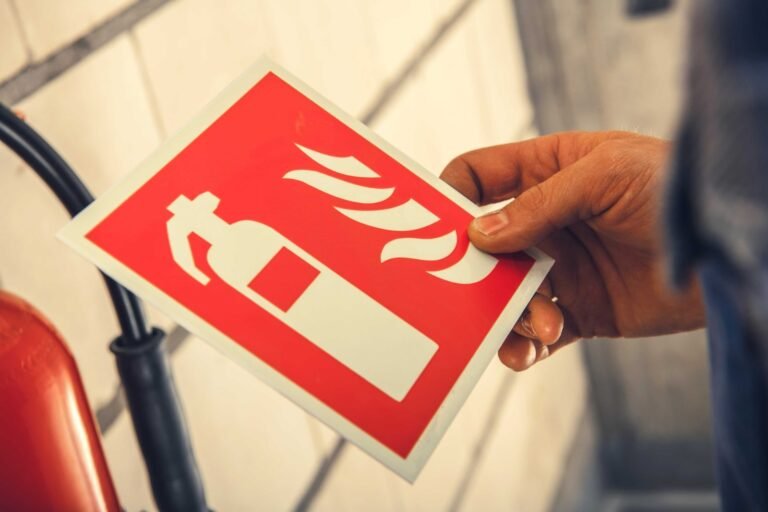
- Kitchens:Must be equipped with a certified fire blanket mounted on the wall and a multi-purpose fire extinguisher (such as a dry powder or foam unit).
- Servicing:All provided extinguishers must be visually checked monthly and professionally serviced and tagged annually by a qualified engineer.
5. Furniture and Electrical Safety
Many house fires stem from faulty appliances or highly flammable materials brought into the property.
The Furniture and Furnishings Regulations
If you let your HMO on a furnished or part-furnished basis, every single piece of furniture you provide, including mattresses, sofas, armchairs, and cushions, must comply with the Furniture and Furnishings (Fire) (Safety) Regulations. Look for the permanent, non-detachable manufacturer labels verifying that the materials have passed mandatory ignition tests.
Electrical Testing (PAT and EICR)
Electricity is a leading cause of accidental fires in shared housing.
- EICR(Electrical Installation Condition Report): You must have the property’s fixed wiring inspected and tested by a qualified, registered electrician at least every five years. A copy of this report must be supplied to tenants and the local council upon request.
- PAT (Portable Appliance Testing):If you supply electrical appliances (such as kettles, microwaves, washing machines, or vacuum cleaners) in communal areas, you are legally required to ensure they are safe. Conducting annual PAT testing is the industry standard for demonstrating your due diligence.
6. Communication and Tenant Obligations
Fire safety in an HMO is a continuous, collaborative effort. Providing top-tier hardware is meaningless if your tenants do not know how to respond during a crisis.
Providing Clear Information
The Responsible Person must provide all residents with clear, accessible fire safety instructions. This information should be detailed in the tenancy agreement and prominently displayed on a communal noticeboard, covering:
- The building’s designated evacuation strategy (typically a simultaneous evacuation policy in standard HMOs).
- How to activate the alarm system.
- The exact escape routes to take.
- Instructions on keeping fire doors closed and routes unobstructed.
HMO Fire Safety Compliance Checklist
| Obligation | Action Required | Frequency |
| Fire Risk Assessment | Comprehensive review of hazards and evacuation | Documented annually / after structural changes |
| Alarms & Detection | Testing interlinked smoke and heat alarms | Test weekly/monthly; service annually |
| Fire Doors | Check self-closers, seals, and structural integrity | Visual check monthly |
| Electrical Safety (EICR) | Professional inspection of fixed wiring | Every 5 years minimum |
| PAT Testing | Testing landlord-supplied portable appliances | Annually recommended |
| Emergency Lighting | Monthly flick-test and annual full discharge test | Monthly / Annually |
| Fire Extinguishers | Professional inspection and maintenance tags | Annually |
Conclusion
Managing an HMO comes with clear rewards, but it carries a significant burden of care. When it comes to fire safety, local authorities across the UK operate on a zero-tolerance policy. Ignorance of the law is never accepted as a valid defence in court.
By taking a proactive, highly organised approach, starting with a definitive, professionally drafted fire risk assessment, fitting certified fire doors, maintaining electrical certifications, and executing regular equipment servicing, you do far more than just tick a regulatory box. You secure your business model, shield yourself from devastating legal penalties, and, most importantly, provide a safe, secure home for the tenants who trust you with their welfare.
