
Growth rarely breaks a business overnight. It shows up as friction: a sales team that cannot see billing data, a mobile app that stalls during a promotion, or two department reports that never agree.
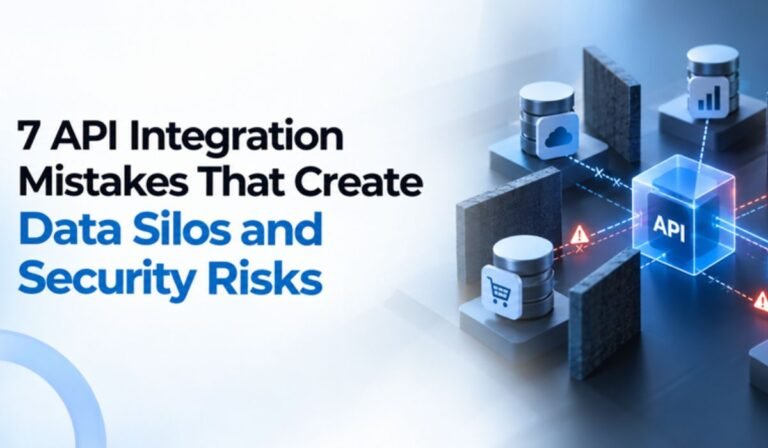
In most cases, the problem sits between systems, not inside them. Application programming interfaces, or APIs, are the messengers that carry data from one platform to another. A single online order can pass through a website, payment gateway, inventory platform, CRM, and shipping provider in seconds. When those connections are rushed, data gets trapped in isolated pockets called data silos, and every weak connection becomes an open door for attackers.
This is why enterprise-grade thinking matters long before a company reaches enterprise size. Businesses investing in custom web application development services often prioritize features and launch dates, while the integration layer underneath receives far less scrutiny.
That imbalance is where most growth bottlenecks begin. Teams re-enter the same data in multiple tools, connections break whenever a vendor updates its software, and security gaps stay hidden until an audit or a breach exposes them. Scalable, well-architected applications prevent these problems by design rather than by repair.
What Defines Enterprise-Grade Applications Today
Enterprise-grade does not mean complicated. It means an application can grow, protect sensitive information, and work reliably alongside other systems. Mobile products raise the bar further. An app created through custom mobile application development services typically depends on APIs for nearly every screen, from login to checkout, which makes integration quality part of the customer experience.
Scalability. Applications and their APIs handle more users, transactions, and integrations without a costly rebuild.
Security. Every endpoint, meaning every doorway into the system, confirms who is asking and what they may access.
Performance. Responses stay fast and predictable, even when thousands of requests arrive at once.
Reliability. If one service fails, the rest keep running, and the issue is flagged rather than ignored.
Integration capabilities. Consistent, well-documented APIs let new tools plug in quickly, keeping data unified.
Key Pillars for Long-Term, Integration-Ready Growth
Four architectural choices determine how well integrations hold up as a business grows.
Modular Architecture: Microservices vs. Monolith
A monolith is one application where every feature shares the same code and database. Microservices split a product into independent services that talk through APIs, like departments exchanging formal requests instead of searching each other’s filing cabinets. Complex, fast-growing platforms often benefit from microservices, while simpler products can thrive as well-organized monoliths. Either way, clean API boundaries keep each part independent.
Cloud-Native Development
Cloud-native applications are built for cloud platforms from the start. API gateways, which act as a secure front desk for incoming requests, and automatic scaling help integrations grow with demand rather than buckle under it.
Data-Driven Decision Making
Forecasts and dashboards are only as reliable as the data behind them. When APIs connect every system to trusted, shared records, leaders work from one version of the truth instead of reconciling conflicting spreadsheets.
Automation and AI Readiness
Automated workflows and AI tools depend on clean, accessible data. If key information sits in systems without dependable APIs, AI projects stall before they can deliver value.
7 API Integration Mistakes Businesses Keep Making
Most integration failures trace back to rushed decisions. These seven create silos, security exposure, or both.
1. Treating Integration as a Short-Term Fix
A short-term development mindset leads teams to connect systems one at a time with quick, custom links built to meet a deadline. Together, those links form a tangle nobody fully understands. Soon, teams avoid sharing data because changing one connection might break three others, and silos quietly take hold.
2. Letting Each System Keep Its Own Truth
When the CRM, billing platform, and support desk each store customer details differently, nobody knows which record is right. Without a designated system of record, the one trusted home for each type of data, integrations just copy errors from tool to tool. Data ownership should be settled before anything is connected.
3. Ignoring Scalability Until Traffic Spikes
APIs built only for today’s volume often skip safeguards like rate limits, which cap requests within a set time, and pagination, which delivers large data sets in smaller batches. When growth arrives, data syncs time out or fail silently. Teams then export spreadsheets as workarounds, creating fresh silos and unprotected copies of sensitive data.
4. Choosing the Wrong Tech Stack for the Job
Picking a framework or integration platform because it is trending, rather than because it fits the workload, creates problems months later. Instant alerts, nightly bulk transfers, and partner connections each need different approaches. Proprietary connectors that work only inside one vendor’s ecosystem can also lock data in place and make future changes costly.
5. Treating Authentication as a Checkbox
Hard-coded API keys, shared passwords, and overly broad permissions remain some of the most common security gaps. Just as risky is an API that confirms who a user is but never checks what they are allowed to open. Changing one number in a request should never reveal another customer’s account. The fix combines proven standards such as OAuth 2.0 with permission checks on every request and regular credential rotation.
6. Sending More Data Than Each Request Needs
Many APIs return complete records and rely on the app to hide sensitive fields. Attackers skip the app’s screens entirely and read whatever the API sends back. If an app needs only a customer’s first name, the API should return only that, not addresses and payment history. Data should also be encrypted as it travels between systems.
7. Losing Track of APIs After Launch
Many organizations lose sight of their own APIs. Old endpoints left running after a project ends, often called zombie APIs, stay reachable long after anyone stops watching. Without a current API inventory, versioning that keeps updates from breaking connected apps, and monitoring for unusual activity, silos and breaches can go unnoticed for months.
Best Practices for Building Future-Ready, Connected Applications
Plan Integrations Before Development Starts
Map every system the application will touch, who owns each data set, and how sensitive it is. Security, compliance, and growth goals should shape the architecture from the outset. Fixing a design flaw on a whiteboard costs a fraction of fixing it in a live system.
Choose a Development Partner That Thinks in Systems
The right partner asks hard questions about data flow, access control, and future scale before discussing features. NewAgeSysIT, a custom software engineering company headquartered in New Jersey, is one such firm, supporting businesses with web, mobile, cloud, and AI integration work. From its New Jersey base, the company primarily serves organizations across the United States that need secure, connected systems built for growth. Whatever the choice, a proven record of documented APIs, security testing, and post-launch support is worth verifying.
Treat Optimization as an Ongoing Discipline
Integrations are never truly finished, and every release is a chance to refine, not just add. Regular reviews of API performance, access logs, and unused endpoints, plus routine security testing, prevent the slow buildup of shortcuts, known as technical debt, that makes flexible systems fragile.
Real-World Example: How API Discipline Fueled Amazon’s Growth
One of the best-known examples comes from Amazon. In the early 2000s, according to a widely shared account by former Amazon engineer Steve Yegge, Jeff Bezos required every team to share its data and features only through service interfaces. No team could reach directly into another team’s database, and every interface had to be designed so outside developers could eventually use it.
The shift was demanding, but it removed hidden dependencies and pushed teams to build monitoring and usage controls into every service. That discipline is widely credited with laying the groundwork for Amazon Web Services, which launched its core cloud offerings in 2006 and became a major profit engine.
Few businesses operate at Amazon’s scale, yet the lesson applies at any size. Clear API boundaries help teams move faster, keep data accessible, and turn internal systems into growth assets.
Conclusion: Integration Is a Growth Strategy
API integration is not a back-office detail. It decides whether data moves freely across a business or collects in disconnected silos, and whether each new connection strengthens security or weakens it.
The seven mistakes above share one trait: they cost far less to prevent than to fix. Businesses that invest in deliberate planning, secure every connection, and revisit their architecture as they grow end up with applications that support expansion for years, not months.
For leaders planning their next digital investment, an early architecture conversation with experienced engineers is often the most valuable step. Well-built integrations rarely make headlines, but they quietly power everything a growing business depends on.
