
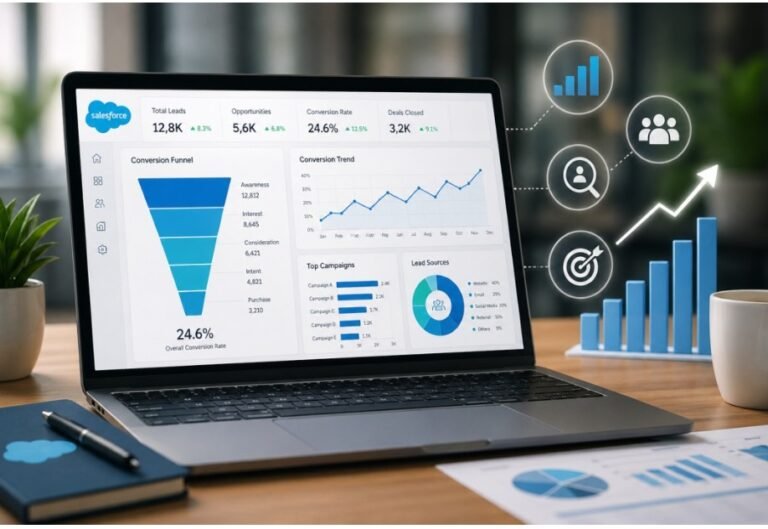
Salesforce Analytics improves conversion rates by helping businesses track customer behavior, identify high-quality leads, and act on real-time insights instead of guesswork. Teams that use CRM analytics often see measurable gains. Salesforce reports up to a 30% lift in conversions, while research from McKinsey shows data-driven companies are 23x more likely to acquire customers. When you know what your prospects are doing, where they drop off, and what actually influences decisions, improving conversions becomes a structured process not a gamble.
Many businesses struggle with low conversion rates because they rely on incomplete data, disconnected tools, or manual tracking. Important signals get missed like which leads are ready to buy or which campaigns are underperforming. Salesforce Analytics fills these gaps by bringing data, automation, and clear insights into one place.
This article explains how it works, where it makes the biggest impact, and how businesses can use it to increase conversions practically.
What is Salesforce Analytics?
Salesforce Analytics refers to the set of tools within the Salesforce ecosystem that help businesses analyze customer data, track performance, and make better decisions. It goes beyond basic CRM usage by turning stored data into actionable insights.
A key tool here is Salesforce Einstein Analytics, which uses artificial intelligence to identify patterns, predict outcomes, and recommend actions.
Basic CRM vs Analytics-Driven CRM
- Basic CRM: Stores customer data, tracks interactions
- Analytics-Driven CRM: Interprets data, predicts behavior, guides decisions
Core Features
- Real-time dashboards
- Custom reports
- Predictive insights
- Data visualization
- Automated recommendations
Instead of just collecting data, Salesforce Analytics helps businesses understand and use it effectively.
Why Conversion Rates Matter in Modern Sales
Conversion rate is the percentage of users who complete a desired action such as signing up, booking a demo, or making a purchase.
Even a small increase in conversion rate can lead to:
- Higher revenue without increasing traffic
- Lower customer acquisition costs
- Better return on marketing investment
For example, if your website converts at 2% and you improve it to 3%, that’s a 50% increase in results without extra spending.
Data-backed strategies play a big role here. According to McKinsey, companies that rely on data are far more likely to outperform competitors in customer acquisition and retention.
How Salesforce Analytics Boosts Conversion Rates
This is where the real impact happens. Salesforce Analytics improves conversions by fixing the exact points where businesses lose potential customers.
1. Better Lead Scoring with Predictive Analytics
Not all leads are equal. Some are ready to buy, while others are just exploring.
Salesforce Analytics uses predictive models to:
- Rank leads based on behavior and engagement
- Identify high-intent prospects
- Prioritize follow-ups
This helps sales teams focus on leads that are more likely to convert, instead of wasting time on low-quality prospects.
Result: Higher efficiency and better close rates.
2. Real-Time Customer Insights
Timing matters in sales. If a prospect shows interest but doesn’t get a response quickly, the opportunity can be lost.
Salesforce Analytics provides:
- Real-time activity tracking
- Instant updates on user behavior
- Alerts for key actions (like form submissions or page visits)
This allows teams to respond at the right moment when interest is highest.
Result: Faster responses and increased chances of conversion.
3. Personalized Customer Journeys
Generic messaging doesn’t convert well anymore. Customers expect relevant and timely communication.
With Salesforce Analytics, businesses can:
- Segment users based on behavior, location, and preferences
- Deliver targeted content and offers
- Customize email campaigns and follow-ups
For example, a returning visitor might see a different offer than a first-time user.
Result: Better engagement and higher conversion rates.
4. Sales Funnel Optimization
Most businesses lose leads somewhere in the funnel but they don’t always know where.
Salesforce Analytics helps identify:
- Where users drop off
- Which stages are underperforming
- What steps slow down the process
Once these gaps are clear, businesses can:
- Improve landing pages
- Simplify checkout processes
- Adjust messaging
Result: A smoother funnel that converts more users.
5. Data-Driven Decision Making
Many decisions in sales and marketing are still based on assumptions.
Salesforce Analytics replaces guesswork with:
- Clear metrics
- Performance tracking
- Visual dashboards
Teams can see what’s working and what isn’t, then adjust quickly.
Result: Better campaigns, smarter strategies, and improved outcomes.
Real-World Examples of Salesforce Analytics in Action
Retail Business Example
A retail company used Salesforce Analytics to segment customers based on purchase history and browsing behavior.
- Created targeted campaigns for repeat buyers
- Offered personalized discounts
Outcome: Significant increase in repeat purchases and overall conversions.
SaaS Company Example
A SaaS business tracked user behavior during free trials.
- Identified where users stopped engaging
- Improved onboarding experience
Outcome: Higher trial-to-paid conversion rate.
Many companies using Salesforce report measurable improvements after implementing analytics-driven strategies.
Key Features of Salesforce Analytics That Drive Conversions
AI-Powered Insights
AI analyzes large datasets and identifies patterns that humans may miss.
Interactive Dashboards
Visual dashboards make it easy to understand performance at a glance.
Automated Reporting
Saves time and ensures consistent tracking.
Customer Journey Tracking
Maps the entire journey from first interaction to conversion.
Seamless CRM Integration
All data stays connected within one system, reducing confusion and errors.
Common Mistakes Businesses Make (And How to Fix Them)
Ignoring Data Insights
Some businesses collect data but don’t act on it.
Fix: Regularly review reports and take action.
Poor Dashboard Setup
Too many metrics can create confusion.
Fix: Focus on key performance indicators (KPIs).
Lack of Team Training
Tools are only useful if teams know how to use them.
Fix: Provide proper onboarding and training.
Overcomplicating Analytics
Complex setups can slow down decision-making.
Fix: Keep dashboards simple and focused.
Best Practices to Improve Conversion Rates Using Salesforce Analytics
Define Clear Goals
Know what you want to improve leads, sales, or engagement.
Track the Full Customer Journey
Understand every step from awareness to conversion.
Update Dashboards Regularly
Keep data accurate and relevant.
Combine AI with Human Insight
Use AI for analysis, but rely on human judgment for strategy.
Align Sales and Marketing Teams
Both teams should work with the same data and goals.
Future Trends in Salesforce Analytics
Salesforce Analytics is evolving quickly, and several trends are shaping its future:
Increased Use of AI
AI will play a bigger role in predicting customer behavior and automating decisions.
Automation in Workflows
Routine tasks will continue to be automated, saving time and reducing errors.
Hyper-Personalization
Businesses will deliver even more tailored experiences based on real-time data.
Predictive Customer Insights
Companies will anticipate customer needs before they arise.
Turn Your Data Into Real Conversions
If your business is collecting data but not seeing results, it’s time to use it the right way. With expert support, you can turn insights into actions that directly improve your conversion rates. Explore our Salesforce CRM Analytics Services to build smarter dashboards, track the full customer journey, and make decisions that actually drive growth.
Conclusion
Salesforce Analytics helps businesses convert more leads by turning raw data into clear, actionable insights. From lead scoring to customer journey tracking, every feature is designed to improve decision-making and remove guesswork.
When used properly, it leads to:
- Better targeting
- Faster responses
- Smarter strategies
- Higher conversion rates
Businesses that rely on data consistently outperform those that depend on assumptions. With the right setup and approach, Salesforce Analytics becomes a strong growth driver.
Companies like OzaIntel help businesses implement Salesforce Analytics effectively, ensuring they get real value from their data and achieve measurable improvements in conversions and ROI.
