
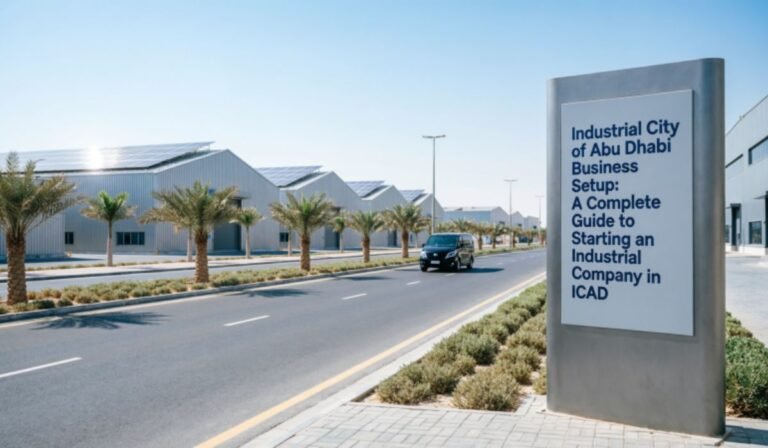
Industrial City of Abu Dhabi business setup is becoming an increasingly attractive option for investors seeking a reliable industrial base in the Middle East. The Industrial City of Abu Dhabi Free Zone (ICAD) stands among the region’s largest industrial clusters, strategically positioned only minutes from Abu Dhabi International Airport and Mussafah Seaport. Such proximity to major logistics hubs ensures rapid transportation and direct access to trade routes across the Middle East, Africa, and Asia, making the zone particularly appealing to export-oriented enterprises.
Why Investors Choose Industrial City of Abu Dhabi Free Zone
The UAE Industrial City of Abu Dhabi free zone company setup option draws attention from companies involved in manufacturing, engineering, energy, and construction materials. Businesses are attracted by the extensive territories available for factories, warehouses, and industrial facilities, as well as by the long-term support provided at the governmental level. This structured support allows companies to plan sustainable growth and expand production over time.
One of the main advantages of establishing a business here is the straightforward registration procedure. Applications can be submitted remotely, and licences are often issued within a few working days when documentation is prepared correctly. Flexible leasing solutions further enhance the zone’s attractiveness, allowing investors to select from production facilities, ready-to-use warehouses, or office spaces depending on operational needs.
From a taxation perspective, the Industrial City of Abu Dhabi freezone business setup in UAE offers favourable corporate tax conditions. Qualifying Free Zone Persons (QFZPs) benefit from a 0% corporate tax rate on eligible income, while standard corporate tax applies at 0% up to AED 375,000 and 9% above this threshold. Transparent pricing and scalable infrastructure make ICAD suitable not only for large corporations but also for mid-sized companies aiming to enter new markets.
Overview of the Industrial City of Abu Dhabi Free Zone
The Industrial City of Abu Dhabi company formation framework was introduced as part of a broader strategy to strengthen non-oil industries and diversify the economy of the UAE capital. The project was launched with strong governmental backing and is managed by ZonesCorp, ensuring operational transparency and long-term stability for investors.
A defining feature of ICAD is its division into several specialised industrial districts:
- ICAD I focuses on heavy industry, including metallurgy, steel manufacturing, and machinery production.
- ICAD II supports light manufacturing sectors such as packaging and construction materials.
- ICAD III is designed for industries like chemicals, plastics, pharmaceuticals, food processing, and textiles.
- ICAD IV attracts companies operating in electronics, energy, and advanced technologies.
Situated approximately 30 kilometres from central Abu Dhabi and near major transport routes, the zone functions not only as an industrial centre but also as a logistics hub. This infrastructure enables companies to efficiently distribute products across multiple regions, strengthening ICAD’s reputation as a strategic export platform.
Permitted Business Activities in ICAD
The Industrial City of Abu Dhabi manufacturing business setup is primarily designed for industrial and production-oriented operations. Companies operating in mechanical engineering, metallurgy, oil and gas services, plastics processing, pharmaceuticals, and chemical manufacturing can establish their presence within the zone. Additionally, businesses producing packaging, metal structures, and construction materials are widely represented.
Launching production facilities typically requires approvals from relevant authorities, particularly in areas related to environmental protection, industrial safety, and handling hazardous materials. These regulatory procedures ensure compliance with established industrial standards while maintaining operational safety.
An important operational advantage is the direct integration of industrial facilities with logistics infrastructure. Companies benefit from proximity to transport corridors and modern warehousing facilities, which significantly simplifies supply chain management and export operations.
Step-by-Step Process for Industrial City of Abu Dhabi Company Formation
The Industrial City of Abu Dhabi company registration process follows a structured approach, beginning with selecting the legal form and business activity, and ending with obtaining the required licence. Preparation of documentation is a critical stage that directly affects approval timelines.
Key documents usually include identification records of shareholders and directors, proof of residence, photographs, incorporation forms, the company charter, and a business plan outlining the type of activity, investment size, and expected workforce. For specialised industries such as pharmaceuticals, food production, or chemicals, additional approvals and technical documentation may be required.
With all necessary documents properly prepared, the average timeframe for completing registration and receiving a licence typically ranges from two to four weeks.
Remote Company Registration in ICAD
The remote Industrial City of Abu Dhabi business setup option provides flexibility for international investors who prefer to manage procedures without travelling to the UAE. Applications are submitted via the free zone’s digital platform, where scanned copies of documents and business plans are uploaded for review.
Identity verification may be completed through video conferencing, during which applicants confirm passport details and respond to verification questions. In many cases, original documents can be delivered via courier or notarised digitally. This approach allows investors to complete company registration from abroad and travel to the UAE only after receiving official documents.
The remote procedure generally follows the same timeline as standard registration, typically lasting between two and four weeks.
Licences, Visa Packages, and Estimated Costs
Selecting the correct licence is an essential step in the Industrial City of Abu Dhabi licence setup process, as it determines permitted business activities and operational requirements. Industrial licences are commonly chosen by manufacturing enterprises, while trading and service licences are available for companies involved in distribution or technical support services.
ICAD also provides flexible visa packages tailored to workforce requirements. Businesses can scale their visa allocation depending on team size, while additional services such as medical checks, Emirates ID issuance, and E-channel registration may apply as supplementary costs.
These scalable options make ICAD suitable for both newly established industrial ventures and expanding companies seeking to increase production capacity.
Who Should Consider Industrial City of Abu Dhabi Free Zone
The Industrial City of Abu Dhabi industrial company setup is particularly beneficial for organisations engaged in production and logistics. Companies that typically benefit from this environment include:
- Manufacturers operating in heavy, light, or chemical industries.
- Producers of construction materials, plastics, and packaging.
- Logistics and distribution companies requiring access to ports and airports.
- Engineering firms working closely with manufacturing operations.
However, ICAD may not be suitable for all business models. Freelancers, consultants without production needs, or digital-only startups may find the zone less practical, as it is specifically designed for industrial activities rather than purely service-based operations.
Conclusion: Is Industrial City of Abu Dhabi Right for Your Business?
The Industrial City of Abu Dhabi free zone company setup model has positioned ICAD as one of the UAE’s leading industrial centres. Its combination of extensive industrial land, developed infrastructure, proximity to major logistics points, and government-backed stability makes it highly attractive for manufacturers and export-oriented companies.
In addition to its operational advantages, the zone provides transparent licensing and leasing costs, as well as remote registration options that simplify the establishment process for foreign investors. While ICAD may not be the ideal solution for small service-based businesses, it remains a powerful platform for companies planning long-term industrial growth.
For entrepreneurs considering expansion into the Middle East manufacturing sector, ICAD represents a strategic starting point. Proper planning, careful licence selection, and well-prepared documentation can significantly streamline the registration process and help ensure a strong foundation for future business success.
