
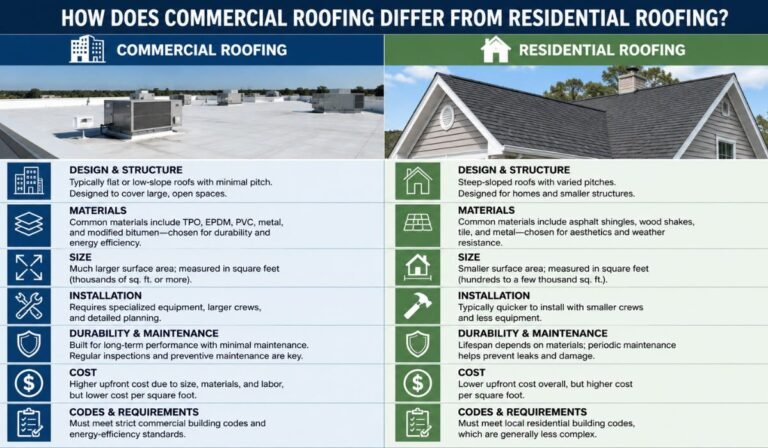
There are many significant differences between a residential roofing project and a commercial roofing project. Most notably, a commercial roofing project will require 60% more materials per square foot of roof than a residential roofing project. There are, however, many other differences that most property owners are not even aware of. This article will attempt to clarify the many differences between a residential roofing project and a commercial roofing project. It will also attempt to clarify the problems that can occur when one attempts to apply residential roofing criteria to a commercial property.
Structural load requirements separate the approaches
Commercial roofs have greater structural load requirements than residential roofs. The snow load, wind load, etc. of a commercial roof can be several times greater than that of a residential roof. In addition, a commercial roof typically has many pieces of roof top equipment such as HVAC units, generators, satellite dishes, and other communications equipment. Also, because of the need for building owners and or managers to periodically inspect and or access the roof for repairs, cleaning, etc. the roof can be subject to many foot prints. The total of all the equipment on a roof can total more than 15 lbs/sqft. This is far greater than the average residential roof and requires a specially designed roofing structure to withstand such loads.
The structural deck is another area where Commercial roofing will differ from Residential roofing. Most commercial roofing jobs will require additional reinforcement to the deck, heavier gauge decking, or even special decking with greater spacing between the individual members. The attachment of the roofing material to the deck is also an important factor for Commercial roofing. There are many commercially available roof attachments that can be used to meet the design loads that the roofing system will encounter. Additional factors that will need to be considered are wind uplift loads, in high wind areas, and building exposure.
Material priorities flip completely
Residential roofing is focused first on appearance of the roof. For many years, the most popular roofing material has been the asphalt shingle. This is the least expensive option to go with and thus the most popular for homes.
This approach to the construction of the roof of the commercial building is different from that of the residential building. For the residential building, aesthetics plays a very important role and for this reason, the most commonly used material for the roofing of residential buildings is the asphalt shingles. The principal reason for the use of the asphalt shingles for the residential roofing is that they look good and can be easily replaced when they wear out. On the other hand, for the commercial building, it is not important how the roof looks, as most of the time it will not be seen from the street. Thus, are used the membranes made of one layer of material, the modified bitumen and the built-up roofing, which have the long lasting properties (20 to 30 years and more with proper maintenance). Thus, the initial cost of the roofing for the commercial building is of less importance than the long lasting properties.
Weather resistance is a completely different issue with commercial roofs versus residential roofs. To begin with, most commercial roofs have lower roof slopes or are even relatively flat, unlike most residential roofs. As a result, the waterproofing system of a commercial roof has to be designed to perform under the worst of circumstances without the aid of gravity. For this reason, the types of weather resistant coverings used on residential roofs are generally not suitable for commercial roofs.
Installation complexity scales exponentially
There are many differences between Commercial Roofing and Residential Roofing, but possibly none greater than the scale of scale of the roof. While a typical residential roof will be 1,500 to 3,000 sq. ft. in size, a typical commercial roof will be 50,000 to 100,000 sq. ft. or more in size. This difference in size of roof can mean that the way that Commercial Roofing is installed and managed on such large scale roofs is very different from the way that Residential Roofing is managed.
Specialized tools and materials, such as hot-air welding machines, large quantities of industrial-strength adhesives, and more are typically used on commercial roofing jobs. These items can be very expensive, and can require a long learning curve to master. Even the most experienced residential roofing technician will require months to become proficient in using all of the wide array of tools, materials, and techniques that are used in commercial roofing.
Safety is a major concern when it comes to installing a commercial roofing system. Fall protection plans, confined space entry, working with other contractors on a job, these are just a few of the safety concerns that a commercial roofer deals with on a daily basis. OSHA has very strict rules and regulations for all commercial construction sites and most residential roofing contractors are not trained or certified to work on these types of projects.
Maintenance philosophies couldn’t be more different
Many single family homes have ‘steep-slope’ roofs, which easily shed water. Most failures on these types of buildings are attributed to the wear and tear of related equipment as opposed to the roof itself.
As property owners, the best way to protect your buildings is to form partnerships with the right commercial roofing Baltimore contractors. These specialized roofers can help property owners from every industry design, install, and even repair the many different styles of roof that are used on commercial buildings. Whether a property owner needs a single-ply membrane, a modified bitumen system, or a built-up roof, the best contractor can offer the experience and knowledge needed to get the job done right the first time.
Cost analysis requires long-term thinking
When it comes to a residential roofing project, a homeowner can typically look at the bids from several roofers and compare the prices. The homeowner can also look at the different options for paying for the work. For example, the homeowner can look at the different bids for installing a new asphalt shingle roof and then look at the terms of the financing that is available to pay for the new roof. The homeowner can look at the interest rate of the financing, the monthly payment, and the length of time that the homeowner would make payments on the new roof.
When it comes to cost, most Residential building owners are only concerned with the initial cost of the roof and how they can finance the construction of the roof. They typically get several bids from several different contractors. They then choose the lowest price initially. The building owner typically has no idea of the long-term performance of the roof until several years have past and it begins to fail. This type of decision making can lead to contractors building roofs for the lowest price initially in order to get the lowest price initially in order to get the contract and make as much as possible off of repairs down the road.
Unlike most residential roof systems, some commercial roof systems’ warranties include the cost of labor to repair any work that has failed within the specified warranty period. For example, some single-ply membrane roofs have warranties of 15 years or more for material failure, and 15-20 years or more for labor failure. Some modified bitumen roof systems have 18-25 year warranties for material failure and 18-20 years for labor failure. Some built-up roof systems have 20-30 years or more of warranty coverage for both material and labor failure.
Regulatory requirements
Regulations for commercial roofs far exceed those of residential roofs. Before a commercial roof can be built, the roof must comply with the energy codes for minimum insulation and roof reflectivity. This is generally not a concern for residential roofs. Also, there are special fire-resistive requirements for commercial roofs. In addition, many local governments require environmental assessments of roofs as well as special roof features to allow people with disabilities to access roofs for maintenance. These regulations can cause many problems and even stop a construction project if not managed properly.
By hiring a roofing contractor who has significant experience roofing similar structures to your own, you will be able to rely on them to successfully handle just about every engineering challenge, project management challenge, and building department compliance challenge that your large roofing structure(s) are likely to pose.
