
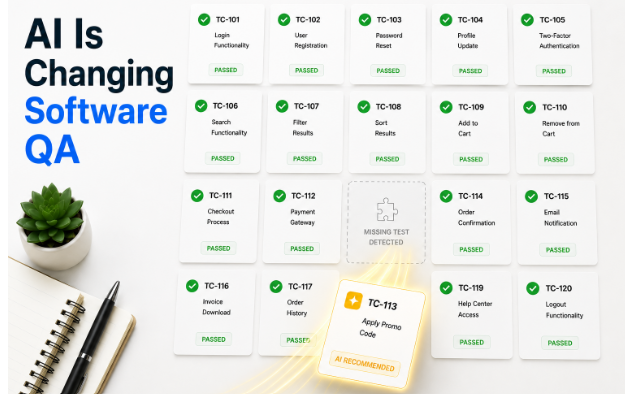
Software quality assurance has always been a critical part of delivering reliable digital products. However, as applications become more complex and release cycles become shorter, traditional testing methods are struggling to keep pace. In 2026, artificial intelligence (AI) is reshaping software quality assurance by helping teams test faster, identify defects earlier, and improve software quality without sacrificing development speed.
Rather than replacing QA engineers, AI is becoming a powerful assistant that automates repetitive tasks, analyzes test data, and helps teams make smarter testing decisions.
Why Traditional QA Needs an Upgrade
Modern software teams often release updates multiple times a day. Applications are expected to work seamlessly across different browsers, devices, operating systems, and cloud environments. At the same time, users expect flawless performance.
Traditional QA processes face several challenges:
- Increasing test case volumes
- Limited testing time before releases
- Frequent UI changes that break automation scripts
- Growing complexity of APIs and microservices
- Rising customer expectations for bug-free experiences
AI Is Automating Test Case Generation
Creating test cases manually is time-consuming and often repetitive. AI tools can now analyze user stories, product requirements, and application behavior to generate meaningful test cases automatically.
Instead of starting from scratch, QA engineers can review AI-generated suggestions and focus on improving coverage rather than writing every test manually.
Benefits include:
- Faster test creation
- Better requirement coverage
- Reduced manual effort
- Easier maintenance of test suites
Smarter Bug Detection
Finding defects is no longer limited to predefined test scripts. AI can analyze historical defects, application logs, and execution patterns to identify unusual behavior before users encounter problems.
Modern testing platforms can even prioritize defects based on business impact, helping development teams focus on fixing the most critical issues first.
Self-Healing Test Automation
One of the biggest frustrations in test automation is broken test scripts caused by small UI changes. AI-powered self-healing automation can automatically identify updated element locators and repair failing tests without requiring manual intervention.
This results in:
- Fewer false failures
- Reduced maintenance costs
- More stable automation pipelines
- Faster release cycles
Explore how AI-powered tools are approaching this problem: AI-Powered Test Automation: Best Practices and Tools You Need to Know.
Predictive Risk Analysis
AI can learn from previous releases and identify areas of the application that are more likely to contain defects. Instead of executing every test during every release, teams can prioritize high-risk components first.
This risk-based testing approach helps organizations:
- Reduce testing time
- Improve release confidence
- Detect critical issues earlier
- Optimize QA resources
For a broader view of how independent QA strategies are evolving alongside AI.
Visual Testing Powered by AI
Visual defects are among the easiest issues for users to notice. AI-driven visual testing compares screenshots across browsers and devices while understanding the intended design. Unlike traditional pixel-by-pixel comparisons, AI distinguishes between meaningful visual regressions and harmless differences.
This significantly reduces false positives and improves UI consistency.
AI Improves API Testing
Modern applications depend heavily on APIs. AI tools can automatically:
- Generate API test scenarios
- Detect unusual response patterns
- Validate schema changes
- Recommend missing edge cases
Intelligent Test Prioritization
Running thousands of automated tests before every deployment can slow development. AI analyzes code changes and determines which test cases are most relevant for the current release.
By executing only the highest-priority tests first, organizations can reduce execution time while maintaining confidence in software quality.
AI Supports Continuous Testing
Continuous Integration and Continuous Delivery (CI/CD) pipelines require rapid feedback. AI integrates seamlessly with DevOps workflows by:
- Selecting relevant test cases
- Predicting failures
- Monitoring production behavior
- Recommending additional validation after deployments
This allows teams to release software more frequently without compromising quality. For a foundational understanding of how CI and CD work together .
Human Expertise Still Matters
Despite impressive advancements, AI cannot replace experienced QA professionals. Human testers continue to play an essential role in:
- Exploratory testing
- User experience evaluation
- Business logic validation
- Accessibility testing
- Security assessment
- Critical decision-making
The future of QA is not AI versus humans it is AI working alongside skilled testers to improve efficiency and software quality. For a complete picture of how AI and human expertise combine across quality engineering,
What Businesses Should Consider Before Adopting AI Testing
Organizations planning to implement AI-driven QA should evaluate:
- Existing automation maturity
- CI/CD integration
- Data quality for AI models
- Team training requirements
- Scalability of testing tools
- Return on investment
For organizations looking for a comprehensive assessment of AI testing services available today, Top AI Software Testing Services to Consider in 2025 provides a solid comparison framework.
Final Thoughts
Artificial intelligence is transforming software quality assurance from a reactive process into a proactive one. AI-powered testing enables faster releases, better defect detection, smarter automation, and improved testing efficiency while allowing QA professionals to focus on higher-value activities.
As software systems continue to evolve, successful organizations will be those that embrace AI as a strategic partner in quality assurance rather than viewing it as a replacement for human expertise.
