
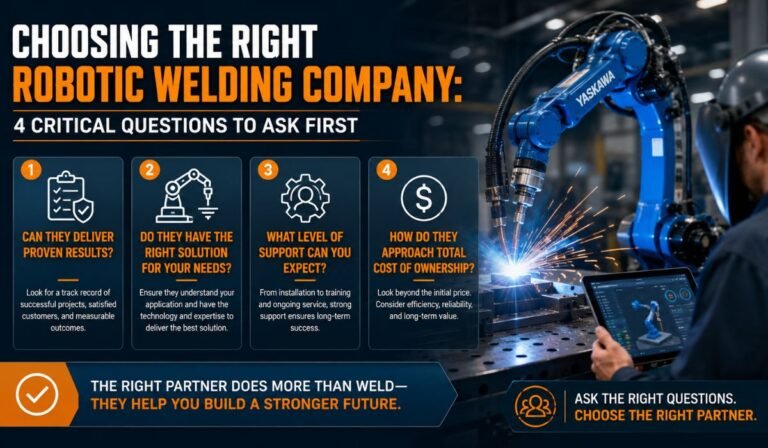
Outsourcing your fabrication work can free up your internal resources, but only if you pick the right partner. Not every shop has the same capabilities, and choosing the wrong robotic welding company can lead to missed deadlines, poor quality, and expensive rework. Before you hand over your blueprints, you need to vet your vendor like a detective. A reputable robotic welding firm should be transparent about its equipment, its workforce, and its quality processes. This guide outlines four essential questions every project manager should ask. By focusing on experience, technology, quality control, and scalability, you will find a robotic welding business that delivers precision parts on time and on budget, protecting your reputation with your own customers.
1. What Is Your Specific Industry Experience?
Does the robotic welding company have a track record with your specific material type and thickness? An automotive specialist with years of welding thin‑gauge aluminium might struggle with structural steel beams that require deep penetration and multi‑pass welds. Ask to see a portfolio of similar past projects. A confident robotic welding business will share case studies, photos, and even customer references. They should also be able to discuss the challenges they faced on those projects and how they solved them. For safety‑critical work, ask about any industry certifications they hold, such as AS/NZS 1554 for structural steel or ASME for pressure vessels. Experience reduces risk. An experienced robotic welding company will already have proven weld procedures for your material, saving you the time and cost of qualification testing.
2. What Equipment and Tech Do You Run?
Not all robotic arms are equal. When evaluating a robotic welding firm, you need to know the age and brand of their cells. Look for firms using adaptive seam tracking and multi-axis articulation. A great robotic welding corporation will have invested in offline programming software, which allows them to test the weld digitally before burning a single piece of metal. This reduces downtime and ensures your parts are handled with care.
3. How Do You Handle Quality Assurance?
Ask the robotic welding business about their inspection process. Do they use non-destructive testing or ultrasonic methods? A reliable robotic welding firm will have ISO certifications and a strict traceability system for every batch. You need a partner who inspects welds visually and mechanically at several stages, not just at the end. This prevents defects from reaching your assembly line and ruining your final product. If a defect is later found, traceability allows the automatic welding company to isolate and recall only the affected batch, not your entire inventory. This level of rigour separates a professional shop from a backyard operator.
4. Can You Scale with My Production Needs?
Your demand might spike next quarter. Can the welding company increase its machine hours? Ask about their staffing and the number of operational robots. A scalable robotics welding company will have flexible capacity to handle both small prototype runs and high-volume production without sacrificing quality. Choosing a robotics welding company that can grow with you ensures you won’t be forced to qualify a new vendor halfway through a large order.
