
Recently a school play by the high school drama club was in need of $15,000 to put on their spring production. The typical fundraising methods did not raise enough funds. Parent Sarah had an epiphany. She empowered the community to raise the funds for them. In 6 weeks 30 parents, students and supporters raised a total of $18,647.51. The majority of this was raised through their own personal networks.
The Basic Model Explained
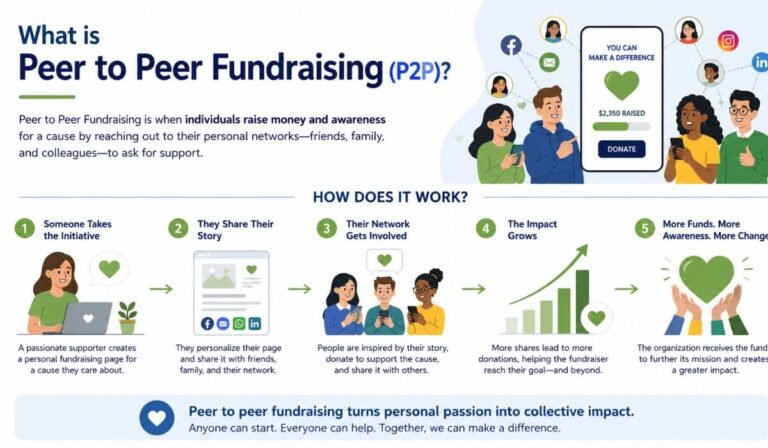
There is a huge difference between Peer to Peer Fundraising and traditional fundraising when it comes to donation collection. Instead of the organization asking for money directly for a cause, an organization brings in supporters of the cause to collect money themselves for a cause they have connection to. They use their own personal network and relationships to get others to donate money to support the cause.
First, the organization sets a campaign goal for the fundraiser and creates individual fundraising pages for each volunteer fundraiser (referred to here as “peer fundraisers” or “fundraising participants” etc.). Each volunteer fundraiser then shares their specific fundraising page with their personal network of family, friends, colleagues, etc. and explains why they personally are raising money for this organization/program etc. The organization supplies the volunteer fundraiser with the necessary tools and/or templates to help make asks but it is the volunteer fundraiser who actually makes the ask to raise money for the organization.
Why Personal Networks Drive Results
The simple reason why online fundraising through personal networks is so powerful is that people give to people, not to institutions. If an individual receives a fundraising request from someone they know, who they trust and possibly even like, the individual is far more likely to respond to the request than if they received the exact same request from an unknown person or from an organization. This is especially true in today’s online world where most people receive numerous solicitations on a regular basis. Because of this, higher response rates for peer to peer fundraising campaigns are typically seen than for direct institutional solicitations.
Research has proven that the highest level of response to an appeal comes from a Peer to Peer fundraising campaign. This is because people give to people, and in a Peer to Peer campaign the people are supporters of the organization who also believe in the good that the organization does.
Each fundraiser brings their own network to the campaign. For example, a school fundraiser could reach the parents of children at the school, and their extended family and friends who live all over town. A group of alumni from a school can reach out to other alumni from different graduating years. Even extended family members and relatives of the students who are involved in the school fundraiser can be reached out to by the fundraiser for donations to the school campaign.
Setting up a Successful Campaign
When planning a Peer to Peer campaign, it is very important to first identify who within an organization would be great advocates for the cause. This would typically be supporters of the organization, donors to previous events, and volunteers. Some individuals will be better at fundraising Peer to Peer than others because of their large personal networks or because they are very comfortable asking for money for a cause that they are very passionate about.
For your Peer to Peer fundraising campaign, your organization will need to set up a platform for your volunteers to raise money on your behalf. These pages can be referred to as personal campaign pages or event pages. This is where your volunteer fundraiser will add a photo and story as to why they are raising money for the organization. Also, make sure that the process to donate is easy and painless for your donors. If the donation form requires too much information, then your donor may abandon their donation.
Peer to peer fundraising is only effective when volunteers are well-trained to fundraise. That means that they have to know how to set up a professional looking online fundraising page. They have to be able to add pictures and share a photo and story on their page. They have to know how to send emails to people who have donated as well as to those who haven’t yet donated. They have to know how to make a personal ask for donations. That means they have to know how to identify the right people in their network to ask in the first place. And then they have to know how to follow up with those people who haven’t yet donated yet. The organization should continue to provide the volunteers with support and encouragement throughout the campaign in order to keep them energized and motivated to continue fundraising.
The goals for the participants and fundraisers in a peer to peer fundraising campaign should be set to be very challenging but also achievable. If the goal is set too low then the fundraisers may lose interest in the campaign as they find it too easy to reach. On the other hand, if the goal is set too high then the participants and fundraisers may get discouraged before the campaign has even started. This is why in the most successful campaigns there are set several goals for the participants and the fundraisers in the initial stages of the campaign, and then later other goals as the campaign continues.
Common Applications
When people school fundraising are doing a peer to peer fund raiser for the school it is often for a school project or event. For example they might be raising money for a new school playground, for field trips, or for other school activities or events. A parent or group of parents create the school fundraising campaign page and then they raise money for their project by seeking out donations from friends, family, and business in their local community.
Another common method for Non-Profits to implement the Peer to Peer fundraising model, is by mixing it with an existing event, like a Walk-a-thon, a fun run or even a Charity ride. As in the above example, participants of the event first sign up for the event, and after that they can create their personal fundraising pages in order to collect money for their participation in the event.
For some organizations, peer to peer fundraising can be an all year round method to raise funds for their general work or for specific projects and initiatives. This type of fundraising has been used by organizations for capital campaigns, to raise funds to purchase large pieces of equipment or for raising money in an emergency.
For more information on how to utilize peer to peer fundraising for your next event or campaign, take a look at our article what is peer to peer fundraising and for some examples of Peer to Peer Fundraising campaigns, check out our examples of Peer to Peer Fundraising. This article will provide strategies for effective campaign planning.
Measuring Success and Managing Challenges
The next thing you need to understand when measuring and evaluating your fundraising campaigns is how to track key campaign statistics (e.g. how many fundraisers participated in the campaign, how much money on average did each of the fundraisers that participated in the campaign raise, how many unique donors did the fundraisers bring in). The goal with using these statistics for future campaigns is to identify areas for improvement before they affect future fundraisers for other fundraising events. And lastly, as with any volunteer-managed fundraising program, there are several things that can go wrong (e.g. fundraiser fatigue, poor participation, more time put into the campaign then what was raised) and so it is also wise to come up with strategies that can help rectify any negative outcomes that may occur with your own fundraising efforts.
There can be difficulties when there are lots of fundraisers involved in a campaign. The problem that some fundraisers are more successful at fundraising than others can place a lot of pressure on those who are not raising as much money. There will be systems in place to deal with these types of problems, and for the fundraisers to be fully supported.
While several people from an organization may solicit for funds from the same pool of potential donors, there are potential for some very awkward interactions. The school administrator for example could have several people soliciting from all of the parents of students at the school. Each of those parents could be solicited by several people. Therefore, it is up to the organization to have a system of prospect management that the fundraisers are following.
Building Long-term Relationships
However, these newly acquired donors by a school through peer fundraising can become direct supporters to the organization, potentially as valuable as any other donor to a school. In addition, the school’s supporters who are participating in a fundraiser for a school’s campaign become more engaged with the mission of the organization for which they are fundraising.
However, to take full advantage of the relationships that have been created and the donations that have been received in a peer to peer fundraising campaign, the organization that sponsored the campaign must recognize the efforts of the fundraisers from time to time after the campaign has closed. The organization must then keep the fundraisers and their donors informed of the use of the funds that were raised in the campaign and continue to offer the fundraisers opportunities to become further involved with the organization. If an organization fails to do these things, then even the best of peer to peer fundraising campaigns will fall short of their full potential.
