
Most residents of the UAE treat their water storage tank the way most people treat their car’s engine. They know it is there, they know it is important, and they prefer not to think too carefully about what is happening inside it. This attitude is understandable, but it leads to situations that are worth understanding and avoiding.
The interior of a rooftop water tank in the UAE during the summer months is an environment that puts significant stress on stored water. Understanding what happens in that environment and what it means for the water coming out of your taps is useful knowledge for anyone who relies on stored water for household use. Without a properly sized and well-built water tank, any home, building, or business is at risk.
Start with temperature. The roof surface of a typical UAE building in July and August can reach 70 to 80 degrees Celsius on the hottest part of a clear day. An uninsulated tank sitting on that surface absorbs heat from the roof below, from direct sunlight on its walls, and from the ambient air temperature which itself is regularly above 45 degrees. Under these conditions, water inside an uninsulated tank can reach 60 degrees or more. That is hot enough to make a cup of tea. It is not a temperature you want your drinking water to reach.
At 60 degrees, several chemical and biological processes accelerate in ways that matter for water quality. Chlorine, which municipal water authorities in Dubai, Abu Dhabi, and other UAE cities add to the water supply as a disinfectant, is volatile at high temperatures. The warmer the water, the faster the chlorine evaporates out of it. Water that arrives at your tank with a chlorine residual that meets health standards can lose most of that residual within hours if the tank temperature is high enough. Water without adequate chlorine residual is water without its primary chemical protection against bacterial growth.
This leads to the second issue, which is biological. The bacterium Legionella pneumophila, which causes Legionnaire’s disease, is a particular concern in water systems. Legionella is present in low concentrations in most natural water sources. Municipal treatment keeps its concentration at safe levels in the distribution network. But Legionella thrives and multiplies rapidly in the temperature range between 25 and 45 degrees Celsius. A tank that sits at 50 degrees during the day and cools to 35 degrees at night is cycling through a temperature range that is ideal for Legionella growth whenever the temperature passes through the danger zone.
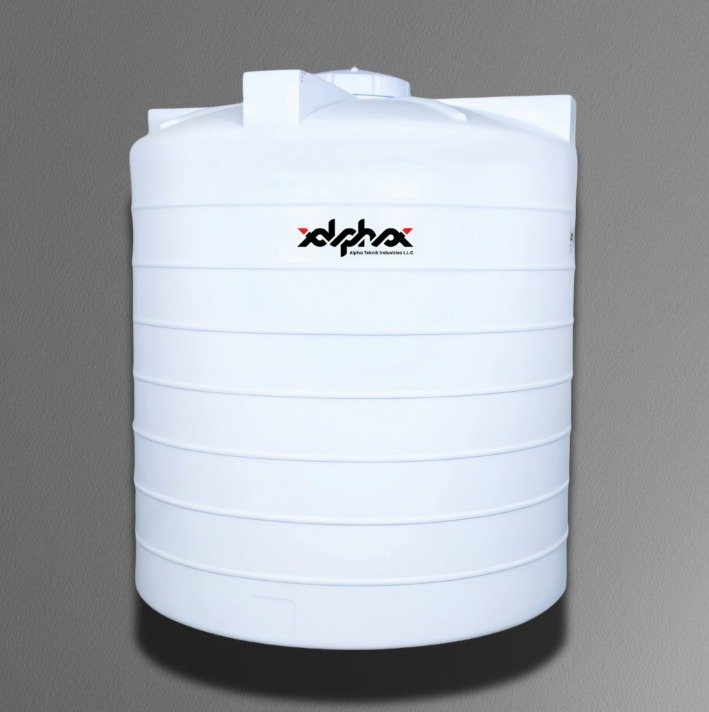
Research into water quality in Gulf region residential buildings has consistently found elevated bacterial counts in tanks that are not regularly cleaned and maintained. This is not a theoretical risk. Outbreaks of waterborne illness associated with building water systems in the region have been documented and traced back to inadequate tank maintenance in conditions where high temperatures accelerated bacterial growth. Alpha Teknik Industries LLC has been supplying water tanks across the UAE for years. We manufacture plastic polyethylene tanks, GRP fiberglass tanks, and IBC tanks for residential, commercial, and industrial customers in Dubai, Abu Dhabi, Sharjah, and all other emirates. This guide will help you understand each product, compare your options, and make the right purchase decision.
The taste and smell effects are less serious than the health risks but more immediately noticeable. Water stored in a hot tank often tastes flat because dissolved oxygen escapes more readily at high temperatures. It can develop a slightly musty or metallic taste as mineral concentrations increase through evaporation from the surface and as any residual biofilm on tank walls begins to affect the water’s character. This is one reason that residents in many UAE buildings prefer bottled water for drinking despite having access to tap water that met quality standards when it left the municipal treatment plant.
A quality insulated tank changes this situation dramatically. The multi-layer construction of a well-designed polyethylene tank creates a thermal barrier between the outside environment and the stored water. The foam insulation layer in the wall of the tank reduces heat transfer from the hot outer surface to the cooler water inside. The black UV-resistant outer shell prevents solar radiation from penetrating to the tank wall and being absorbed as heat. The result is that water inside an insulated tank in UAE summer conditions runs 10 to 20 degrees cooler than water in an uninsulated equivalent.
Those 10 to 20 degrees make a meaningful difference. Water at 40 degrees instead of 60 degrees retains chlorine residual far longer. Bacterial growth rates that would be dangerously high at 50 degrees are significantly slower at 35 to 40 degrees. The water remains more palatable and fresher for longer between cleaning cycles.
Beyond insulation, the design of fittings and connections matters for summer performance. Inlet pipes that bring hot water from rooftop supply lines into a cool tank can act as pathways for heat transfer if not properly configured. Overflow pipes that remain open can allow hot ambient air to circulate inside the tank. Lids that do not seal tightly allow hot air in and humidity out, both of which affect water quality.
The cleaning schedule is particularly important in summer. If you are going to clean your tank twice a year as UAE regulations recommend, the timing of those cleans matters. Cleaning immediately before summer, around April or May, removes the sediment and biofilm that has accumulated over the previous six months and ensures the tank goes into the hottest period with the cleanest possible interior. The second clean in October or November clears anything that developed during summer before the cooler winter months.
Between cleans, a few practices help maintain water quality. Running the taps for a minute or two after periods of non-use, such as returning from a holiday, flushes stagnant water from the pipes rather than drawing directly from what has been sitting in a hot tank. Installing a tank thermometer, which is an inexpensive addition, allows you to monitor whether the insulation is performing as expected. If tank temperature consistently exceeds expected levels, there may be insulation degradation or an installation issue worth investigating.
The overall picture for UAE residents is that summer is the season when water storage requires the most attention, not less. The natural instinct to put infrastructure out of mind during the busy, hot months is the opposite of what tank performance and water quality require. A few minutes of awareness and basic monitoring during the summer period pays dividends in water quality and peace of mind for the whole year.
