
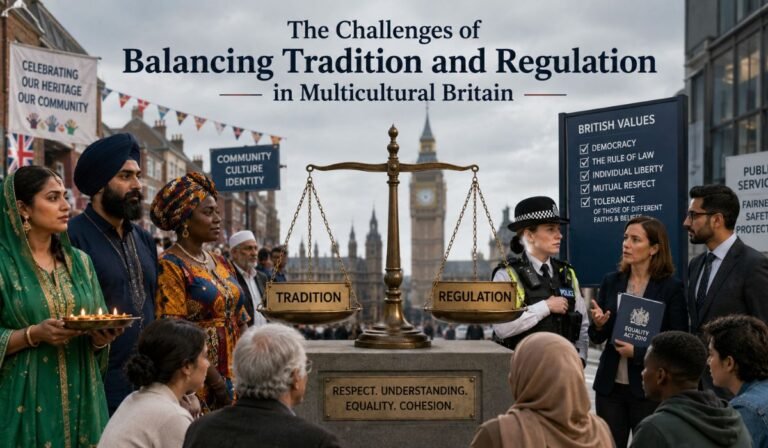
Britain Has Changed in Small but Noticeable Ways
Britain still feels British. The weather complaints are still there. So are packed trains, crowded high streets, Sunday roasts, and Christmas markets that appear almost overnight every winter. But daily life has changed quietly over time.
Walk through parts of London, Birmingham, Leicester, or Manchester and the mix of cultures is impossible to miss now. One area may be preparing for Diwali while another is advertising Ramadan food offers late into the evening. Chinese New Year celebrations pull huge crowds into city centres. Vaisakhi processions regularly stop traffic for hours in some areas, and hardly anyone seems surprised by it anymore.
Years ago, many of these traditions happened more privately within communities. Now they are part of public life in a very visible way. Schools mention them. Workplaces plan around them. Councils prepare for them months ahead of time. Most people do not even think twice about it anymore. This is how much a normal mix of different religious and cultural occasions are for people there. However, things are much more complicated behind the scenes than they were in the past.
Most People Only See the Fun Part
A community event today is rarely just a community event. Even smaller cultural celebrations often involve permits, safety reviews, council approvals, transport coordination, insurance requirements, and food regulations. A lot of organisers quietly spend weeks dealing with paperwork before a single visitor even arrives.
Part of that is understandable. Cities are more crowded now. Public safety expectations are stricter. Councils also face immediate criticism whenever something goes wrong during a large public gathering.
Diwali celebrations have faced this in several cities, especially around fireworks, overcrowding, and traffic concerns. Chinese New Year events in Manchester and London now involve visible security barriers, organised crowd routes, and police coordination that would have been unusual years ago.
The same thing happens during Vaisakhi processions and Japanese cultural fairs. Visitors usually see the colourful side of these events. Organisers see the paperwork.
None of this necessarily means Britain has become less welcoming toward different traditions. It mostly reflects how regulated public life has become in general.
Religious Traditions Are Adapting Too
Muslim communities have also had to adjust certain practices over time, especially in larger cities.
Life looks different now compared to previous generations. More families live in apartments. Working hours are longer. Extended family structures are often more spread out than before. Naturally, traditions adapt around those realities. That is partly why religious practices such as Eid al Adha Qurbani have increasingly shifted toward organised charity networks and regulated distribution systems, particularly in urban areas where direct participation is less practical than it once was.
There is also more public attention now around transparency, food handling standards, and regulated charitable systems. Younger generations especially tend to prefer organised processes they can track and trust.
What stands out is that traditions themselves are not disappearing. They are just being handled differently than they were twenty or thirty years ago.
Workplaces Are Having Different Conversations Now
This shift is not limited to festivals or religious organisations either. Employers across Britain are dealing with these changes in real time.
Not that long ago, many workplaces barely discussed religious observances beyond Christmas holidays. Today, conversations around Ramadan schedules, dietary requirements, prayer spaces, or religious leave requests are fairly common in many sectors. Some companies manage it smoothly. Others still struggle.
Retail, healthcare, transport, and customer service industries often find themselves trying to balance inclusivity with operational demands that cannot simply stop during busy periods. That sometimes creates awkward situations nobody really has a perfect answer for. At the same time, employees increasingly expect workplaces to understand cultural and religious differences instead of treating them as unusual exceptions.
Technology has helped ease some of that pressure. Digital booking systems, online charity platforms, virtual learning spaces, and organised event management tools have made participation easier while also helping institutions maintain oversight and compliance.
Multiculturalism Now Feels More Practical Than Political
Public conversations around multiculturalism used to sound more ideological. Now they often feel more practical. Questions today are less about whether Britain is multicultural and more about how multiculturalism functions day to day. How should councils manage competing community needs fairly? Where should regulations become stricter? How much flexibility should workplaces offer?
There are still disagreements, obviously. Noise complaints, public funding debates, environmental concerns, and animal welfare discussions continue to surface around religious celebrations every year. Social media usually makes those arguments louder than they need to be. But something else has changed too.
Many councils and public organisations now work more directly with faith groups and community organisers before problems escalate. That approach tends to work better than treating cultural traditions as disruptions that need controlling afterwards. Because the reality is simple: multicultural Britain is no longer an abstract political idea. It is just everyday life now.
Conclusion
The diversity of Britain is no longer a side issue. Every day, it influences public areas, transportation networks, companies, schools, and communities.
Determining whether traditions are acceptable in modern Britain is no longer the hard part. The discussion has already moved on. Determining how long-standing customs survive in a country that is growing increasingly regulated, congested, and interconnected every year is the true difficulty.
