
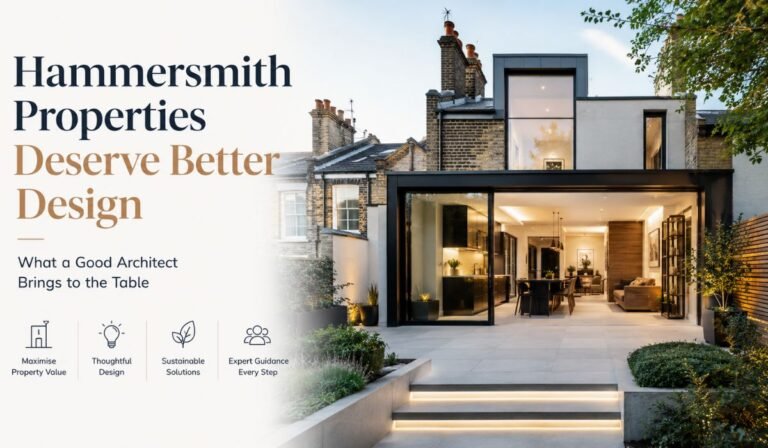
Hammersmith has some of the most interesting residential streets in West London. Victorian terraces around Brackenbury Village. Edwardian houses near Ravenscourt Park. Mansion flats along the main roads. And pockets of post-war housing scattered throughout. The area has real architectural variety, which is part of what makes it such a desirable place to live.
But that variety also means there’s no single formula for improving a home here. What works on a wide fronted Edwardian semi near the park won’t necessarily suit a narrow mid terrace on a Brackenbury street. Each property needs individual attention, and too many homeowners in Hammersmith aren’t getting it. They’re going straight to builders, getting generic designs, and ending up with extensions that add space but miss the opportunity to make the house genuinely better. At Extension Architecture, we’ve worked on residential projects across the borough for years. If you’re looking for a Fulham architect who treats every property as a one off, here’s what proper design input actually looks like.
The Problem with Generic Extensions
Walk around Hammersmith on a Saturday, and you’ll spot them. Rear extensions that look identical on every house in the terrace. Same flat roof, same bi fold doors, same grey kitchen behind them. They’re not badly built. They’re just not designed. Nobody thought about how this specific family uses their home. Nobody considered which direction the garden faces or where the light comes from at different times of day. Nobody asked whether the existing rooms behind the extension still work or whether they’ve been left as awkward leftover spaces.
A generic extension adds square meters. A designed one adds quality of life. The difference in cost between the two is minimal. The difference in outcome is enormous.
Understanding Hammersmith’s Housing Stock
Brackenbury Village terraces are typically narrow fronted with long rear gardens. They suit side return and rear extensions that wrap around the back of the house, creating L shaped ground floors with enough width for a proper kitchen island and dining area.
The Edwardian properties near Ravenscourt Park are wider, often with side access and more generous plots. These can accommodate larger rear extensions and sometimes double storey additions. Their higher ceilings and bigger windows give architects more to work with in terms of proportion and natural light.
The mansion flats along King Street and Hammersmith Road present different challenges entirely. Floor area is fixed, so improvements focus on internal reconfiguration, better storage, and upgraded finishes rather than extensions.
Each type demands a different design response. An architect who understands the local housing stock approaches each one appropriately rather than applying the same template to every project.
Getting Light Into Narrow Terraces
Natural light is the biggest challenge on Hammersmith’s terraced streets. The houses are narrow, the party walls block light from the sides, and the only real opportunities for glazing are at the front and back. The middle of the house is almost always dark.
A well designed rear extension addresses this directly. Roof lights positioned over the center of the plan pull daylight down from above. Full height glazing at the rear floods the back of the room. And internal changes like removing the wall between the old kitchen and the room behind it allow light to travel further into the house than it ever could before.
We’ve designed extensions in Hammersmith where the homeowner said the room felt brighter at the back than at the front, even though the front has a bay window. That’s what happens when roof lights and glazing are positioned with intention rather than just dropped in wherever they fit.
Planning in Hammersmith and Fulham
The London Borough of Hammersmith and Fulham handles planning for the area. Conservation areas cover significant parts of the borough, including much of Brackenbury Village and streets around Ravenscourt Park. Properties within these areas may have restricted permitted development rights, meaning even relatively modest changes can require a full planning application.
The council expects good quality design in conservation areas. Materials need to match or complement the existing building. Roof profiles should respect the original roofline. And extensions should sit comfortably within the plot without overwhelming the garden or impacting neighboring properties.
Your architect should check all of these designations before starting any design work. Designing first and checking planning constraints afterward is a recipe for wasted fees and wasted time.
Loft Conversions That Complete the Picture
Many Hammersmith homeowners combine a ground floor extension with a loft conversion to get maximum value from a single building project. The extension gives you the kitchen and living space downstairs. The loft gives you an extra bedroom and en suite upstairs. Done together, the two projects share scaffolding, skip hire, and contractor mobilisation costs, which makes the combined price noticeably cheaper than doing them separately.
On Hammersmith’s Victorian terraces, a rear dormer conversion works particularly well. It gives you full standing height across the back of the loft and enough floor area for a generous double bedroom. The dormer is invisible from the street, which helps with both planning approval and preserving the character of the terrace.
What a Good Architect Actually Changes
The difference shows up in details you might not consciously notice but definitely feel. A door that swings the right way so it doesn’t block the view when you walk in. A window positioned to frame the best tree in the garden rather than the neighbour’s fence. A step down into the extension that creates a subtle sense of arrival in the new space. Storage built into walls that would otherwise serve no purpose.
These decisions don’t appear on a builder’s basic drawing. They come from an architect who has spent time understanding your house, your habits, and your priorities. They cost roughly the same to implement as the generic alternative. But they produce a home that feels intentional, considered, and unmistakably yours.
