
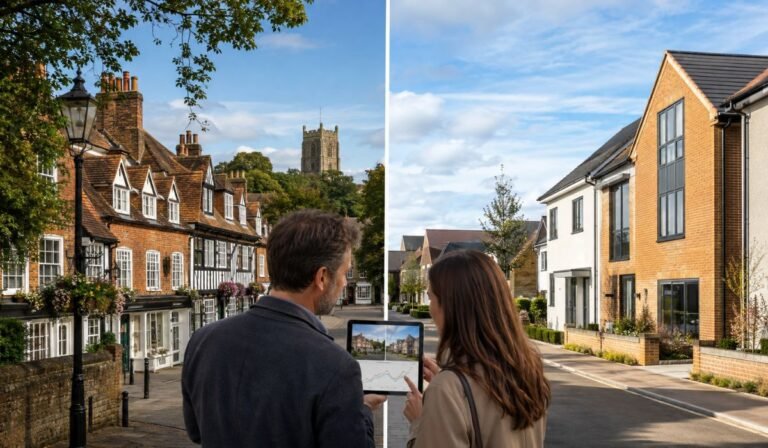
This is one of the questions we get asked more than almost anything else. Buyers walk into a viewing on the High Street, fall in love with the exposed beams and the canal view, then go and see something out towards Shootersway and start doing the maths in their head. Both sides of town have a strong case, but they suit very different people and reliable estate agents in Berkhamsted for buyers will usually tell you the same thing: it comes down to what you’re actually prioritising day to day, not just what looks nicest on a Sunday afternoon walk.
The Old Town Has a Pull That’s Hard to Ignore
Berkhamsted’s Old Town and the conservation area around it have real history behind them. There are medieval roots here, old coaching inns that have been standing for centuries, and rows of Victorian terraces running along the canal. Walk down the High Street on a Saturday morning and it’s busy — proper independent shops, small cafes, the Town Hall sitting right in the middle of it all. You can do your whole week’s errands on foot if you live here, which a lot of buyers genuinely value.
That charm comes at a cost though. Literally. Price per square foot in the conservation area is noticeably higher than almost anywhere else in town. The properties themselves also tend to be smaller than people expect — period cottages weren’t built with modern storage or open-plan living in mind, so you’re often paying a premium for less actual space. Parking is another sticking point. Some of these streets have none at all, and resident’s permits don’t stretch as far as buyers hope.
There’s also the maintenance side, which doesn’t get talked about enough. Older buildings need looking after. Roofs, sash windows, damp in some of the canal-side terraces — none of it is necessarily a dealbreaker, but it’s an ongoing cost that buyers usually ask about once the excitement of the viewing wears off.
Newer Berkhamsted Plays a Different Game
Head up towards Shootersway and the higher ground around the edges of town, and the whole conversation changes. These homes were mostly built with families in mind — bigger footprints, proper driveways, garages, and layouts that actually work for modern life. Energy efficiency tends to be far better too, which matters more now than it did even five years ago given how heating costs have moved.
Getting in and out by car is much easier from up here. You’re closer to the road networks that lead out towards the motorway, which suits people who commute by car rather than train. We see this quite often with buyers relocating from London who still need to drive for work reasons, or families who’d rather load the car for the school run than navigate narrow historic streets.
The trade-off is distance. You’re further from the station and further from the High Street, so that walkable, everything-on-your-doorstep feeling isn’t really there in the same way. The architecture is more straightforward too — well built, practical, but without the character that draws people to the Old Town in the first place. Some buyers don’t mind that at all. Others find it’s the one thing that puts them off.
So Which One Actually Offers Better Value?
It depends on what you’re measuring. If value means space and modern practicality for your money, newer Berkhamsted usually wins. You get more square footage, easier parking, and lower ongoing maintenance for a similar budget. If value means character, walkability, and being close to everything without needing a car, the Old Town earns its premium, even if the numbers look steeper on paper.
What We’d Actually Tell A Buyer
Think about your daily routine before you think about the property itself. If you commute by train and like being able to walk to a decent coffee shop, the extra cost of the Old Town often works out fine over time, because you’re not running a second car or spending as much on petrol. If you need space for a growing family, work from home and need a proper office, or commute by road, the newer developments tend to make more practical sense.
Berkhamsted’s market has held up well across both areas over recent years, so neither choice is really a poor investment. It’s more a question of matching the area to how you actually live, rather than chasing the option that photographs best.
A Quick Word on Resale
This comes up less often, but it’s worth a mention. Old Town properties tend to attract a smaller, more specific pool of buyers — people who actively want a period home and are willing to accept the compromises that come with it. That can mean a slightly longer sale process, but the buyers who do come through are usually committed, because they’ve chosen the area on purpose.
Newer Berkhamsted appeals to a wider range of buyers by comparison, simply because family-friendly, practical homes suit more people’s circumstances. That doesn’t make one better than the other for resale, but it does mean the type of buyer you’re likely to attract, and how quickly, can differ quite a bit depending on which side of town you’re in. Worth factoring in if you think you might move again in five or ten years.
