
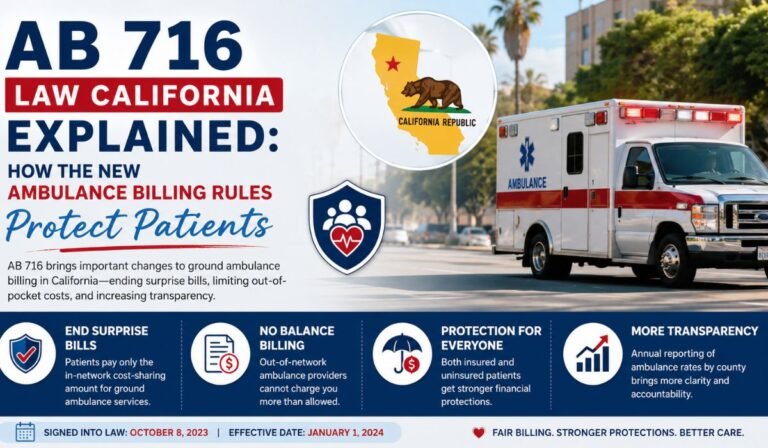
Medical emergencies happen without warning. During those stressful moments, most people focus on getting help as quickly as possible. Very few patients stop to think about whether the ambulance transporting them is part of their insurance network. Unfortunately, many Californians discovered that after receiving emergency care, they were left with unexpectedly large ambulance bills.
To address this problem, California passed AB 716 Law California, a landmark law designed to strengthen consumer protections and reduce surprise ambulance billing. The law changed how insurers, ambulance providers, and patients share financial responsibility for ground ambulance transportation. Since taking effect in 2024, AB 716 has become one of California’s most important healthcare consumer protection measures.
As healthcare costs continue to rise in 2026, understanding how this law works is more important than ever. Whether you have private insurance, receive emergency medical services regularly, or simply want to understand your healthcare rights, this guide explains everything you need to know about AB 716 Law California in simple and practical language.
Quick Bio Information
| Information | Details |
|---|---|
| Law Name | AB 716 |
| State | California |
| Full Focus | Ground Ambulance Transportation Billing |
| Legislative Session | 2023–2024 |
| Chapter Number | Chapter 454 |
| Signed Into Law | October 8, 2023 |
| Effective Date | January 1, 2024 |
| Main Purpose | Protect Patients From Surprise Ambulance Bills |
| Applies To | Ground Ambulance Services |
| Patient Protection | Limits Out-Of-Network Charges |
| Insurance Impact | Requires Insurer Reimbursement Rules |
| Collection Protection | Restricts Certain Collection Actions |
| Uninsured Patient Protection | Billing Caps Based On Government Rates |
| Oversight Agency | Emergency Medical Services Authority |
| Reporting Requirement | Annual Ambulance Rate Reporting |
| Primary Beneficiaries | California Patients |
| Coverage Type | Emergency Medical Transportation |
| Consumer Benefit | Lower Financial Risk |
| Transparency Goal | Public Ambulance Rate Information |
| Status In 2026 | Active California Law |
What Is AB 716 Law California?
AB 716 Law California is a state law that focuses on ground ambulance transportation billing and patient financial protection. The legislation was created to address a long-standing problem within healthcare: patients receiving large and unexpected bills after being transported by an ambulance that was not part of their health insurance network.
Unlike many healthcare services, ambulance transportation often occurs during emergencies. Patients typically cannot choose which ambulance company responds to their call. As a result, individuals frequently received services from providers outside their insurance network, even when they had comprehensive health coverage.
The law establishes new rules governing how health insurers and ambulance providers handle payments. Most importantly, it limits what insured patients can be charged when receiving covered ground ambulance services from noncontracting providers. This shift helps ensure that patients are not unfairly penalized for circumstances beyond their control.
Why California Created AB 716
Before AB 716 became law, ambulance billing created significant financial challenges for many residents. Emergency transportation costs could reach hundreds or even thousands of dollars. In many cases, insurance companies paid only part of the bill, leaving patients responsible for the remaining balance.
Consumer advocates argued that this system was unfair because patients had little or no ability to select an in-network ambulance provider during an emergency. A person suffering a heart attack, stroke, serious injury, or other medical crisis cannot realistically compare ambulance networks before seeking help.
Lawmakers recognized that emergency medical transportation differs from many other healthcare services. Because patient choice is limited during emergencies, traditional network rules often failed to protect consumers. AB 716 was introduced to create a fairer system that balances patient protection with provider reimbursement.
How Ambulance Billing Worked Before The Law
Understanding the importance of AB 716 requires looking at how ambulance billing worked previously. When an ambulance transported a patient, the provider billed the patient’s insurance company. If the ambulance company did not have a contract with the insurer, disagreements often occurred regarding payment amounts.
The insurer might pay only a portion of the requested charge. The ambulance provider could then bill the patient for the difference between its full charge and the insurer’s payment. This practice became known as balance billing.
Many patients were shocked to receive large invoices weeks or months after their emergency transport. Some individuals believed their insurance would cover the service fully, only to discover substantial out-of-pocket expenses. This created confusion, financial hardship, and frustration throughout the healthcare system.
The Biggest Changes Introduced By AB 716
The most significant achievement of AB 716 Law California is its focus on protecting patients from excessive financial responsibility. Instead of leaving consumers caught between insurers and ambulance providers, the law establishes clearer payment rules.
Under the new framework, insured patients receiving covered services from noncontracting ground ambulance providers generally cannot be charged more than the in-network cost-sharing amount. This means patients are treated similarly whether the ambulance provider is in-network or out-of-network.
The legislation also shifts more responsibility to insurers and providers to resolve payment differences directly. Rather than involving patients in reimbursement disputes, the law encourages healthcare organizations to work out payment arrangements among themselves.
Protection Against Surprise Ambulance Bills
One of the most widely discussed features of AB 716 is its protection against surprise ambulance bills. Surprise billing occurs when patients receive unexpected charges after obtaining medical services from providers outside their insurance network.
Ground ambulance transportation has historically been one of the most common sources of surprise medical bills. Because emergency transportation often happens without prior planning, patients frequently had no opportunity to verify network participation.
AB 716 significantly reduces this risk. Patients who receive covered ambulance services generally pay only the amount they would owe if the provider were part of their network. This protection creates greater predictability and allows families to focus on recovery rather than unexpected medical debt.
New Rules For Out-Of-Network Ground Ambulance Services
The law specifically addresses noncontracting ground ambulance providers. These are ambulance companies that do not have a negotiated contract with a patient’s health insurer.
Under AB 716, patient cost-sharing is limited to the same amount that would apply for an in-network provider. Depending on the insurance plan, this may involve a deductible, copayment, or coinsurance amount.
This change provides substantial relief for consumers. Instead of facing potentially unlimited balance billing exposure, patients now have a clearer understanding of their financial obligations. The law effectively creates a shield between patients and many of the billing disputes that previously occurred.
How AB 716 Affects Health Insurance Companies
Health insurers play a major role in the new system established by AB 716. The law requires insurers to make payments directly to noncontracting ambulance providers according to specific standards established under California law.
This approach helps ensure that providers receive compensation while preventing patients from becoming responsible for disputed balances. The insurer pays its share, while the patient’s responsibility remains limited to applicable in-network cost-sharing requirements.
Insurance companies have had to update billing procedures, reimbursement practices, and claims processing systems to comply with the law. While implementation required operational adjustments, the result is a more consumer-friendly billing process that better protects policyholders.
Protections For Uninsured And Self-Pay Patients
While much of the discussion surrounding AB 716 focuses on insured individuals, the law also provides important protections for uninsured and self-pay patients. Historically, people without health insurance often faced the highest ambulance bills because they lacked the negotiating power that insurance companies possess.
AB 716 helps address this issue by limiting what certain ground ambulance providers can charge uninsured or self-pay patients. In many situations, providers cannot bill these patients more than the applicable Medicare fee-for-service amount or Medi-Cal fee-for-service amount, whichever is greater. This creates a meaningful safeguard against excessive charges and helps make emergency transportation more affordable.
For families already dealing with medical emergencies, these protections can reduce financial stress and prevent medical debt from becoming overwhelming. As healthcare costs remain a concern in 2026, these provisions continue to play an important role in protecting vulnerable patients.
Can Ambulance Providers Still Send Bills To Collections?
One of the most common questions people ask about AB 716 Law California involves debt collection. Many patients worry that if they dispute a bill, it could eventually damage their credit or lead to collection actions.
The law includes important restrictions designed to prevent patients from being pursued for amounts they do not legally owe. When a patient receives covered services from a noncontracting ground ambulance provider, the provider cannot seek collection of amounts beyond the patient’s allowed in-network cost-sharing obligation.
This means patients should not face collection efforts for prohibited balance-billed amounts. If a consumer believes an ambulance provider is seeking payment that violates AB 716, it is important to contact the insurer, provider, or relevant regulatory agency to review the situation. Understanding these rights can help patients respond confidently if billing problems arise.
The Role Of The Emergency Medical Services Authority
AB 716 does more than regulate billing. It also increases transparency within California’s emergency medical transportation system. The Emergency Medical Services Authority, often referred to as EMSA, plays a key role in carrying out these responsibilities.
EMSA coordinates many statewide emergency medical services activities and serves as an important source of information regarding ambulance operations and healthcare transportation trends. Under AB 716, the agency has additional reporting obligations that help lawmakers, healthcare organizations, and the public better understand ambulance pricing throughout California.
These reporting requirements reflect a broader effort to improve transparency and support informed policymaking in the healthcare sector.
New Reporting Requirements Under AB 716
One of the lesser-known but highly important provisions of AB 716 requires annual reporting of maximum allowable ground ambulance transportation rates across California counties. EMSA must collect and publish information showing how ambulance rates vary throughout the state.
These reports help identify pricing trends and regional differences. They also provide valuable insight into how ambulance transportation costs change over time. Policymakers can use this information when evaluating future healthcare reforms and emergency transportation policies.
For consumers, increased transparency can improve public understanding of ambulance pricing and support efforts to create a more accountable healthcare system. While most patients never compare ambulance rates during an emergency, public reporting still contributes to long-term policy improvements.
Who Benefits Most From AB 716?
The primary beneficiaries of AB 716 Law California are patients and families who rely on emergency medical transportation services. Insured individuals now have stronger protections against unexpected bills, while uninsured patients benefit from important billing limitations.
Families facing medical emergencies gain peace of mind knowing that a sudden ambulance ride is less likely to result in overwhelming financial consequences. This can be particularly valuable for people living on fixed incomes or those already managing healthcare expenses.
Healthcare consumers are not the only beneficiaries. Greater billing clarity can also reduce disputes between patients, providers, and insurers. Regulators gain access to better data, while policymakers receive information that may help improve future healthcare legislation.
How The Law Changes The Patient Experience
One of the most practical effects of AB 716 is the way it changes the patient experience after an emergency. Before the law, many patients were surprised by ambulance invoices arriving long after their medical event. The uncertainty surrounding payment obligations often created confusion and anxiety.
Today, patients generally have a clearer understanding of what they owe. Instead of being responsible for potentially large out-of-network charges, they typically pay the same cost-sharing amount that would apply if the ambulance provider were in-network.
This shift allows patients to focus more on recovery and less on financial uncertainty. While healthcare billing remains complex, AB 716 removes one of the most common sources of surprise expenses in emergency care.
Potential Challenges And Criticisms
Like many healthcare reforms, AB 716 has generated discussion among various stakeholders. Some ambulance providers have expressed concerns regarding reimbursement levels and the financial impact of billing restrictions.
Emergency medical transportation is an expensive service that requires trained personnel, specialized vehicles, advanced medical equipment, and around-the-clock availability. Some providers argue that payment limitations could affect revenue and create operational challenges.
Supporters of the law, however, contend that patient protections must remain a priority. They argue that consumers should not bear the burden of payment disputes between insurers and providers. The ongoing conversation highlights the challenge of balancing fair compensation for ambulance services with affordable healthcare for patients.
What California Residents Should Know In 2026
As of 2026, AB 716 remains an important part of California’s healthcare landscape. Residents should understand that the law primarily applies to ground ambulance transportation and is designed to protect patients from many forms of surprise billing.
Consumers should still review their health insurance benefits and understand their plan’s cost-sharing requirements. Knowing the amount of your deductible, copayment, or coinsurance can help you better understand potential costs after receiving emergency transportation services.
It is also wise to carefully review any ambulance bill you receive. If the charges appear inconsistent with your insurance coverage or seem unusually high, contacting your insurer for clarification may help identify potential billing errors.
Why AB 716 Matters For The Future Of Healthcare
AB 716 represents part of a larger movement toward stronger healthcare consumer protections. Across the United States, lawmakers have increasingly focused on surprise medical billing and the financial burden unexpected healthcare costs place on families.
California’s approach to ground ambulance billing demonstrates how states can address specific gaps in patient protection. While federal laws have addressed many forms of surprise medical billing, ground ambulance transportation has often required separate state-level solutions.
As healthcare policy continues to evolve, AB 716 may serve as a model for future reforms that prioritize fairness, transparency, and patient-centered care. Its emphasis on protecting consumers while maintaining access to emergency medical services reflects broader trends in modern healthcare regulation.
Final Thoughts
AB 716 Law California has significantly changed the way ground ambulance billing works throughout the state. By limiting patient responsibility for out-of-network ambulance services, restricting balance billing practices, and creating stronger protections for uninsured individuals, the law addresses a problem that affected thousands of Californians.
The legislation recognizes an important reality: during a medical emergency, patients rarely have the ability to choose their ambulance provider. Because of this, they should not face excessive financial penalties for circumstances beyond their control.
As California continues to refine its healthcare system in 2026 and beyond, AB 716 stands as an important example of consumer-focused legislation. For patients, families, and healthcare advocates, the law provides valuable protections that make emergency medical transportation more predictable, transparent, and fair.
FAQs About AB 716 Law California
What Is AB 716 Law California?
AB 716 Law California is a state law that protects patients from many surprise ground ambulance bills. It limits what insured patients can be charged when they receive covered services from out-of-network ground ambulance providers and establishes new payment rules for insurers and providers.
When Did AB 716 Take Effect?
The law was signed on October 8, 2023, and most of its major insurance-related provisions became effective on January 1, 2024. These protections remain in place in 2026.
Does AB 716 Eliminate All Ambulance Bills?
No. Patients may still be responsible for normal in-network cost-sharing amounts such as deductibles, copayments, and coinsurance. The law mainly limits additional out-of-network charges that previously created surprise bills.
Does The Law Apply To Air Ambulance Services?
AB 716 primarily focuses on ground ambulance transportation. Air ambulance services are governed by different rules and may involve separate federal and state regulations.
How Does AB 716 Help Uninsured Patients?
The law includes billing protections that generally limit what uninsured or self-pay patients can be charged. In many situations, charges cannot exceed applicable Medicare or Medi-Cal fee-for-service amounts, whichever is higher.
Can An Ambulance Provider Still Balance Bill Me?
For covered services addressed by AB 716, noncontracting ground ambulance providers generally cannot require patients to pay more than the applicable in-network cost-sharing amount. This significantly reduces balance billing exposure.
What Should I Do If I Receive A Bill That Seems Wrong?
Review the bill carefully and compare it with your insurance explanation of benefits. If something appears incorrect, contact your insurance company and the ambulance provider for clarification. You may also seek assistance from California healthcare regulators if necessary.
Why Is AB 716 Considered Important?
The law addresses a long-standing healthcare problem by protecting patients from unexpected ambulance bills. It improves financial transparency, strengthens consumer rights, and creates a fairer billing system for emergency medical transportation.
Recommended For You: Tamil Movie Download Guide: How Fans Find The Latest Tamil Films Online
