
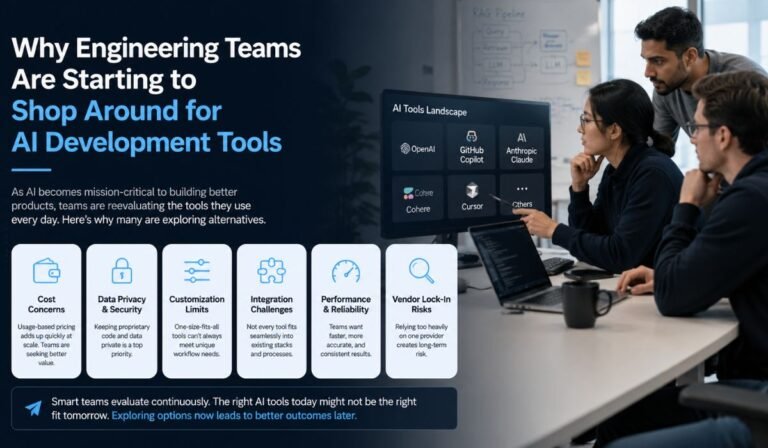
For a while, the AI coding assistant market felt like it had settled. A few dominant tools emerged, teams picked one, and that was more or less the conversation. That’s changed. More engineering teams are actively evaluating new options, revisiting decisions they made a year or two ago, and in some cases rebuilding their tooling stack from scratch.
The reasons are more varied than you might expect.
The First Wave of Adoption Revealed Real Gaps
Early adoption of AI coding tools happened fast, and in a lot of cases it happened without much evaluation. A tool got buzz, developers started using it individually, and eventually the organization just formalized what was already happening. That’s not a criticism, it’s just how these things tend to go when a new category moves quickly.
The problem is that informal adoption doesn’t surface the right questions. Teams are now a year or two into using these tools and they have actual data. Which tasks does the tool genuinely help with? Where does it slow things down? How does it perform on their specific stack, their specific codebase, their specific team size?
Answers to those questions don’t always match the original pitch. And when they don’t, teams start looking around.
Cost Has Become a Real Variable
In the early days, a lot of teams were on free tiers or early pricing that didn’t reflect what vendors would eventually charge at scale. That pricing has normalized now, and for larger engineering teams, the per-seat cost of AI tooling is a line item that someone in finance is paying attention to.
That scrutiny is pushing teams to ask whether they’re getting proportional value. Sometimes the answer is yes. Sometimes it isn’t, and that gap creates room for alternatives to make a case. The market has matured enough that alternatives to AI coding assistants have emerged across different price points, with different trade-offs around capability, privacy, and integration depth. Teams that weren’t shopping before are shopping now.
Privacy and Data Handling Has Moved Up the Priority List
This was an afterthought for a lot of teams initially. It isn’t anymore. Security reviews, enterprise compliance requirements, and a few high-profile conversations about what AI vendors actually do with code have pushed data handling to the front of the evaluation checklist.
Some teams discovered, later than they’d like to admit, that their existing tool was sending proprietary code to external servers in ways they hadn’t fully understood. Others are operating in regulated industries where that kind of data exposure creates real legal exposure. Either way, the question of where your code goes has become a standard part of the vendor conversation in a way it wasn’t two years ago.
The Tooling Itself Has Gotten More Specialized
The early AI coding assistants were fairly general purpose. They worked across languages, across frameworks, across different types of tasks. That generality was part of the appeal. It was also a limitation, because general-purpose tools don’t always perform as well as purpose-built ones.
What’s emerged since then is a more specialized market. Tools designed specifically for certain languages, for certain team sizes, for certain workflow contexts like code review or documentation rather than generation. Some are built around a particular model, others let you swap the underlying model depending on the task.
For engineering teams with a well-defined stack and clear use cases, a more specialized tool often outperforms a general one. The catch is that you have to know your use cases clearly enough to pick the right specialization. Teams that skipped that analysis early are doing it now.
Dissatisfaction Is a Normal Part of Market Maturation
It’s worth saying that a lot of this exploration is healthy and expected. Any category that moves as fast as AI development tooling is going to see teams revise their choices as the options improve and their own understanding deepens. The teams exploring alternatives aren’t necessarily doing something wrong. They’re responding to new information.
What tends to separate teams that handle this well from those that don’t is the quality of their evaluation process. Switching tools has a cost. Doing it based on a demo or a competitor’s blog post usually leads to the same situation two years later. The teams getting this right are building actual evaluation criteria, running real trials on representative work, and making decisions they can defend on specifics rather than sentiment.
That rigor takes time. It’s worth it.
