
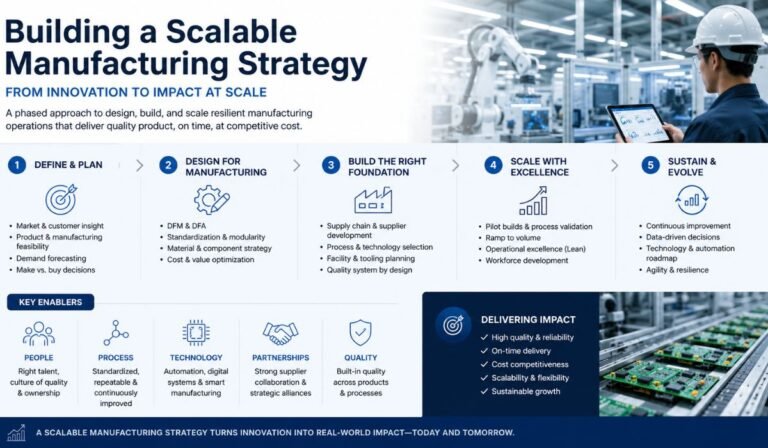
Scaling hardware manufacturing is one of the most complex challenges a product company can face. Unlike software, physical products involve supply chains, tooling costs, quality control, and production timelines that can make or break a business. The difference between a hardware startup that thrives and one that stalls often comes down to whether scalability was built into the strategy from day one—not bolted on after the fact.
This guide breaks down the core pillars of a scalable manufacturing strategy, from early design decisions to mass production, so you can grow with confidence.
Understanding Scalability in Hardware Manufacturing
What Does Scalable Manufacturing Actually Mean?
Scalable manufacturing means building a production system that can grow in volume, speed, and complexity without requiring a complete overhaul every time demand increases. For hardware products, this goes beyond simply ordering more parts. It involves designing products that are easy to produce at scale, building supplier relationships that can flex with your needs, and putting quality systems in place that hold up under pressure.
The goal is not to anticipate every future challenge—it’s to create a foundation resilient enough to adapt when those challenges arrive.
Why Scalability Matters for Hardware Products
Hardware companies face a unique set of pressures. Production costs tend to decrease significantly with volume, but reaching that volume requires upfront investment in processes, tooling, and supplier partnerships. Companies that neglect scalability early often find themselves scrambling when demand spikes—facing supply shortages, quality issues, or production bottlenecks that erode margins and damage customer trust.
Planning for scale from the start reduces costly redesigns, shortens lead times, and makes it far easier to attract manufacturing partners and investors.
Key Pillars of a Scalable Manufacturing Strategy
Design for Manufacturability and Assembly
Design for Manufacturability (DFM) and Design for Assembly (DFA) are two disciplines that ensure your product is built to be manufactured efficiently—not just engineered to function correctly. DFM focuses on simplifying components and material choices to reduce production costs. DFA goes a step further, optimizing how parts come together on the assembly line to minimize labor and error.
For electronics-heavy products, this means working closely with PCB assembly services early in the design phase. Bringing in assembly expertise before designs are finalized helps identify potential production issues before they become expensive problems. Small decisions—component placement, board layer count, connector selection—can have an outsized impact on assembly speed and yield rates at scale.
The earlier DFM and DFA principles are applied, the cheaper and faster it becomes to manufacture at higher volumes.
Supplier Management and Diversification
A single-source supplier strategy might work during prototyping, but it becomes a critical vulnerability at scale. Disruptions—whether from geopolitical events, raw material shortages, or factory delays—can halt production entirely if there’s no alternative supply channel in place.
A resilient supplier strategy involves:
- Qualifying multiple suppliersfor key components before volume production begins
- Building long-term relationshipsthat give you negotiating leverage and priority access during high-demand periods
- Monitoring supplier performancethrough lead time tracking, defect rates, and communication responsiveness
Diversification doesn’t mean splitting every order down the middle. It means having qualified alternatives ready to activate when your primary source can’t deliver.
Automation and Process Optimization
Labor-intensive manual processes are one of the biggest obstacles to scaling efficiently. Automation—where it makes economic sense—reduces per-unit costs, improves consistency, and frees up skilled workers for higher-value tasks.
Process optimization starts with mapping every step of production and identifying where delays, defects, or waste occur most frequently. Even before investing in automated equipment, lean manufacturing principles can dramatically improve throughput by eliminating unnecessary steps and standardizing workflows.
As volume grows, consider phased automation: start with the highest-volume or highest-error processes, measure the impact, and expand from there.
Navigating Production Stages for Growth
Prototyping and Iteration
Prototyping is where assumptions get tested against reality. The goal at this stage is speed and learning—producing functional units quickly, identifying failures, and iterating before tooling costs lock in design decisions.
Keep prototype runs small and focused. Each iteration should answer a specific question about performance, assembly, or user experience. Document every change and the reasoning behind it. This creates a knowledge base that accelerates future iterations and supports smoother handoffs to contract manufacturers.
Pilot Production and Testing
Pilot production bridges the gap between prototype and mass manufacturing. A pilot run—typically 50 to 500 units depending on product complexity—stress-tests the production process under semi-realistic conditions. It reveals tooling issues, assembly inefficiencies, and quality problems that don’t show up at prototype scale.
This stage is also when you should validate supplier reliability, packaging specifications, and testing protocols. Rushing through pilot production to hit a launch date is a common and costly mistake. The time invested here pays dividends in reduced defects and smoother mass production ramp-ups.
Mass Production and Expansion
Once pilot production confirms your process is stable, scaling to full production requires close coordination between your engineering, operations, and supplier teams. Establish clear production targets, lead time expectations, and escalation protocols before ramping up.
Plan capacity in stages rather than committing to maximum volume upfront. This reduces financial exposure while giving you time to identify and resolve bottlenecks as volume increases. Maintain close communication with your manufacturing partners throughout the ramp—issues caught early cost far less to fix than those discovered after thousands of units have shipped.
Financial Considerations and Investment
Cost Analysis and Budgeting
Accurate cost modeling is essential for sustainable scaling. This means going beyond the bill of materials (BOM) to include tooling amortization, quality testing, logistics, warehousing, and the cost of defects and returns.
Unit economics tend to improve significantly with volume—but only if the underlying production process is efficient. A poorly optimized process scaled up simply produces more waste at a higher cost. Before committing to volume increases, ensure your cost model reflects the full picture, not just component prices.
Funding Growth and Infrastructure
Scaling manufacturing often requires capital investment in tooling, equipment, and inventory before revenue catches up. Hardware companies should map out these capital requirements well in advance and explore appropriate funding mechanisms—whether through revenue-based financing, manufacturing partnerships, or equity investment.
Investors and lending partners will want to see a credible production plan, realistic cost projections, and evidence of manufacturing feasibility. Having a well-documented scalable strategy in place significantly strengthens that case.
Conclusion
Scaling hardware manufacturing demands careful planning, sound design, and operational discipline. Companies that invest in DFM, supplier diversification, and staged production are better positioned to grow. Financial clarity and risk management are key. Building scalability from the start separates successful companies from those that struggle to keep up.
