
The best technology upgrades are not always the most dramatic. Sometimes they are the ones that quietly remove a daily irritation. For many phone users, that irritation is not having no charger at all. It is having the wrong kind of charger at the wrong moment: too bulky to carry every day, too slow to be useful, too cable-heavy for quick top-ups, or too awkward to use while walking between meetings, trains and errands.
That is why the slim powerbank has become one of the more interesting accessories in the everyday carry space. It is not trying to replace a high-capacity battery pack for camping trips, festivals or long-haul travel. Instead, it solves a more common problem: how to keep a phone alive during an ordinary day without carrying a brick.
In the UK, where many people move between home, commute, office, café, gym, train and social plans in the same day, portable charging is no longer just for emergencies. It has become part of the daily rhythm. The phone handles train tickets, banking, maps, messages, payments, authentication, music, calendars and camera use. When the battery falls into the red, the whole day starts to feel less flexible.
A slim powerbank is designed for exactly that moment. It gives users enough backup power to stay mobile, without forcing them to redesign their bag around a large charging accessory.
The shift from “big battery” to “always with you”
For years, the portable charging market was dominated by a simple idea: more capacity is better. That still makes sense in some contexts. A large power bank is useful for camping, long travel days, remote work away from mains power or charging multiple devices. But everyday carry follows a different rule: the best charger is the one you actually bring.
A large power bank may look reassuring on a spec sheet, but if it is too heavy for a jacket pocket or too bulky for a small crossbody bag, it often stays at home. A slim powerbank takes the opposite approach. It prioritises portability, shape and convenience. It is meant to be carried casually, not packed deliberately.
That difference matters. Backup power only helps if it is available at the moment the battery runs low. A compact design makes that more likely.
Why phones drain faster on ordinary days
Modern phones are efficient, but modern usage is relentless. Even a normal weekday can be surprisingly demanding. A user might start with streaming music on the commute, check rail updates, use maps, answer messages, join a video call, authenticate work logins, pay for lunch, take photos, use mobile data and then rely on the same phone for travel home.
None of these tasks is unusual. Together, they drain battery steadily. Poor signal on trains or in busy urban areas can make things worse, as the phone works harder to stay connected.
This is where a slim powerbank becomes less about emergency rescue and more about daily resilience. It helps users avoid the mid-afternoon calculation of whether they should stop using their phone to preserve the last 15 percent.
Magnetic charging changed the behaviour
One reason slim power banks are becoming more attractive is the rise of magnetic wireless charging for compatible phones. Traditional power banks are still useful, but they usually require a cable. That is fine at a desk or on a plane, but less convenient when standing on a train platform, walking between appointments or trying to use the phone while it charges.
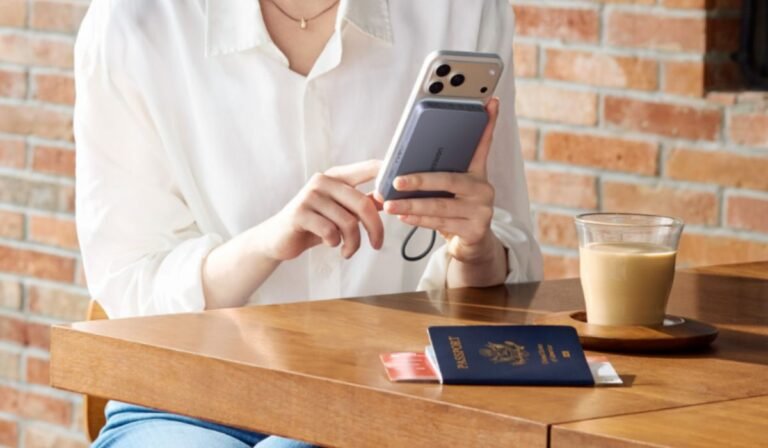
Magnetic slim power banks change the behaviour. Attach the charger, keep using the phone, and top up without a loose cable between hand and bag. For iPhone users especially, that style of charging feels more natural for quick everyday use.
This is where products such as ugreen magflow air fit naturally into the conversation. UGREEN’s UK range lists MagFlow Air Magnetic Power Bank models with Qi2 15W wireless charging, including 5000mAh and 10000mAh options, positioning them around slim portable power rather than oversized backup batteries.
The pocket test matters
A good everyday charging accessory has to pass what might be called the pocket test. Can it fit in a coat pocket without feeling like a second phone? Can it sit behind a handset without making the whole setup awkward? Can it go into a small bag without taking the space meant for keys, wallet or earbuds?
That physical experience matters as much as capacity. A slim powerbank has to be comfortable enough to carry daily, otherwise it becomes another accessory people only pack when they already expect trouble.
The best designs understand that people do not always want to carry a dedicated tech pouch. Sometimes they just want a simple battery that can live in a pocket and be ready when needed.
Everyday use cases are more common than extreme ones
Marketing for power banks often focuses on dramatic scenarios: remote travel, long flights, outdoor trips, festivals. Those situations are real, but the everyday cases are more frequent.
A phone drops to 20 percent before a dinner booking. A delayed train turns a short commute into a two-hour journey. A parent needs enough battery for school messages and maps. A student spends the day between campus buildings. A freelancer works from a café longer than expected. A shopper uses maps, payments and messaging through an afternoon in town.
These are not extreme power needs. They are ordinary modern-life needs. A slim powerbank is appealing because it matches the scale of the problem. It gives enough extra confidence without asking the user to carry expedition-level capacity.
The role of the UGREEN Nexode MagFlow Air Editions
The phrase UGREEN nexode magflow air editions reflects a broader product idea: compact charging for users who want power without bulk. UGREEN UK describes the Nexode & MagFlow Air Editions as a line featuring compact chargers and power banks in a clean, travel-ready design.
That matters because portable charging is no longer a single-product decision. Many users now think in systems. A slim magnetic power bank handles movement. A compact wall charger handles faster top-ups at home, in the office or in a hotel. A short USB-C cable sits in the bag for backup. Together, these accessories create a lighter, more flexible charging setup.
The goal is not to carry more. It is to carry better.
Slim does not mean careless
A smaller power bank still needs to be chosen carefully. Build quality, charging efficiency, thermal management, magnet strength, cable options and device compatibility all matter. A slim design is only useful if the charger remains stable in real use and does not become frustrating after a week.
For magnetic models, attachment strength and hand feel are especially important. The charger should stay aligned, feel manageable behind the phone and not make normal use awkward. For wired backup charging, USB-C support and sensible output options remain valuable.
A slim powerbank should feel like part of the phone routine, not like an object fighting against it.
Who benefits most?
The most obvious audience is the heavy phone user who does not want to carry a large battery pack every day. Commuters, students, hybrid workers, city travellers, parents, content creators and anyone who relies on digital tickets or contactless payments will understand the appeal quickly.
It is also useful for people who prefer smaller bags. A compact charging setup suits crossbody bags, handbags, work satchels and jacket pockets far better than older high-capacity packs. For many users, that is the real difference between owning backup power and actually having it available.
Conclusion
The slim powerbank is not about chasing the biggest number. It is about fitting portable power into the way people actually move through the day. Phones have become essential to travel, work, payments, communication and photography, but battery anxiety still interrupts that experience far too often.
A slim magnetic charger such as ugreen magflow air points towards a more convenient category of everyday power: light enough to carry, simple enough to use, and useful enough to become part of the daily kit. Within the wider UGREEN nexode magflow air editions, the idea is clear: charging accessories should be compact, practical and ready for movement.
For UK users, that may be the most important shift. The future of portable charging is not only about bigger batteries. It is about power that is slim enough to come with you every day.
