
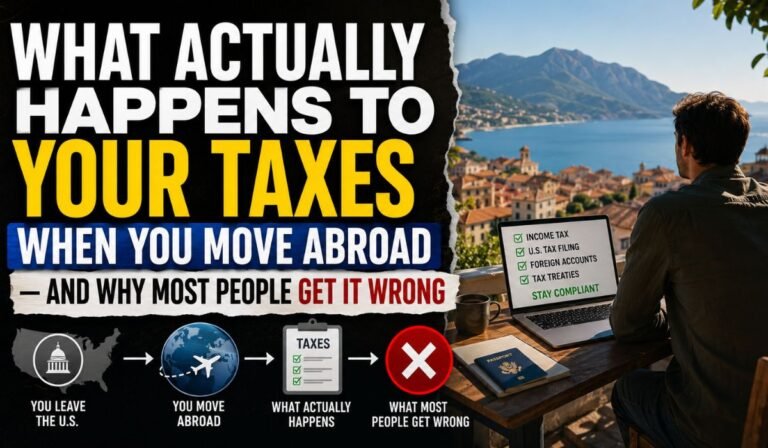
Every year, millions of people around the world pack their bags and relocate to another country — chasing better salaries, global career opportunities, or simply a fresh start somewhere new. And every year, a significant number of them make the same costly assumption: that once you’ve left your home country, your tax obligations go with you.
They don’t.
Whether you’re an Indian professional landing in the US, a UK citizen settling into Singapore, or an American building a life in Germany, moving abroad doesn’t simplify your tax situation. In most cases, it multiplies it. You now have obligations in two countries — and the rules governing both can be far more complex, and far less forgiving, than you were ever told before you boarded the plane.
Here’s what you actually need to know.
Your Home Country Doesn’t Forget You Exist
One of the most surprising discoveries for people who’ve recently relocated is that their country of citizenship or origin can still have a claim on their income — even from thousands of miles away.
The United States takes this to an extreme: it’s one of only two countries in the world that taxes based on citizenship rather than residency. That means an American living in Tokyo, Toronto, or Tenerife still owes the IRS a tax return every single year, regardless of where their income is earned or where they’ve built their life. But the US isn’t alone in expecting departing citizens to meet certain obligations. Many countries require exit filings, tax clearance certificates, or continued reporting for several years after a person leaves.
For Indians moving abroad, the relevant concept is residential status as defined under the Income Tax Act. Once you’ve spent fewer than 182 days in India in a financial year, you typically qualify as a Non-Resident Indian (NRI) — and your tax obligations in India shift accordingly. Indian-sourced income remains taxable in India; foreign-earned income generally does not. But the transition is not automatic, and failing to correctly update your residential status — or to close or convert bank accounts appropriately — can create complications that take years to unravel.
The Country You Move To Has Its Own Set of Rules
Equally important — and often even more daunting — is the tax system of the country you’re moving into.
Every country has its own definition of tax residency, its own rules for what counts as taxable income, and its own deadlines, forms, and penalties. Some countries tax you from your first day of arrival. Others allow a grace period. Some tax your global income once you’re a resident; others only tax locally-sourced earnings.
For Americans specifically, the moment they establish residency in a foreign country, they must begin navigating a dual-compliance landscape. Their new host country taxes them as a resident. The US continues to tax them as a citizen. Understanding the full picture of what this means in practice — from filing deadlines to which income is exempt and which isn’t — is not something most people discover until they’re already dealing with the consequences of not knowing.
A comprehensive breakdown of exactly what American expats face when they relocate — covering filing requirements, foreign income exclusions, tax treaties, and strategies to avoid double taxation — is available in this detailed guide for Americans moving abroad. The specifics are US-focused, but the structural challenges mirror what any international professional will encounter when crossing tax borders.
Tax Treaties: Your Most Underused Advantage
If there’s a silver lining in all of this complexity, it’s tax treaties.
Most major economies have bilateral tax agreements designed to prevent the same income from being taxed twice — once by each country involved. India has Double Taxation Avoidance Agreements (DTAAs) with over 90 countries, including the US, UK, UAE, Singapore, Germany, and Australia. The US maintains its own network of treaties with dozens of nations.
These treaties can significantly reduce your tax burden — but only if you know they exist and understand how to apply them. Common benefits include reduced withholding tax rates on dividends, interest, and royalties; exemptions for certain categories of income; and provisions for determining which country gets primary taxing rights.
The catch? Treaty benefits are rarely applied automatically. In most cases, you have to actively claim them — which means knowing which form to file, which country to file it in, and which specific treaty provision applies to your situation. Many expats leave substantial money on the table simply because they didn’t know to ask the question.
The Paperwork Nobody Warned You About
Beyond the headline issue of where to pay tax, there’s an entire layer of compliance paperwork that catches internationally mobile professionals off guard.
For Americans, this includes the FBAR — a disclosure of all foreign bank accounts if the combined balance exceeds $10,000 at any point during the year — and Form 8938 under FATCA for foreign financial assets above certain thresholds. Neither form generates a tax bill by itself. Both can generate severe penalties if not filed.
For NRIs, the equivalent obligations include updating your KYC status with Indian banks and financial institutions, converting resident savings accounts to NRO accounts (as required under FEMA regulations), and correctly reporting any income repatriated from abroad. If you hold assets in India — property, mutual funds, fixed deposits — there are specific rules governing how income from those assets is taxed and how it can be moved across borders.
In both cases, the penalties for non-compliance are significant and in some instances automatic — meaning they’re triggered simply by the failure to file, regardless of whether any tax was actually owed.
The Questions to Ask Before You Leave
If you’re planning an international move — or you’ve recently relocated and haven’t yet sorted out your cross-border tax position — here are the most important questions to address early:
What is my residential status in both countries? Tax residency isn’t always where you live. Each country has its own rules, and in some cases, you can be resident in two countries simultaneously — triggering obligations in both.
Does a tax treaty apply to my situation? If your home and host countries have a DTAA, get familiar with its provisions. This can determine everything from how your salary is taxed to how your retirement savings are treated.
What reporting obligations exist beyond the tax return? In many countries, financial disclosure requirements exist separately from income tax filing — and the penalties for missing them can exceed the penalties for unpaid tax itself.
What happens to the financial accounts and investments I left behind? Foreign bank accounts, stock portfolios, provident funds, and property all have their own cross-border compliance rules. Ignoring them doesn’t make them go away.
Do I need a specialist? General tax preparers often lack the expertise to handle cross-border situations. An accountant who handles only domestic returns may not know what they don’t know. For anything involving two countries, specialist expat tax advice is almost always worth the cost.
The Takeaway
Moving abroad is one of the most exciting decisions a person can make. It’s also one of the most financially complex — not because of the cost of living in a new country, but because the financial and tax systems of two countries now apply to you simultaneously, often in ways that neither country makes particularly clear.
The professionals who navigate this successfully tend to share one trait: they asked the questions before the problems arrived. The ones who struggle are those who assumed that leaving a country would simplify their financial lives.
In virtually every case, it does the opposite. The key is knowing that going in.
This article is for general informational purposes only and does not constitute tax or legal advice. Readers should consult a qualified tax professional familiar with both their home country and host country regulations before making financial decisions.
