
Not all proxies are built the same. Two services can offer identical pricing and still deliver completely different results—one connecting seamlessly, the other getting flagged before the first request is complete.
Quality in residential proxies is not a marketing word. It is the distinction between a working tool and a waste of the budget tool.
What Makes a Residential Proxy “High Quality”?
Traffic routed using residential proxies is going to flow through real devices on real internet connections. This is a given. But the quality of those internet connections (how they were sourced), how they are maintained, and how the network is managed will determine everything about the performance in the real world.
Additionally, if the right proxy provider is not chosen correctly in advance, it could take weeks to troubleshoot the connection issues. The wrong network means blocked requests, unreliable uptime, and IP addresses that target sites already recognize and reject.
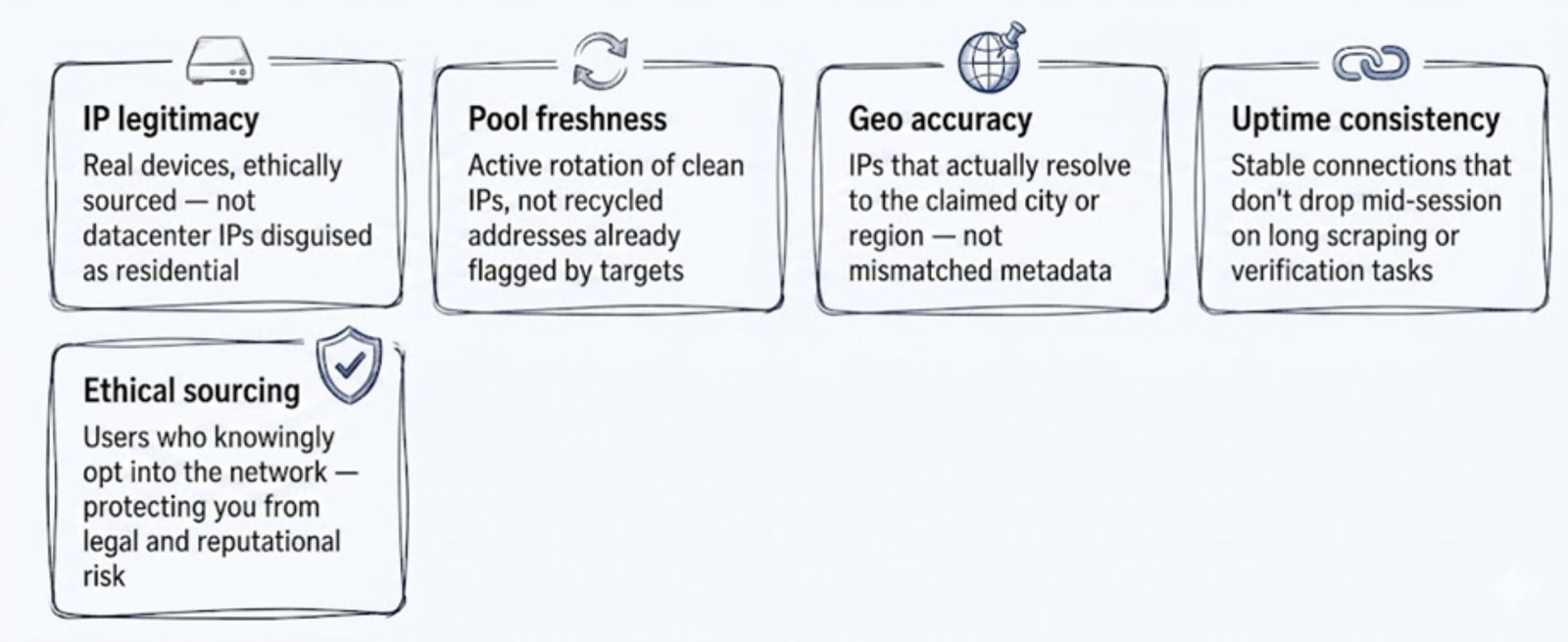
The Real Cost of Choosing a Low-Quality Network
Budget proxies look attractive until the first campaign fails. Low-quality networks cut corners in ways that are invisible at signup — and expensive in production.
Common consequences of poor proxy quality:
- Requests are blocked within seconds by anti-bot systems
- IPs flagged across multiple target sites simultaneously
- Session drops that corrupt data mid-collection
- Geo-targeting that places us in the wrong country entirely
- Sourced IPs that create compliance exposure for our business
The best residential proxy networks invest heavily in the infrastructure that prevents all of the above. That investment is what separates a usable tool from a liability.
High Quality vs. Low Quality — Side by Side
| Factor | High-Quality Network | Low-Quality Network |
| IP sourcing | Ethical, verified, opt-in | Unclear or reused sources |
| Block rates | Low, consistent success | High, frequent failures |
| Geo accuracy | Precise city & ISP-level targeting | Frequently incorrect locations |
| Session stability | Strong and reliable | Frequent drops and resets |
| IP freshness | Continuously refreshed pool | Stale, overused IPs |
| Compliance | Transparent and safe | Potential legal risks |
| Scalability | Performs under load | Breaks at higher volumes |
Why Evomi Stands Out on Network Quality
The Evomi quality network is built around infrastructure integrity rather than surface-level metrics like pool size alone. Where many services compete on price alone, it focuses on what actually determines success in real-world use cases.
When we choose it as our proxy provider, we are connected to a unique network. Each IP address in the pool has been sourced transparently, checked against fraud, verified as legitimate, and kept up to date through an active quality control process. This is important for all of us, whether proxies are being used for price intelligence, ad verification purposes, or larger‑scale data collection scenarios.
What sets Evomi Quality Network apart:
- Fully ethical IP sourcing with clear user consent at every node
- Continuous pool health monitoring to retire flagged addresses fast
- Precise city and ISP-level targeting with verified geo-metadata
- High session success rates across the most competitive target sites
- Transparent compliance posture—no legal grey areas in the sourcing chain
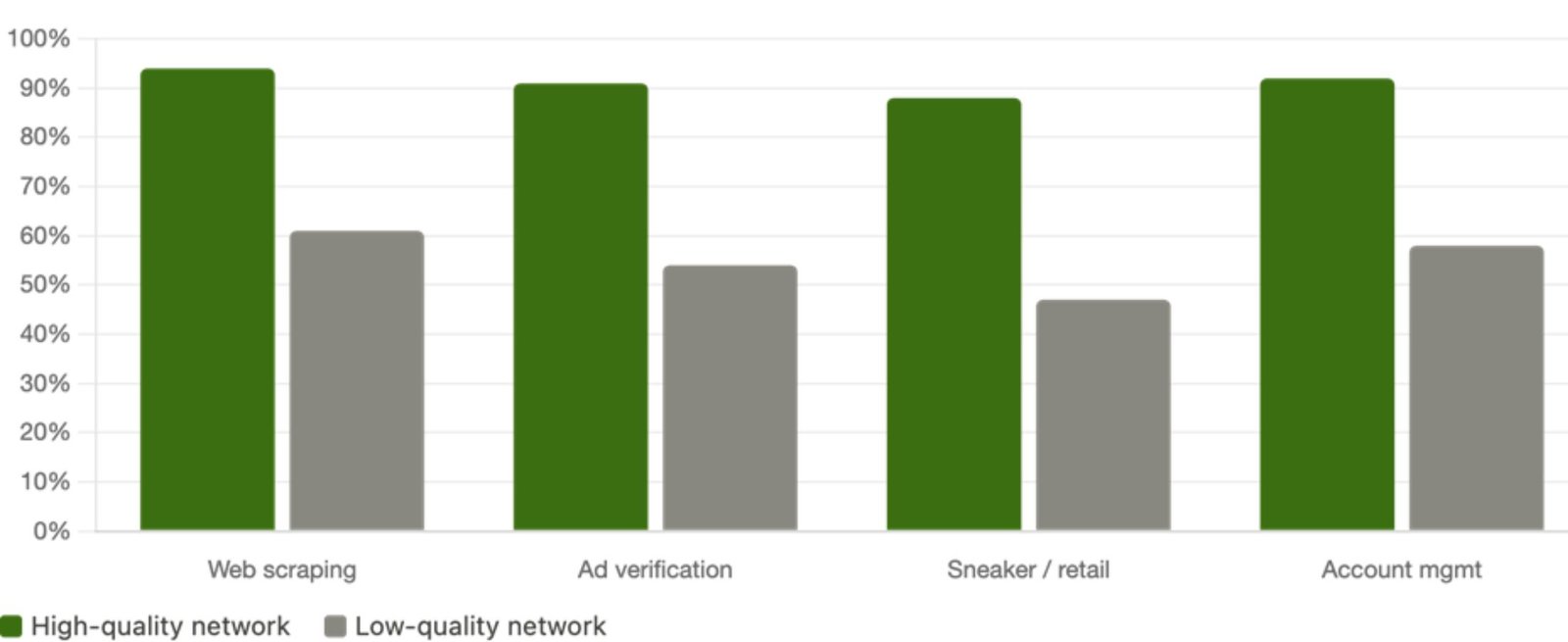
Use Case Performance—Where Quality Shows Most
FAQ
- How do residential proxies & datacenter proxies vary?
A residential proxy accesses an IP from an average house, from an average user who’s using a home device connected to their internet provider. Conversely, a datacenter proxy accesses an IP from a server-based resource, which is generally much easier for a target website to identify & block.
- Why do some residential proxies get blocked so easily?
Low-quality networks reuse the same IP addresses repeatedly across many users. Target sites recognize and blacklist these IPs over time. A fresh, well-maintained pool rotates addresses fast enough to stay ahead of detection.
- How do we know if a residential proxy network is ethically sourced?
Reputable providers like Evomi publish clear documentation on how IPs are sourced and confirm that device owners have opted in. Do not use networks that are unable to answer the question of how they sourced them- the legal and ethical risk is put on the end user.
- Which is the most optimal residential proxy that can be used to scrape in large volumes?
When doing high-volume work, consider pool size, session stability, and geo-accuracy more than price alone. Networks that maintain active quality controls will consistently outperform cheaper alternatives once we scale past a few thousand requests.
- Does paying more always mean better proxy quality?
Not automatically — but quality infrastructure has a real cost. Networks priced significantly below market rate almost always cut corners on sourcing, pool maintenance, or support. Value comes from transparent pricing matched to verifiable performance.
Summary
Quality in residential proxies is not a premium feature — it is the baseline requirement for anything that needs to work reliably at scale.
- Low-quality networks cost less upfront and more in failed tasks
- The best residential proxy networks invest in sourcing, not just pool size
- Ethical IP sourcing protects both performance and compliance
- Evomi quality network is built around these principles from the ground up
- Checking block rates and geo-accuracy before committing saves weeks of pain
The right network does not just connect us — it keeps us connected, stays clean under pressure, and scales without degrading. That is what quality actually means in this space.
