
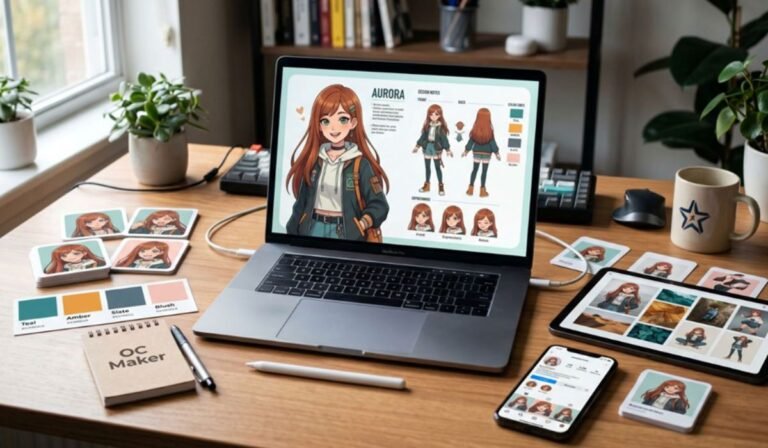
I used to think original characters belonged mostly to comics, anime fandoms, games, and roleplay communities. That has changed. More creators now use characters as a way to show up online without showing their real face.
That is the angle I wanted to explore in this OCMaker AI review. I was not just looking for pretty anime portraits. I wanted to see whether an OC maker could help build a usable character identity: something that works as an avatar, a brand face, a story seed, or a visual anchor for a creator who wants to stay private.
What I Looked For in This OCMaker AI Review
A normal image generator can create a nice portrait. That is useful, but it is not the same as building an original character.
For this review, I paid attention to a different set of questions. Could the tool help shape a character with a clear look? Could the result work as a profile image? Would the character feel reusable, or would it look like a random one-off AI image? Could a writer, streamer, Discord admin, or no-face creator take the output and build on it?
OCMaker AI is a platform for creating original characters, anime-style visuals, avatars, and character concept images. I judged it as a starting point for character identity, not as a replacement for professional illustration or long-term IP development.
That distinction is important. A character generator can help you see an idea. It cannot decide what your character means.
Why Original Characters Are Becoming Online Identity Tools
A lot of creators do not want to use their real face online. Some want privacy. Some are not comfortable being the center of the brand. Some run niche pages, story accounts, gaming channels, commentary pages, or community spaces where a human headshot feels out of place.
The usual alternatives are not always satisfying. A logo can feel too cold. A stock avatar can feel forgettable. A random profile picture may work for a week, then lose meaning.
An original character solves a different problem. It gives the creator a visual identity that can grow over time.
A good OC can become:
| Creator need | How an original character helps |
| Privacy | The creator can stay off-camera |
| Recognition | The same character can appear across platforms |
| Personality | The design can suggest mood, genre, or tone |
| Storytelling | The character can carry lore or themes |
| Branding | The OC can become a mascot or visual signature |
This is why I think OC tools are moving beyond fandom spaces. They are becoming part of creator branding.
Testing the Character Creation Workflow
The most useful part of OCMaker AI is that it gives users a way to start from identity rather than only from surface style. That matters because original characters need more than hair color and clothing.
When testing the workflow, I found it more helpful to begin with a role or personality. For example, “quiet sci-fi archivist,” “cozy fantasy shopkeeper,” “streetwear anime gamer,” or “soft-spoken virtual host” gives the tool more direction than simply asking for a beautiful character.
The output quality depends heavily on how specific the character idea is. Vague prompts tend to produce attractive but generic results. More grounded prompts create characters that feel easier to reuse.
The details I watched most closely were:
| Review point | What I checked |
| Silhouette | Can the character be recognized at small size? |
| Outfit | Does it support the character’s role? |
| Expression | Does it suggest personality? |
| Color palette | Could it work across a profile, banner, or card? |
| Style consistency | Does the character feel like one concept, not mixed ideas? |
The tool worked best when I treated it as a concept partner. I still had to make decisions.
From Avatar to Character System
The strongest use case for OCMaker AI is not making one profile picture. It is building the first piece of a character system.
A no-face creator might start with a headshot avatar, then expand the same character into a banner, a reaction image, a newsletter illustration, or a channel mascot. A fiction writer might use the character as a reference while drafting scenes. A gaming creator could turn the OC into a recurring identity for thumbnails and community posts.
That is the difference between an image and a character.
An image is posted once. A character can return.
For creators who are trying to become recognizable, that repeatability matters. People may forget a username, but they often remember a face, color scheme, or mascot. If the creator does not want to use their own face, an OC can fill that gap.
Where the AI Anime Generator Helps
The AI anime generator is more useful once the character direction already exists. I would not use it only to make a random anime portrait. I would use it to explore how the same character idea might look in different visual formats.
That could include:
- Profile avatars
- Character posters
- Social media images
- YouTube or TikTok cover visuals
- Story illustrations
- Community badges
- Concept art for a larger project
This is where anime style becomes more than decoration. It gives creators a flexible visual language. A character can feel soft, dramatic, futuristic, cozy, humorous, mysterious, or polished depending on the art direction.
The tool is especially useful for people who know the feeling they want but cannot draw it themselves.
What Worked Well
The biggest advantage of OCMaker AI is speed. It helps move a character from a vague idea to something visible.
That is valuable for creators who are still exploring their identity. You may not know whether your channel mascot should feel cute, serious, magical, cyberpunk, cozy, or rebellious until you see a few versions on screen.
The tool also lowers the entry barrier for people who are not artists. A writer can visualize a protagonist. A streamer can test avatar concepts. A Discord owner can create a community character. A small brand can explore mascot ideas before commissioning a final design.
For early-stage planning, that is useful.
What Still Needs Human Direction
OCMaker AI does not remove the need for character thinking. In fact, it makes that thinking more obvious.
The tool can generate visuals, but the user still needs to decide who the character is. What does the character want? What kind of audience should connect with them? Are they cute, serious, strange, calm, chaotic, elegant, or funny? What should stay consistent every time the character appears?
Without those answers, the results may look polished but empty.
I would also be careful with commercial use. Anyone building a serious brand, product mascot, VTuber identity, or long-term IP should check usage rights, originality, and platform rules. AI can be a strong draft tool, but final branding deserves a more careful review.
Who OCMaker AI Is Best For
I would recommend OCMaker AI most strongly for people who need a visual identity but are not ready to hire an illustrator or build a full brand system.
It fits:
| User type | Why it helps |
| No-face creators | Creates a recognizable identity without showing a real face |
| Fiction writers | Turns written characters into visual references |
| Anime-style avatar users | Helps explore profile images and character looks |
| Discord communities | Creates mascots or themed character visuals |
| YouTube and TikTok creators | Supports thumbnails, banners, and recurring identity |
| Early VTuber planners | Helps test character direction before deeper production |
| Small brands | Useful for mascot brainstorming |
It is less ideal for professional animation teams, strict character-sheet production, or commercial IP work that needs exact consistency from every angle. For those cases, it is better as an early concept tool than the final step.
The Best Way to Use It
The best results come from giving the tool a role, not just a look.
Instead of writing, “anime girl with blue hair,” I would write something more like: “a calm no-face creator mascot for a cozy tech review channel, soft blue-gray palette, simple hoodie, gentle expression, clean avatar framing.”
That kind of prompt gives the character a job. It also makes the result easier to judge.
The question becomes: does this character fit the creator identity?
That is a better question than: is this image pretty?
Final Verdict
OCMaker AI is worth trying if the goal is to turn a loose character idea into a usable visual direction. Its value is not just in generating anime-style art. Its stronger use is helping creators build a face for an online identity without using their real face.
I would not treat it as a complete branding solution. A lasting character still needs story, consistency, editing, and human judgment. But as a starting point for avatars, mascots, no-face creator branding, and original character exploration, it does the job well.
For creators who have an idea in their head but no way to draw it, that first visible version can be the hardest step. OCMaker AI makes that step much easier.
