
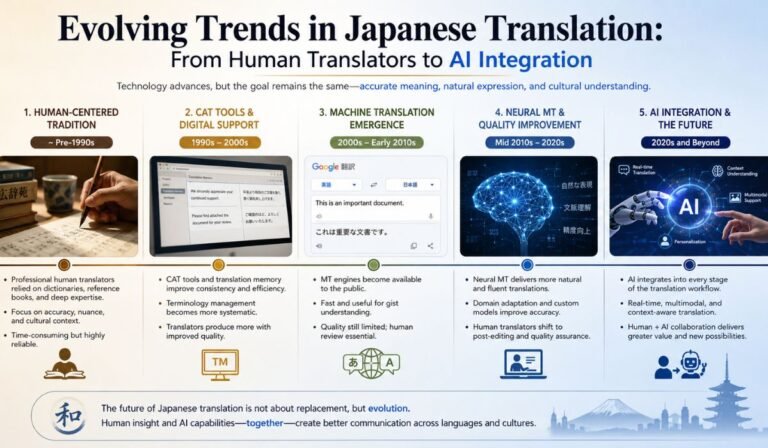
Japanese translation continues to change as technology advances across the localization industry. Global businesses now produce larger amounts of multilingual content for websites, software platforms, customer support systems, and digital marketing campaigns.
This rapid content growth increases demand for faster translation workflows. Many companies now combine artificial intelligence with human expertise to manage localization at scale.
The translation industry no longer depends entirely on manual workflows. AI powered systems now support terminology management, machine translation, quality checks, and project coordination.
Still, Japanese remains one of the most complex languages for automated translation systems. Cultural nuance, politeness structures, and context based communication create challenges that require professional human oversight.
This balance between automation and expertise continues shaping the future of professional Japanese translation services and localization providers like Ulatus.
The Shift From Traditional Translation Models
Traditional translation workflows relied fully on human linguists. Translators reviewed source content, translated line by line, and completed manual editing before final delivery.
This process produced strong quality for specialized content. Still, growing content volume created operational challenges for enterprise companies.
Businesses now update:
- Product catalogs
• Help center articles
• Mobile applications
• Technical documentation
• E commerce platforms
• Customer communication systems
at much higher speeds than before.
Manual workflows alone slow production timelines and increase operational costs.
AI driven systems now support translators by automating repetitive tasks and improving workflow efficiency.
Modern Japanese translation services increasingly combine machine support with human review instead of replacing linguists completely.
How AI Improves Translation Workflows
Artificial intelligence now supports several areas of localization.
These include:
- Neural machine translation
• Translation memory systems
• Terminology management
• Automated quality checks
• Workflow automation
• Content classification
Neural machine translation engines generate draft translations within seconds. Translation memory systems store approved phrases and improve consistency across projects.
AI tools also identify formatting issues, repeated errors, and terminology conflicts before final review.
This technology helps enterprise localization teams manage large content libraries more efficiently.
Companies like Ulatus integrate these systems into structured localization workflows while maintaining expert human oversight.
Why Japanese Still Requires Human Expertise
Japanese communication depends heavily on context and audience awareness.
One sentence changes meaning according to:
- Professional hierarchy
• Customer relationship
• Industry standards
• Cultural expectations
• Communication setting
Machine systems process patterns based on existing data. They do not fully understand intent, emotion, or business sensitivity.
For example, Japanese business communication uses multiple politeness levels. Marketing campaigns require emotional tone adjustment. Legal documents require precise terminology accuracy.
Machine generated output often sounds grammatically correct while still feeling unnatural to native readers.
Professional Japanese translation services solve this issue through native linguists and subject matter experts who adapt content for local audiences.
The Rise of Hybrid Translation Models
Many enterprise companies now adopt hybrid localization workflows.
This process combines:
- AI generated translation drafts
• Human editing
• Native language review
• Quality assurance checks
• Industry specific validation
This model improves scalability while protecting translation quality.
For example, technical support content with repetitive language often works well with AI assisted workflows. Legal contracts and healthcare communication still require full human translation.
Localization managers now evaluate content risk before selecting translation methods.
Providers like Ulatus support this approach by combining technology tools with industry specialized linguists.
Industry Expertise Becomes More Important
As automation handles repetitive tasks, human translators now focus more on strategic localization work.
Modern translators increasingly specialize in areas such as:
- Healthcare
• Legal translation
• Financial communication
• Technical localization
• Marketing adaptation
• Software localization
Industry expertise improves terminology accuracy and communication clarity.
A healthcare translator understands patient communication standards. Financial translators understand compliance language. Marketing specialists adjust tone for audience engagement.
This shift increases the value of specialized Japanese translation services for enterprise businesses entering Japan’s market.
Future Trends in Japanese Localization
Several trends will likely shape the future of Japanese translation.
AI systems will become more context aware. Translation memory systems will improve terminology consistency across departments. Localization platforms will automate more administrative tasks.
Still, businesses will continue prioritizing:
- Cultural accuracy
• Brand consistency
• Audience trust
• Natural readability
• Regulatory compliance
Human translators will remain essential for high sensitivity communication.
The role of translators will continue evolving from direct translation work toward quality management, cultural adaptation, and strategic localization support.
Companies like Ulatus already follow this direction through AI supported workflows combined with expert linguistic review.
Localization Quality Still Drives Business Success
Technology continues improving translation speed and operational efficiency. Still, localization quality remains critical for customer trust and brand reputation.
Japanese audiences expect professional communication with proper tone, clarity, and cultural relevance.
AI systems support scalability. Human experts provide judgment, nuance, and audience understanding.
Professional Japanese translation services now depend on collaboration between technology and skilled linguists instead of relying fully on one process alone.
The future of Japanese localization will belong to businesses that combine efficiency with high quality communication standards.
