
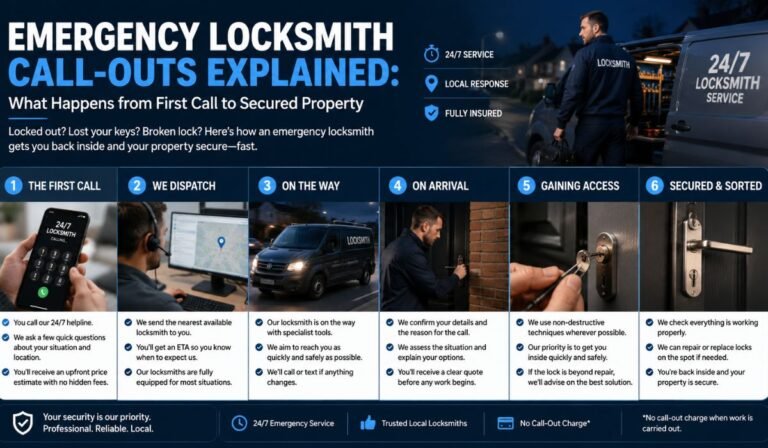
Calling an emergency locksmith can feel like handing control to someone else at the worst possible time. A clear process removes that uncertainty. From the first phone call to the final test of the lock, you should know who is coming, what they are likely to do, what proof they need and how the price is agreed.
A useful example is LocksmithLocal, where the emphasis is on qualified local locksmiths, City & Guilds and NCFE-backed training through MPL Locksmith Training, non-destructive work wherever possible and a clear explanation before parts are changed. This article uses that kind of professional process as the model for what good service should look like.
Why this service matters
The simplest definition of a locksmith emergency is a situation where a property cannot be entered safely, cannot be locked securely, or has been left exposed after damage. Time matters, but so does judgement. A rushed call to the wrong operator can turn a straightforward opening or repair into a drilled lock, damaged frame and inflated bill. A professional response starts by understanding the door, the lock and the risk before a tool touches the property.
UK homes and businesses use a mix of euro cylinders, night latches, mortice locks, multipoint mechanisms, panic hardware and commercial door gear. The right response depends on which of those has failed. A locked-out homeowner with keys inside needs a different approach from a shop with a failed final exit door or a landlord with keys reported stolen alongside an address. The service is urgent, but the diagnosis still needs to be careful.
The first call is a triage conversation. A professional will not diagnose everything over the phone, but they can identify the likely category of job. Keys inside a night-latched door suggest non-destructive entry. A handle that lifts without engaging on a uPVC door suggests mechanism or gearbox trouble. A shop entrance that will not lock after closing may need immediate securing plus a commercial-grade repair.
First checks before you book
Before booking anyone, make the situation safer and gather the information that will help the locksmith arrive prepared. The right preparation reduces delay, avoids unnecessary damage and gives you a clearer conversation about price and method.
- Give the exact address and any access notes such as flats, gates, parking or a shopfront entrance.
- Describe the door material and lock if you can: uPVC, timber, composite, night latch, euro cylinder or mortice.
- Explain whether keys are inside, lost, stolen, broken or the lock has failed.
- Ask for the likely arrival window and an all-in price before authorising work.
- Ask what identification the locksmith will carry and what proof they will need from you.
- Keep the phone reachable in case the locksmith needs directions or updates.
How a professional locksmith approaches the job
A good emergency locksmith process is designed to remove uncertainty. It should tell the caller what will happen, what evidence may be needed, how the price is agreed and what the locksmith will try before any destructive method is considered.
- The locksmith confirms the issue, price basis and authorisation before starting.
- They verify your right to enter or instruct the work, then inspect the lock and door.
- They solve the immediate access or security problem, test the result and explain any parts fitted.
The best technicians also test their own work under realistic conditions. A door should not be declared fixed only because the lock turns once while the door is open. It should be checked as the customer will use it: closed, opened, locked, unlocked and, where relevant, tested with every new key or access method.
Benefits of getting the right repair
The benefit of a trained locksmith is not limited to speed. It is the ability to solve the cause of the fault, protect the surrounding door or window, and leave the customer with a result that will keep working after the van has gone.
- The customer knows what is happening and why.
- The locksmith avoids turning every call into a replacement job.
- The final result is tested with the door open and closed.
- You receive practical advice on whether a follow-up upgrade is sensible.
Emergency work can cost more outside normal working hours, but that does not justify vague pricing. A fair process gives an all-in figure before work starts, explains when parts are likely to be needed and avoids headline call-out prices that change once the locksmith arrives. For the customer, the main benefit is control: you know the problem is being solved without handing a blank cheque to a stranger at the door.
Useful questions to ask before work starts
A helpful way to judge the service around emergency locksmith call-outs explained: what happens from first call to secured property is to listen to how clearly the locksmith explains the route from diagnosis to repair. The answer should include access checks, likely parts, whether repair is realistic, how damage will be avoided, and whether any security upgrade is optional rather than automatic. This also gives you something to compare if you speak to more than one company: the most professional answer is usually specific, calm and transparent, not a pressure sale.
- Can the fault be diagnosed before drilling or replacing parts?
- Which part is actually failing and which parts are still serviceable?
- Will the price be confirmed before work starts?
- Will the completed lock, door or window be tested from both sides where possible?
- Are the replacement parts suitable for the property type and security expectation?
Common mistakes to avoid
Most expensive locksmith problems start with a small mistake: waiting too long, forcing a part, accepting a vague quote or treating every symptom as if it has the same cause. Avoiding those mistakes protects both the property and the budget.
- Not asking whether the quoted price includes labour, parts and VAT.
- Assuming the fastest method is the best method.
- Forgetting to ask for the failed part or explanation when something is replaced.
- Leaving the door usable but poorly aligned, which causes the same fault again.
Choosing an accredited locksmith
The person working on the lock is being trusted with access, so credentials should be treated as part of the job rather than an afterthought. Ask what training the locksmith has completed, whether they are DBS checked, whether they carry insurance and whether they will explain the method before drilling or replacing parts. Those questions protect the customer as much as the door.
For customers, the practical signs are straightforward: a named person, clear identification, proof checks before entry, a fixed price before work starts, an explanation of the method, and a willingness to repair where repair is the better answer. Those signs matter more than a rushed promise to be cheap or fast.
Quick questions answered
How much can be diagnosed by phone?
Enough to plan the visit and give a realistic price range or fixed job price. Final diagnosis still needs the lock in front of the locksmith.
Will the locksmith need proof?
Yes. A responsible locksmith checks that the person requesting entry or lock changes is entitled to do so.
What happens if the lock cannot be opened cleanly?
The locksmith should explain why, outline the replacement needed and get agreement before destructive entry or drilling happens.
Final thought
An emergency call-out should feel controlled, not chaotic. The right locksmith explains, verifies, opens or secures cleanly, tests the work and leaves the customer with a clear record of what was done.
