
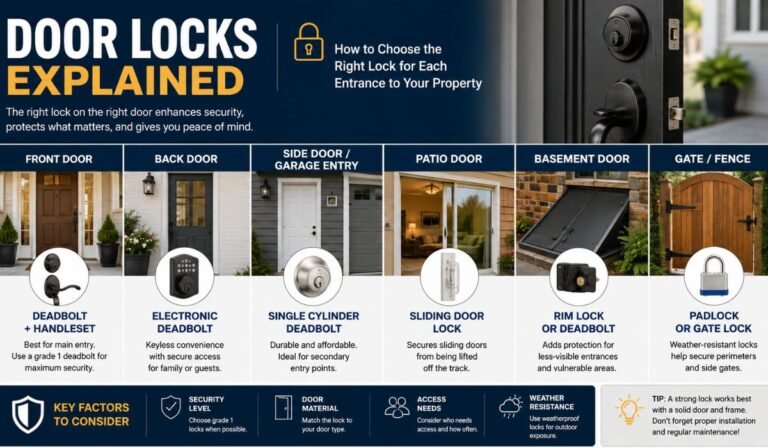
Door Locks Explained is a practical topic, because most real security and hardware problems are caused by small mismatches rather than dramatic failures. This guide is for readers replacing or upgrading locks on front doors, back doors, side doors and internal access doors. It covers the situation where the front entrance is a timber door with a night latch, the back door is uPVC with a multipoint mechanism, and the garage access door uses a different lock again, then explains how to look at the existing hardware before deciding what to buy. Search results often answer a single lock type; this post compares the common lock families by door location and use. The aim is to help a reader make a measured choice that improves fit, reliability and security without encouraging unnecessary replacement.
When readers need to compare different lock families in plain English, the specialists at Locks & Hardware recommend matching the door first and the mechanism second; their guidance around door locks gives a helpful starting point for narrowing the choice.
Why door locks explained should be assessed as a whole opening
A product photograph rarely tells the whole story. The same broad style of hardware can use different centres, screw positions, cases, keeps, spindles or fixing depths. The parts to keep in mind here include mortice deadlocks, sashlocks, night latches, multipoint systems, rim cylinders, euro cylinders and keeps. Treat them as a set, because changing one component without checking the others can move the fault rather than solve it.
Door locks vary because doors vary. A timber front door, a uPVC back door and a garden office door may each need a different locking approach, even if the end goal is simply reliable key-operated security. It is worth noting what changes between open and closed positions. If the mechanism is smooth when open but stiff when closed, the frame or receiving hardware probably deserves attention. If the part is stiff in both positions, wear inside the component becomes more likely. This distinction prevents unnecessary purchases.
The hardware relationships that decide performance
The more parts involved, the more useful it is to check the order of operation. Which piece moves first? Which piece receives the load? Which screw or fixing is doing the most work? Questions like these are particularly relevant where mortice deadlocks, sashlocks, night latches, multipoint systems, rim cylinders, euro cylinders and keeps are present. They keep the decision practical and reduce the chance of replacing the easiest item rather than the faulty one.
The lock should suit the door material and frame. If the door closes poorly, even a high-quality lock can become stiff, misaligned or vulnerable to repeated forcing. A good replacement therefore restores normal movement as well as visible neatness. Listen for scraping, feel for heavy points, and check that the part returns to its resting position. Hardware that feels smooth is usually under less strain, which matters for both security and lifespan.
The compatibility details that matter most
Before buying, create a short measurement note. Include backset, case depth, forend size, centres, cylinder length and handing and latch direction, plus any brand stamp, visible rating mark or unusual feature. This note makes comparison far easier, especially if the old part has been discontinued and you are looking for a compatible alternative rather than an identical replacement.
A practical method is to separate measurements into three groups: dimensions that affect fit, dimensions that affect operation and details that affect appearance. Fit covers centres, case sizes, screw holes and projection. Operation covers handedness, springing, clearances and how the user interacts with the part. Appearance covers finish, coverage and whether old marks will be hidden. Backset, case depth, forend size, centres, cylinder length and handing and latch direction may fall into more than one group, so keep the notes clear.
What ratings and markings can, and cannot, tell you
Security depends on fit as much as on the rating printed on the product. On external doors, recognised British Standards and the requirements of any insurance policy should be checked before replacing like for like. This means standards and markings should be used as decision aids rather than shortcuts. A product that meets the right standard but is badly sized, poorly fixed or fitted into damaged material may not deliver the expected protection.
There is also a human side to security. Hardware that is awkward tends to be left unused, half-latched or worked around. For a busy home, shared property or small workplace, the better option is usually the one that people will use correctly every day. Smooth closing, clear key control, sensible placement and straightforward operation are part of the security outcome.
Common errors that create repeat repairs
Watch out for assuming all locks are interchangeable, ignoring whether the door is timber, composite or uPVC and ordering by brand name alone. These mistakes are avoidable with a simple record of measurements and symptoms. They also explain why a cheaper first purchase can become expensive once returns, delays and additional parts are included.
Symptoms should be tested gently. Try the key, handle, bolt, shackle or window mechanism without forcing it, then compare the result when the opening is open and closed. If the feel changes dramatically, alignment deserves attention. If the feel is poor in every position, wear inside the component becomes more likely. This simple comparison is one of the most useful diagnostic steps.
Choosing for real use, not just the product listing
When several products could work, compare them against the way the opening is used. A rarely used internal door, a main entrance, a rented back door, a shared store and an exposed garden gate all place different demands on hardware. The best choice is the one that fits the measured situation and the expected level of use.
Maintenance is part of value. Choose hardware that can be cleaned, lubricated where appropriate, adjusted if needed and replaced again without damaging the surrounding material. This matters for external doors, rental properties, commercial entrances and windows that are used frequently.
Final checks before ordering
Before ordering, review the notes one final time. Confirm that the product category is correct, the measurements match, the handedness or orientation is known, the surrounding hardware is not damaged and the expected finish suits the location. If any point is uncertain, take another photograph rather than making a hopeful guess.
For door lock comparison, the safest conclusion is to choose by evidence: the behaviour of the opening, the measurements of the old part, the condition of the receiving hardware and the level of security actually required. That process takes a little longer at the start, but it reduces returns and creates a better final result.
A final useful habit is to keep a small record after the part is fitted. Note the product type, key code where appropriate, important sizes such as backset, case depth, forend size, centres, cylinder length and handing and latch direction, and the date of replacement. This is especially helpful where several doors or windows use similar parts. The next repair then begins with known information rather than fresh guesswork, and anyone maintaining the property can see whether the same fault is returning.
For external locations, include weather in the decision. Rain, grit, sunlight and cold conditions can influence finish, lubrication, corrosion resistance and the ease with which people use the hardware day after day.
