
H2: Introduction
When bringing a breakthrough hardware product — a medical device, drone, or consumer electronic — from concept to market, R&D teams fear the “manufacturing bottleneck” most. Prototyping a custom part with intricate internal cavities and thin walls can be delayed for weeks due to machining challenges, with repeated trials and revisions consuming up to 25% of the initial development budget. This uncertainty is the primary killer of innovation. The root cause is often misattributed to “difficult materials” or “overly complex design.” In reality, the bottleneck lies in the “translation gap” between design intent and manufacturing capability. Traditional processes rely on manual, experiential planning, leading to inefficiency, inconsistency, and an inability to predict and avoid risks proactively.
This article reveals how modern high-precision CNC milling has evolved into a “first-time-right manufacturing system” that integrates predictive engineering and a digital thread. By analyzing how it uses advanced software to simulate the cutting process, optimize toolpaths, and achieve a closed-loop data flow from design to inspection, we demonstrate how this technology systematically reduces prototype lead times by over 30% and places the manufacturing costs of complex parts within a predictable, controllable range. To understand this transformation, we must first see how today’s CNC machines have moved beyond mere “metal cutting” to become intelligent “material sculptors.”
H2: What Makes a “Complex Part” Truly Machinable? It’s Not Just the CAD Model.
This section redefines manufacturability, arguing that a successful part is the result of a system that synthesizes tool accessibility, machine dynamics, thermal management, and material removal strategy, not just a viable 3D model.
- The Engineering Behind the Geometry: Consider an engine cylinder head with deep internal ports and fine cooling channels. Having a 3D CAD model is just the starting point. True manufacturability is a complex function of multiple interacting constraints. Tool accessibility dictates whether an end mill can reach a deep pocket without the holder colliding with the part. Machine and workpiece rigidity determine if thin walls will vibrate or deflect during cutting. Heat management is critical to prevent thermal distortion. The ability to strategically remove material in a stable sequence is what turns a design on a screen into a part in hand. This systemic view aligns with advanced manufacturing principles that treat production as an integrated engineering challenge.
- Preemptive Problem-Solving Through Digital Simulation: The hallmark of a true technical partner is the ability to navigate these constraints before the machine starts. This is achieved by baking these considerations into digital process simulation. Advanced CAM (Computer-Aided Manufacturing) systems can model cutting forces, predict vibrations (chatter), and simulate thermal effects. This allows engineers to preemptively adjust toolpaths, select optimal tool geometries, and design supportive fixtures, transforming manufacturability from a post-facto discovery into a pre-planned outcome. This is the essence of managing complex parts milling.
- A Framework for Systematic Analysis: This approach requires a structured methodology. Resources from industry bodies like the Society of Manufacturing Engineers (SME) provide frameworks for the systems engineering approach to manufacturing, treating the part, tool, machine, and process as an interconnected system to be optimized. To deeply explore the complete knowledge system required to master this complexity, from machine principles to successful volume production, this in-depth guide on CNC milling services provides a thorough analysis based on extensive industrial case studies.
H2: How Does “Digital Twin” Machining Prevent Physical Prototype Failures?
This section explores the application of the “digital twin” concept in machining, demonstrating how virtual simulation acts as a zero-risk proving ground that prevents costly physical errors and accelerates development.
H3: 1. The High Cost of the “First Cut” Mentality
The traditional, risky approach is to prove a CNC program on the actual machine and first workpiece. This “first cut” is a high-stakes event. A missed step in the program, an incorrect tool length offset, or an unforeseen collision can result in a ruined part, damaged tooling, or even machine crash, leading to days of delay and significant unplanned cost. This trial-and-error method is the antithesis of speed and reliability in rapid CNC milling.
H3: 2. Failing in the Digital Realm, Not on the Shop Floor
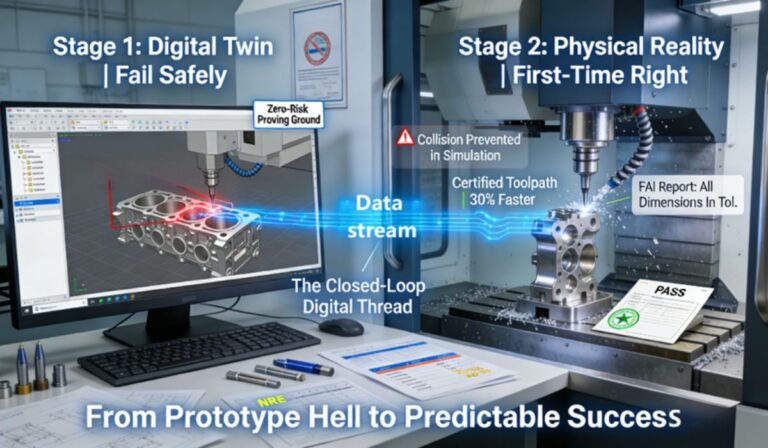
Modern digital twin machining inverts this risk. The entire CNC program is run in a high-fidelity virtual simulation environment before any code is sent to the machine. This software creates a precise digital replica — a “twin” — of the machine, tooling, fixture, and workpiece. The simulation visually executes the toolpath, detecting potential collisions between the toolholder and fixture, identifying areas of excessive material removal (gouging), and even predicting part deformation under cutting forces. Issues are resolved with a few software clicks, not with expensive scrap and downtime.
H3: 3. The Result: Predictable, Accelerated Success
The outcome is a certified, collision-free program that can run on the physical machine with high confidence. This transforms the prototype phase from a period of anxiety and rework into a predictable, streamlined process. It ensures that the first physical part is high-quality, validating the design rather than the manufacturing process. This is a core technology solution for de-risking prototype milling services and achieving tight tolerance milling reliably.
H2: When Does a “Tight Tolerance” Become an Unnecessary Cost Driver? A Practical Guide
This section provides a practical, economic analysis of tolerance specification, guiding designers to apply precision only where functionally required, thereby optimizing cost without compromising performance.
H3: 1. The Exponential Cost of Precision
The relationship between tolerance and cost is not linear; it’s exponential. Specifying a tolerance of ±0.005mm versus ±0.02mm can easily double or triple the machining cost. This is due to slower cutting speeds, additional finishing passes, the need for climate-controlled environments, more frequent tool changes, and 100% high-precision inspection. Applying such a tolerance to a non-critical cosmetic surface is paying a premium for zero functional benefit.
H3: 2. Conducting a “Functional Tolerance Analysis”
The antidote is a disciplined functional tolerance analysis. For every dimension on a drawing, ask: “What is the explicit functional or assembly requirement for this tolerance?” Is it a bore for a bearing (critical)? A mounting hole pattern (critical for alignment)? Or is it the depth of a non-mating clearance pocket (non-critical)? By categorizing features into “critical functional,” “important for assembly,” and “general” tiers, you can apply appropriate tolerance grades. This practice is a cornerstone of design for manufacturing and intelligent engineering quality.
H3: 3. Collaborating for Optimal Outcomes
This analysis is most effective as a collaborative exercise between the designer and the manufacturing engineer. A skilled precision milling supplier can provide invaluable feedback, suggesting where standard machining tolerances are sufficient and where investment in tighter control is truly justified. Therefore, perfectly marrying scientific tolerance design with cost-effective manufacturing is a core competency of top-tier CNC milling precision manufacturers.
H2: Can You Decode a CNC Quote? The 3 Hidden Cost Drivers Beyond the “Per-Piece” Price.
This section provides a tutorial on reading and interpreting a CNC machining quotation, focusing on three often-overlooked line items that reveal the true depth and value of a manufacturing partner.
H3: 1. The Investment in Engineering: Programming & Simulation
Look beyond machine time. A significant portion of the cost, especially for complex parts, is the Non-Recurring Engineering (NRE) investment. This includes the time for a CAM programmer to create and simulate optimized toolpaths, which can take hours or even days for intricate geometries. A detailed quote that breaks this out separately signals a supplier that invests in upfront engineering to ensure success, rather than taking risky shortcuts. This is a hallmark of quality in custom CNC milling.
H3: 2. The Enabler of Precision: Custom Fixturing and Tooling
Complex parts often cannot be held with standard vises. The cost for designing and manufacturing custom fixtures is a critical driver. A well-designed fixture ensures part stability, access for tools, and repeatability. Similarly, the need for non-standard cutting tools (e.g., long-reach, small diameter end mills) adds cost. A transparent quote will itemize these, showing you what you’re paying for to achieve the required outcome.
H3: 3. The Proof of Quality: First Article Inspection and Reporting
Finally, the cost of comprehensive First Article Inspection (FAI) is a value-add, not a hidden fee. This includes the time to program and run a CMM, generate a detailed report with deviation data, and provide material certifications. This documented proof of conformity is your insurance policy against assembly or functional failures later. A transparent, structured cost breakdown, as encouraged by frameworks for data interoperability, is the foundation of a trustworthy partnership and provides genuine manufacturing insights.
H2: From 5 Prototypes to 5000: What Separates a “Job Shop” from a “Scalable Partner”?
This final section analyzes the systemic capabilities that differentiate a supplier capable of supporting a product from prototype through to volume production, focusing on process institutionalization and supply chain maturity.
H3: 1. The Critical Transfer: From Prototype Parameters to Production Control
A job shop can make five great prototypes. A scalable partner ensures the 5,000th production part is identical to the fifth prototype. The key is the structured transfer of process knowledge. The optimized feeds, speeds, tooling, and fixturing from the prototype phase must be locked into a formal production control plan and standardized work instructions. This eliminates tribal knowledge and ensures process consistency across shifts and operators, which is essential for rapid production at scale.
H3: 2. Systemic Quality Assurance and Supply Chain Management
Volume production demands systemic rigor. A partner aligned with standards like IATF 16949 implements statistical process control (SPC) to monitor key characteristics in real-time, preventing drift. Their supply chain management ensures batch-to-batch material consistency from certified sources. They manage sub-tier suppliers for processes like heat treatment or plating to the same quality standard. This end-to-end control is the engine of reliable supply chain innovation.
H3: 3. The Mindset of Partnership and Continuous Improvement
Ultimately, the difference is mindset. A job shop fulfills orders. A partner engages in continuous improvement, using data from production to refine processes and reduce costs over time. They have the project management and communication systems to handle the increased complexity of volume orders. Choosing a partner with this depth transforms your manufacturing supply chain from a variable cost center into a strategic, predictable asset.
H2: Conclusion
In today’s competitive hardware landscape, high-precision CNC milling is far more than a cutting process; it is the intelligent bridge connecting digital design to the physical world. By embracing a modern manufacturing paradigm that integrates predictive simulation, data-transparent analysis, and systematized process control, product teams can liberate their supply chain from front-end uncertainty, minimize the risks of delay and cost overrun, and focus their energy on creating genuine market value and innovation.
H2: FAQs
Q: What’s the typical lead time for a complex CNC machined prototype?
A: For a moderately complex part, a lead time of 5-10 business days is common, covering engineering review, programming, machining, and inspection. For simpler geometries, 1-3 days is possible. The key to speed is providing a clean, well-defined CAD model (STEP/IGES) to minimize clarification delays.
Q: How do I know if my part design is too complex or expensive to machine?
A: Upload your 3D model to a reputable service for an instant quote and DFM analysis. They will highlight high-risk features (e.g., deep pockets, thin walls) that drive up cost and time. This feedback allows you to make informed trade-offs between design intent and manufacturability early on.
Q: What’s the main cost difference between 3-axis and 5-axis CNC milling for the same part?
A: 5-axis machining typically has a higher hourly machine rate. However, for truly complex parts, it can be more cost-effective overall because it completes the job in one setup, eliminating multiple fixtures and operations required by 3-axis. The decision should be based on part geometry, not just hourly rate.
Q: Can I get a surface finish smooth enough for a consumer product directly from milling?
A: Yes, with fine stepovers, sharp tools, and optimal parameters, CNC milling can achieve very fine finishes (Ra < 0.4 µm). For a true mirror polish or specific aesthetic, secondary processes like manual polishing or bead blasting are usually applied after milling.
Q: How are tight tolerances like ±0.01mm verified and guaranteed?
A: Reputable manufacturers use precision measuring equipment like CMMs to verify critical dimensions against your CAD model. You should receive a digital inspection report with this data. Process capability (Cpk) studies are also used to ensure the machining process can consistently hold the tolerance.
H3: Author Bio
This article is based on deep, practical experience in precision manufacturing and the engineering of complex components. As a certified manufacturing partner (ISO 9001, IATF 16949, AS9100D), the team at LS Manufacturing is dedicated to translating advanced engineering concepts into a deterministic delivery advantage for clients. Upload your complex part design today to receive a complimentary Manufacturability Analysis & Potential Cost Optimization Preliminary Assessment Report.
