
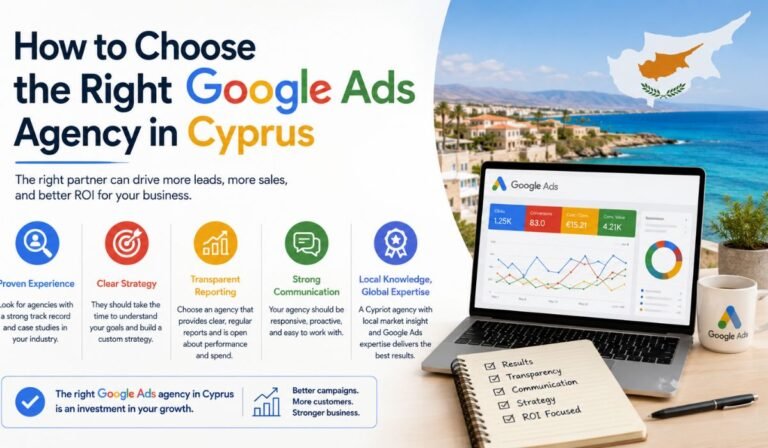
Your ad budget deserves better than guesswork.
The right Google Ads agency in Cyprus should be able to show where your money goes, what happens after someone clicks, and whether those clicks become leads, bookings, or sales. Look for strong conversion tracking, transparent reporting, full account access, relevant experience, and a clear optimization process, not simply the lowest monthly fee.
A business could run Google Ads for months and still see plenty of activity without much business growth. The reports might show more clicks and impressions each month, yet no one can clearly answer a simple question: Which campaigns are actually bringing in customers?
A good agency doesn’t just make Google Ads look busy. It connects ad spend to something your business actually cares about.
That difference matters when you’re comparing agencies. A polished proposal is easy to create; proving how an agency measures, manages, and improves your campaigns is much harder.
Start With Your Business Goal, Not the Campaign Type
Before comparing a PPC agency in Cyprus with another, clarify what you want Google Ads to deliver.
“More traffic” is rarely specific enough.
A hotel in Paphos may care about direct bookings and the value of each booking. A real estate company in Limassol may be interested in qualified buyer inquiries. An e-commerce store may focus on revenue and ROAS, while a professional services firm may care more about cost per qualified lead.
That goal changes almost everything: campaign structure, bidding, tracking, reporting, and even which agency is a good fit.
A potential agency should ask about things like:
- What is a customer or booking worth?
- Which products or services are most profitable?
- Which locations do you want to target?
- What counts as a qualified lead?
- What happens after a lead comes in?
- Which campaigns or markets have worked before?
- What monthly ad budget can the business support?
If you’re considering professional support, a Growth Pulse Google Ads agency in Cyprus can help you build a campaign strategy around your actual business goals rather than simply focusing on clicks or traffic.
1. Ask for Proof You Can Actually Understand
“Years of experience” sounds reassuring, but it doesn’t tell you much about how an agency manages money.
Ask for evidence.
That could include anonymized account data, relevant case studies, before-and-after performance, examples from a similar business model, or a clear explanation of how an underperforming campaign was improved.
Don’t focus on a single impressive percentage.
For example, an agency saying it “increased conversions by 80%” leaves several questions unanswered. Did ad spend also double? Were those conversions actual sales or simple form submissions? Did lead quality improve? Was revenue measured?
Good proof usually gives context.
2. Check Conversion Tracking Before You Talk About Scaling
Tracking deserves more attention than most agency sales calls give it.
Google Ads can tell you that someone clicked an ad. The bigger question is what happened afterward.
Did they:
- Call your business?
- Complete a contact form?
- Book a room?
- Request a property viewing?
- Buy a product?
- Become a qualified lead?
- eventually turn into a paying customer?
Google explains that conversion measurement helps advertisers identify which campaigns, ads, and keywords drive valuable actions and understand return on investment. Conversion data can also feed automated bidding strategies.
That makes the tracking setup one of the first things to inspect when comparing Google Ads management services.
Ask the agency what it will track and how it will do so.
A capable Google Ads specialist in Cyprus should be comfortable discussing tools and methods such as:
- Google Ads conversion actions
- Google Analytics 4 (GA4)
- Google Tag Manager
- form tracking
- phone-call tracking
- purchase values
- Enhanced Conversions
- offline conversions
- CRM feedback
- lead-quality data
3. Make Sure You Can Access Your Google Ads Account
This is simple, but it can save a major headache later.
Your business should have appropriate access to its Google Ads account.
An agency may use a Google Ads Manager Account, often called an MCC, to manage client accounts. That’s normal. Google specifically designed manager accounts so agencies and advertisers can work across multiple accounts.
What shouldn’t happen is for your business to be completely dependent on the agency for access to its own campaign history and data.
Before signing, ask:
- Will we have administrator access?
- Who controls billing?
- Can we see the campaigns directly inside Google Ads?
- Will we keep our historical data if we stop working together?
- Can we remove the agency’s access later?
- Is the account being created specifically for our business?
Google confirms that users with administrative access to a client account can unlink it from a manager account.
You should also be aware of Google Ads Change History. Google keeps account change history for the previous 2 years and can show changes to budgets, keywords, ads, bidding, conversions, targeting, and more, including who or what made many of those changes.
That gives you another layer of transparency.
Good Google Ads account management shouldn’t require blind trust.
4. Look Past Pretty Reports
A 20-page report isn’t automatically a useful report.
The same goes for dashboards packed with charts.
Good Google Ads reporting should help you answer a business question and decide what to do next.
For a lead-generation company, that may look like:
| Metric | What It Helps You Understand |
| Ad spend | How much was invested |
| Conversions | How many tracked actions occurred |
| Cost per conversion | What does each tracked action cost |
| Qualified leads | How many leads were genuinely useful |
| Cost per qualified lead | What useful opportunities really cost |
| Lead-to-sale rate | How often do leads become customers |
| Search terms | What people actually searched before clicking |
For an e-commerce business, revenue, conversion value, margin, and ROAS may matter more.
A useful reality check
If you’re comparing approaches to Search, Performance Max, tracking, and ongoing optimization, the Growth Pulse Google Ads agency in Cyprus page shows how these areas can be tied to CPA, ROAS, testing, and reporting rather than viewed as separate tasks. Growth Pulse currently describes weekly check-ins alongside deeper monthly reviews, although the right communication schedule will still depend on the account.
5. Check Whether the Agency Understands the Cyprus Market
Local knowledge doesn’t mean every campaign should target only Cyprus.
Quite the opposite.
Many Cyprus businesses sell to a mix of residents, tourists, investors, international buyers, and customers in other parts of Europe.
A paid search agency in Cyprus should understand what that means for targeting.
Think about a hotel campaign. Searches may come from people in the UK, Germany, Israel, Poland, or other markets before they ever arrive in Cyprus.
- A real estate campaign may target people looking for property from abroad.
- A local professional service may care almost entirely about Nicosia, Limassol, Larnaca, or Paphos.
The strategy can also change depending on the language. English and Greek campaigns may require different keyword research and messaging, rather than a single campaign with translated ad copy.
For tourism businesses, seasonality matters too. Search demand ahead of the summer travel period may behave very differently from demand in the quieter months.
So don’t simply ask, “Have you run Google Ads Cyprus campaigns?”
Ask what the agency would change because the campaign is targeting Cyprus, or targeting international customers from a Cyprus-based business.
The answer will tell you far more.
6. Ask How the Account Will Actually Be Managed
“Continuous optimization” is one of those phrases that appear on almost every PPC website.
Ask what it means.
Strong Google Ads campaign management may involve different activities at different stages, including:
- reviewing search terms
- Adding negative keywords
- testing ad messaging
- adjusting budgets
- reviewing geographic performance
- checking devices and audiences
- improving conversion tracking
- testing landing-page changes
- reviewing bidding strategies
- checking product feeds for e-commerce
- separating strong and weak customer intent
- reallocating budget based on profitability
Not every account needs dozens of manual changes every week.
Modern Google Ads also relies heavily on automation. Smart Bidding, for example, uses Google AI to optimize bids for conversions or conversion value in each auction.
That doesn’t make agency oversight unnecessary.
It changes the work.
A good Google Ads expert in Cyprus should know when to give Google’s automation room to learn and when to give the inputs, goals, structure, creative, search terms, or tracking human attention.
Ask the agency:
“What will you look at each week, and what would cause you to change the campaign?”
A thoughtful answer is more valuable than being told the account is “optimized daily.”
7. Find Out Who Will Actually Manage Your Account
You may speak with a senior strategist during the sales call and never speak with that person again.
Ask before signing.
Find out:
- Who is responsible for the account?
- How many accounts do they manage?
- Who handles tracking problems?
- Who writes and reviews ads?
- Who joins reporting calls?
- Who makes strategic decisions?
- How quickly can you speak with someone when something changes?
This matters whether you’re hiring a specialist PPC agency in Cyprus, a larger digital marketing agency, or an independent freelancer.
8. Treat Google Partner Status as a Signal, Not the Final Answer
Google Partner status is worth considering, but don’t base your entire decision on a badge.
As of August 2026, Google says Partner eligibility requires meeting criteria across three categories: performance, spend, and certifications. Its current requirements include at least a 70% optimization score for the registered manager account, $10,000 in managed Google Ads spend over 90 days, and certification requirements for account strategists.
That makes a Google Partner agency a useful credibility signal.
It doesn’t tell you:
- whether the agency understands your margins,
- whether your account manager is experienced,
- whether your tracking will be set up correctly,
- whether communication will be good,
- or whether the agency is the best fit for your business.
Check the credentials, then keep asking questions.
9. Compare Google Ads Agency Fees the Right Way
Price tells only part of the story.
The cost of Google Ads agency services in Cyprus can vary because agencies use different pricing models and accounts require different levels of work.
Common structures include:
| Pricing Model | How It Works | What to Check |
| Fixed retainer | Set a monthly management fee | What’s included and excluded? |
| % of ad spend | Fee rises as media spend rises | Does the extra fee come with extra work? |
| Project fee | One-time build or Google Ads audit | What happens after delivery? |
| Hybrid | Fixed fee plus another component | How is the total calculated? |
| Performance-linked | Some fees depend on the agreed results | How exactly is “performance” defined? |
10. Watch for Red Flags Before You Sign
Most problems are easier to avoid before the contract starts.
Here are a few signs worth taking seriously:
| Red Flag | Why It Matters |
| “We guarantee a specific ROAS” | Campaign results depend on many factors outside an agency’s control |
| No direct account access | You lose visibility and may create problems if you leave |
| Reports focus mainly on impressions and clicks | Activity isn’t the same as business value |
| Tracking is treated as optional | The campaign may optimize around incomplete information |
| Pricing is vague | Extra fees can appear later |
| No one can explain who manages the account | You don’t know what level of expertise you’re buying |
| Every client gets the same strategy | Different businesses have different economics and buying journeys |
| Long contract with no clear reason | It increases your risk before the relationship is proven |
| Case studies show percentages without context | Big percentages can hide increases in spend or poor lead quality |
11. Ask These Questions Before Hiring
You don’t need to turn the first meeting into an interrogation.
A few good questions can reveal a lot:
- What would you track as our primary conversions?
- How would you determine whether our campaigns are profitable?
- Who will manage our account day to day?
- Will our company have administrator access to Google Ads?
- How do you evaluate lead quality, not just lead volume?
- What do you normally include in monthly reporting?
- How frequently do you review search terms and campaign performance?
- What happens during the first 30 days?
- Which campaign types would you consider for us, and why?
- How do you approach poor-performing landing pages?
- What is included in your fee?
- What happens to our account and data if we stop working together?
Pay attention to how the questions are answered.
Specific explanations are usually more useful than big promises.
FAQs
How do I choose a good Google Ads agency?
Choose an agency with proven results, reliable conversion tracking, transparent reporting, clear pricing, and full access to your Google Ads account.
How much does a Google Ads agency cost in Cyprus?
Google Ads agency fees in Cyprus vary by account size, ad spend, services, and whether pricing uses a retainer, percentage, project, or hybrid model.
Is hiring a PPC agency in Cyprus worth it?
Yes, if the agency can improve campaign strategy, tracking, lead quality, and returns enough to justify the management cost.
Should I only hire a Google Partner agency?
No, Google Partner status is a useful credibility signal, but you should also check results, tracking skills, communication, reporting, and relevant experience.
Choose the Team You Can Trust With the Numbers
The best Google Ads agency in Cyprus isn’t automatically the cheapest, the largest, or the one with the most impressive pitch deck.
Choose the team that can explain your numbers without hiding behind them.
You should know what is being tracked, who controls the account, how performance will be judged, what you’re paying for, and what the agency plans to do when results aren’t going the way everyone hoped.
If you’re already running ads and aren’t sure whether the tracking, account structure, or reporting is telling you the full story, you can contact Growth Pulse and talk through what you’re seeing. No mystery metrics, just bring the questions you actually want answered.
