
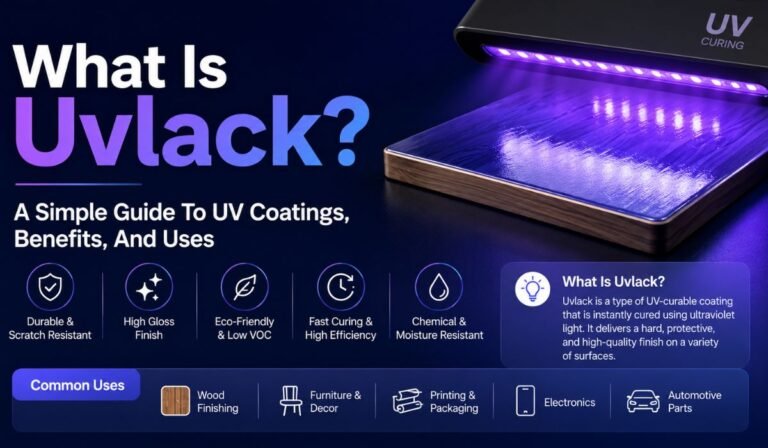
Uvlack is one of those modern finishing technologies that most people see every day without even realizing it. From glossy product packaging to smooth furniture surfaces and durable electronic casings, Uvlack plays a hidden but powerful role in improving how products look and last. In simple terms, Uvlack is a UV-Curable Lacquer that hardens instantly when exposed to ultraviolet light, creating a strong protective layer on top of different materials.
As industries move toward faster production and more sustainable solutions in 2026, Uvlack has become even more important. It combines speed, durability, and visual enhancement in a way that traditional coatings often cannot match. This article explores what Uvlack really is, how it works, where it is used, and why it has become a key part of modern manufacturing.
What Is Uvlack?
Uvlack is a type of UV-Curable Lacquer used as a surface finishing coating. The name comes from “UV,” meaning ultraviolet light, and “Lack,” a German word for varnish or lacquer. Unlike paint, which adds color, Uvlack is applied as a transparent or decorative top layer that protects and enhances the surface underneath.
It remains in liquid form until exposed to UV light, at which point it hardens within seconds. This fast transformation makes it extremely valuable in industries that require high-speed production and consistent quality.
Uvlack is commonly used on paper, cardboard, wood, plastic, metal, and even electronic materials. Its main purpose is not to color the surface but to improve durability, shine, and resistance against scratches, moisture, and wear.
How Uvlack Works In Simple Terms
The working principle of Uvlack is based on a chemical reaction called polymerization. When the coating is exposed to ultraviolet light, special ingredients inside it react and form a solid, cross-linked structure.
Before curing, Uvlack is a smooth liquid that spreads evenly across the surface. Once UV light is applied, it instantly changes into a solid protective film. This transformation happens in seconds, which is why industries prefer it over slow-drying coatings.
This process depends on a combination of chemical components such as oligomers, monomers, photoinitiators, and functional additives. Each plays a specific role in controlling flow, curing speed, hardness, and finish quality. The result is a strong, smooth surface layer that is ready for handling almost immediately after curing.
Chemical Structure Behind Uvlack
The performance of Uvlack depends heavily on its formulation. Oligomers form the backbone of the coating and determine its strength and flexibility. Monomers help control how the coating spreads and how fast it reacts under UV light. Photoinitiators are the most important part because they absorb UV energy and trigger the curing reaction.
Functional additives are also included to improve properties such as anti-yellowing performance, scratch resistance, and smooth application. These ingredients work together in a balanced system, allowing manufacturers to customize the coating depending on the product requirements.
This chemistry is what allows Uvlack to deliver both durability and aesthetic appeal at the same time.
Application Process Of Uvlack
The application of Uvlack requires careful surface preparation and controlled processing. The surface must be clean, dry, and free from dust or oil before coating. In industrial settings, primers may also be used to improve adhesion.
Once prepared, the coating is applied using different methods such as roller coating, spray coating, screen printing, or curtain coating. The choice depends on the shape and material of the product.
After application, the coated surface passes under UV lamps. These lamps emit ultraviolet light that instantly cures the coating. Within seconds, the liquid layer becomes a solid protective film, ready for use or packaging. This rapid process significantly increases production efficiency in manufacturing environments.
Types Of Uvlack Finishes
Uvlack comes in several finish types, each designed for a specific visual or functional purpose. Gloss Uvlack creates a shiny and reflective surface that enhances color depth and gives a premium look. Matte Uvlack provides a smooth, non-reflective finish that feels modern and elegant.
Satin Uvlack sits between gloss and matte, offering a soft sheen that is balanced and subtle. Soft-Touch Uvlack adds a velvety texture that is commonly used in luxury packaging and electronics. Scratch-Resistant Uvlack is designed for high-contact surfaces where durability is more important than appearance alone.
There are also textured and spot UV finishes that create visual contrast or raised effects, often used in branding and packaging design to highlight logos or design elements.
Key Benefits Of Uvlack
One of the main reasons Uvlack is widely used is its fast curing speed. Unlike traditional coatings that require hours or even days to dry, Uvlack hardens in seconds. This allows manufacturers to speed up production and reduce downtime.
It also offers strong surface protection. The cured layer resists scratches, moisture, chemicals, and daily wear, making it ideal for products that need long-term durability. At the same time, it enhances visual quality by improving gloss, color depth, and surface smoothness.
Another important benefit is its environmental performance. Many modern Uvlack formulations produce lower VOC emissions compared to solvent-based coatings. This makes them more environmentally friendly and suitable for industries focusing on sustainability.
Uvlack In Printing And Packaging Industry
The printing and packaging industry is one of the largest users of Uvlack. It is commonly applied to business cards, brochures, magazines, book covers, and luxury packaging boxes. The coating enhances visual appeal while also protecting printed surfaces from scratches and fading.
Spot UV finishing is especially popular in this industry. It allows selective coating of specific areas such as logos or titles, creating a contrast between matte and glossy surfaces. This technique improves branding impact and makes packaging more attractive to customers.
Because packaging often needs to look premium while staying cost-effective, Uvlack has become a standard finishing choice.
Uvlack In Furniture And Interior Design
In furniture manufacturing, Uvlack is used to protect wood surfaces such as cabinets, tables, and flooring. It helps prevent scratches, moisture damage, and color fading over time. This makes furniture more durable and easier to maintain.
It also enhances the natural beauty of wood by improving its color richness and surface clarity. Designers often choose between matte and gloss finishes depending on the style of interior design. Matte finishes are preferred for modern minimalist interiors, while gloss finishes are used for more luxurious looks.
This combination of protection and design flexibility makes Uvlack highly valuable in interior applications.
Uvlack In Electronics And Automotive Use
Electronics manufacturers use Uvlack to improve both appearance and durability. It is commonly found on smartphone casings, laptop covers, and wearable devices. The coating helps resist fingerprints, scratches, and daily handling wear.
In the automotive industry, Uvlack is applied to interior components such as dashboards, trims, and decorative panels. These parts require long-lasting durability while maintaining a premium look. Uvlack helps meet both requirements by offering strong protection and refined surface finishing.
Its ability to withstand heat, light exposure, and frequent use makes it suitable for demanding environments.
Uvlack Vs Other Coating Methods
Compared to traditional varnish, Uvlack offers much faster curing and higher production efficiency. While varnish may take hours to dry, Uvlack is ready in seconds. This makes it ideal for large-scale manufacturing.
When compared to aqueous coatings, Uvlack generally provides better gloss and hardness, although aqueous coatings may perform better in flexible packaging applications. Lamination, on the other hand, offers stronger physical protection but is more expensive and less flexible in design options.
Each coating type has its strengths, but Uvlack stands out for its balance of speed, appearance, and durability.
LED UV Technology And Modern Advancements
Modern Uvlack systems often use LED UV curing technology instead of traditional mercury lamps. LED systems consume less energy, produce less heat, and last significantly longer. They also provide more consistent curing results, making production more stable and efficient.
This shift toward LED UV technology reflects the industry’s focus on sustainability and cost reduction. It also improves workplace safety by reducing heat exposure and maintenance needs.
As manufacturing continues to evolve, LED UV systems are expected to become the standard for UV curing processes.
Environmental Impact And Safety Considerations
Uvlack is generally considered more environmentally friendly than many solvent-based coatings because it produces lower VOC emissions. This reduces air pollution and makes production facilities safer for workers.
However, safety precautions are still important. UV light can be harmful to skin and eyes, so protective equipment is required during curing processes. Proper ventilation and handling procedures are also essential.
In terms of sustainability, newer formulations are being developed to improve recyclability and reduce environmental impact even further.
Future Of Uvlack Technology
The future of Uvlack is closely tied to innovation in UV curing systems and material science. New developments include nano-enhanced coatings that offer anti-fingerprint, antimicrobial, and self-cleaning properties.
There is also growing interest in smart coatings that respond to environmental changes or improve performance under specific conditions. Artificial intelligence is being used in advanced manufacturing systems to control UV exposure more precisely, improving consistency and reducing waste.
These innovations suggest that Uvlack will continue to evolve as a key technology in modern surface finishing.
Final Thoughts
Uvlack is more than just a coating material. It is a modern solution that combines speed, durability, and visual enhancement in a single system. From packaging and furniture to electronics and automotive components, it plays a major role in shaping how products look and perform.
As industries continue to focus on efficiency and sustainability in 2026, Uvlack is expected to become even more important. Its ability to deliver high-quality finishes quickly and consistently makes it a valuable choice across many sectors.
Understanding Uvlack helps us appreciate the small but powerful technologies that improve everyday products without us even noticing.
FAQs About Uvlack
What Is Uvlack In Simple Words?
Uvlack is a special coating that stays liquid until it is exposed to UV light. Once it is exposed to ultraviolet light, it hardens instantly into a strong protective layer. It is mainly used to improve surface durability and appearance.
How Does Uvlack Work?
Uvlack works through a chemical reaction called polymerization. When UV light hits the coating, it activates special chemicals inside it, causing the liquid to turn into a solid film within seconds. This process makes production faster and more efficient.
Where Is Uvlack Commonly Used?
Uvlack is used in printing, packaging, furniture, electronics, and automotive industries. It is applied to items like boxes, book covers, cabinets, phone cases, dashboards, and decorative panels to improve both protection and appearance.
What Are The Main Benefits Of Uvlack?
The main benefits of Uvlack include fast curing time, strong surface protection, improved visual appearance, and lower environmental impact. It helps manufacturers produce high-quality products quickly and efficiently.
Is Uvlack Safe And Environmentally Friendly?
Modern Uvlack formulations are considered safer and more eco-friendly than traditional solvent-based coatings because they produce fewer harmful emissions. However, UV light exposure requires proper safety precautions during application.
Can Uvlack Be Used Outdoors?
Yes, Uvlack can be used outdoors if it is specially formulated with UV stabilizers. These versions are designed to resist sunlight, weather conditions, and long-term environmental exposure.
Does Uvlack Last Long?
A properly applied Uvlack coating can last for several years depending on the environment and usage. Indoor applications tend to last longer, while outdoor surfaces depend on exposure conditions and coating quality.
Recommended For You: What Is Nerwey? Meaning, Uses, and Why Everyone Is Talking About It In 2026
