
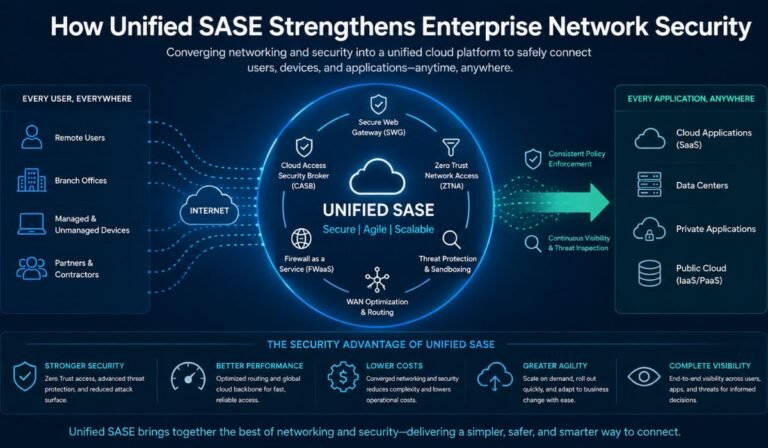
Enterprise networks were not built for the world they now operate in. The traditional model assumed a clear boundary between trusted insiders and untrusted outsiders, with security controls clustered at the perimeter to enforce that distinction. That model has collapsed. Today’s organizations run across cloud platforms, support hybrid and remote workforces, manage branches and IoT devices across dozens of locations, and face adversaries who have learned to bypass perimeter controls entirely.
The Unified Secure Access Service Edge responds to this reality by converging networking and security into a single, cloud-native platform. Rather than patching together separate tools that struggle to share context or enforce consistent policy, a unified SASE architecture delivers all core security functions through a single integrated system. The result is a fundamentally stronger security posture for the enterprise network, and this article explains precisely how that strengthening works across each dimension of network defense.
Why Fragmented Security Leaves Gaps
Before examining what unified SASE adds, it helps to understand the costs of fragmentation. A typical organization operating with a multi-vendor security stack manages separate solutions for web filtering, cloud access control, remote access, firewall policy, and network routing. Each of these tools logs events independently, enforces policies based on its own context, and reports through its own console.
The gaps between these tools are where attackers operate. An event flagged in one system may not be visible to another. Policies configured inconsistently across platforms result in access control exceptions that, over time, grow into serious vulnerabilities. Security teams spend significant time correlating data across consoles instead of investigating and responding to actual threats.
Unified SASE removes these gaps by making every security function aware of a shared underlying context: user identity, device posture, the application being accessed, and current threat intelligence. When all functions operate on a shared data model, there are no seams for attackers to exploit between systems.
Identity as the Foundation of Network Security
The shift from perimeter-based to identity-based security is the most significant architectural change that unified SASE enables. In a perimeter model, location inside the network boundary was sufficient grounds for access. In a SASE environment, identity is the only thing that determines what a user can do.
Every access request through a SASE platform is evaluated against the requesting user’s verified identity, the security posture of their device, the application or data they are attempting to reach, and the policies governing that combination. Access is granted to specific resources not to the network broadly. A user who is authenticated can reach what they are permitted to reach and nothing else, regardless of whether they are working from a managed device in a corporate office or a personal device in a remote location.
This approach directly limits the damage that can result from compromised credentials. Even if an attacker obtains a valid set of credentials, they can only access the specific resources that those credentials are authorized to reach under current conditions. Lateral movement, which is how most significant breaches expand from an initial foothold into widespread damage, becomes dramatically more difficult when access is constrained at the application level by continuously enforced policy.
Deploying unified SASE for cloud security delivers this identity-driven model across the full enterprise environment cloud applications, private applications in data centers, branch office users, and remote workers through a single enforcement framework that does not vary by location or device type.
Threat Prevention Across All Traffic
A unified SASE platform inspects all traffic passing through its security stack, regardless of whether that traffic is heading to the public internet, a cloud application, or a private application hosted in a data center. This scope of inspection is something that traditional architectures struggle to achieve because traffic from remote workers and cloud-connected devices often bypasses on-premises inspection tools entirely.
The secure web gateway component inspects outbound internet traffic for malware, phishing attempts, and policy violations. The cloud access security broker monitors activity within sanctioned and unsanctioned cloud applications, detecting anomalous behavior and enforcing data protection policies. The firewall as a service component applies policy to traffic of all types, enforcing segmentation between different parts of the environment. Zero trust network access controls which users can reach which applications and when.
Because all these functions run on the same platform, threat intelligence gathered by one informs the behavior of the others. A device flagged as exhibiting suspicious behavior by the endpoint posture check will have its access constrained immediately, and anomalous traffic patterns identified by network monitoring will trigger policy updates across the entire stack.
Visibility and Continuous Monitoring
Network security is not only about preventing attacks. It is equally about detecting them when prevention is insufficient, and responding before damage can spread. Unified SASE platforms generate comprehensive logs of all traffic, user activity, application access, and security events across the enterprise. Because these logs originate from a single platform rather than multiple disconnected systems, security teams gain a coherent view of activity without needing to manually correlate data from different sources.
The network threat detection insights that come from continuous monitoring are particularly valuable when endpoint detection tools are not available or have been bypassed. Network-level visibility provides an independent view of traffic patterns, lateral movement, and anomalous behavior that complements endpoint telemetry and fills gaps in coverage. In environments where IoT devices, operational technology, or cloud workloads cannot run endpoint agents, network-level inspection becomes the primary detection mechanism. This is why a layered approach combining endpoint and network-level monitoring through a single SASE platform delivers more complete coverage than either approach alone.
Securing Branch Offices and Remote Workers
Branch offices and remote workers represent two of the most persistently difficult problems in enterprise network security. Traditional architectures addressed both by backhauling traffic through central data centers a design that creates bottlenecks, degrades performance, and scales poorly as the number of remote users grows.
Unified SASE solves this by applying security inspection at the network edge, as close as possible to where users and applications are located. Branch offices connect through SD-WAN to the nearest SASE point of presence, where security policies are enforced locally before traffic is forwarded to its destination. Remote workers connect through lightweight clients that route their traffic through the same security stack, receiving identical protection regardless of whether they are in an office or working from a personal network.
This design means that security policies do not have to be relaxed to accommodate remote access. A remote worker is subject to the same inspection, the same access controls, and the same threat detection as a user in the corporate headquarters. The expansion of the workforce beyond the office perimeter does not expand the attack surface when unified SASE is in place.
Reducing Complexity and Operational Overhead
Security complexity is itself a risk factor. Every additional tool in the stack is a system to be configured, patched, monitored, and updated. Each additional vendor relationship brings its own support processes, contract negotiations, and integration requirements. The accumulation of these burdens diverts security team attention from the work that matters most and creates opportunities for misconfiguration.
Unified SASE substantially reduces this complexity by consolidating multiple security and networking functions into a single platform. There is one management console, one policy engine, one place to review logs, and one vendor relationship covering the core of the enterprise security architecture. This consolidation does not merely reduce administrative effort it actively improves security by ensuring that policies are consistently applied and that there is no gap between systems where threats can go undetected.
Aligning With Zero Trust Architecture Standards
Unified SASE is the primary way most organizations operationalize zero-trust principles at scale. Zero trust requires that every access request be verified, that access be granted on the basis of least privilege, and that the system continuously monitors for anomalous behavior. These are not principles that can be enforced through a collection of siloed tools they require an integrated architecture with a shared enforcement layer.
The foundational zero trust architecture standards developed by federal cybersecurity authorities describe a model built around identity, dynamic policy enforcement, and continuous monitoring of all assets and network traffic. Unified SASE platforms are designed to embody precisely these principles, applying them consistently across every user, device, and application regardless of location. Organizations that adopt unified SASE are not simply purchasing a networking product; they are building an architecture that aligns with the most current understanding of what effective enterprise security requires.
Frequently Asked Questions
How does unified SASE reduce the risk of data breaches?
By enforcing identity-based access controls and inspecting all traffic through a single policy engine, unified SASE prevents unauthorized access to sensitive data and detects anomalous behavior before it can escalate. The elimination of implicit trust means that even compromised credentials cannot grant broad access, limiting the scope of any breach.
What is the difference between SASE and traditional network security?
Traditional network security is built around a perimeter and trusts traffic inside that boundary. SASE eliminates the concept of a trusted perimeter entirely, replacing it with continuous verification of every user and device on every access request. It also converges networking and security functions into a single cloud-delivered platform, where traditional architectures keep these functions separate.
Can unified SASE work alongside existing on-premises infrastructure?
Yes. Most unified SASE deployments are incremental rather than rip-and-replace. Organizations typically begin by extending SASE coverage to remote workers or cloud application access, then progressively migrate branch offices and on-premises application access to the new architecture over time.
