
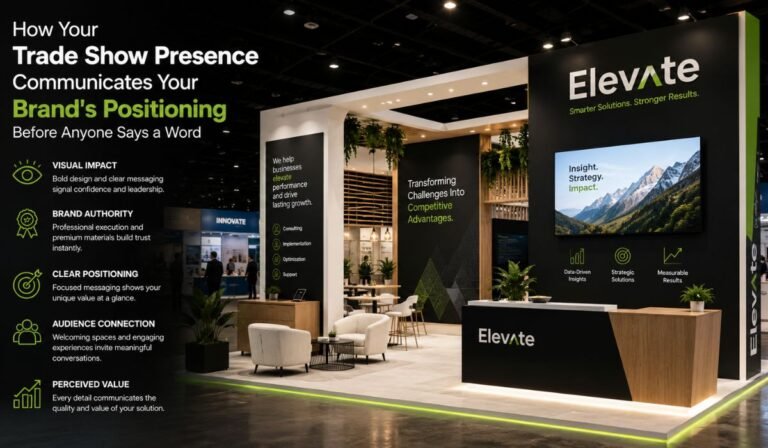
Picture a potential customer stepping onto a trade show floor. Seconds. That’s all it takes. They’ve already sized up your company based on what they see, hear, and feel in the vicinity of your booth — long before a single handshake or elevator pitch enters the picture. Your physical presence has been telling a story the whole time: who you are, what you stand for, where you slot into the industry. That silent broadcast — booth design, layout, atmosphere — can lock in your market position or quietly destroy it.
Visual Design Sets the Tone for Your Brand Story
The instant someone moves toward your booth, visual cues land fast. Color, typography, imagery, aesthetic consistency — all of it fires off an immediate signal about where you sit in the competitive landscape. Are you cutting-edge? Established? Premium? Approachable? An enterprise software company might lean into clean geometry, muted sophisticated palettes, and high-end finishes to radiate stability. A creative agency hunting startup clients might do the opposite entirely — bold colors, unconventional structures, interactive elements screaming “we don’t follow rules.” Neither is wrong. What matters is that the visual language matches the actual position you’re claiming. When it does, credibility compounds. When it doesn’t, visitors feel the friction even if they can’t name it.
Booth Layout Reveals Your Approachability and Accessibility
How your space is physically arranged says a lot. Multiple entry points, open sightlines, accessible seating — these signal that you welcome engagement, that walking up feels easy rather than intrusive. A closed or rigidly structured layout reads differently: more exclusive, more formal, maybe deliberately selective about who gets access. Staff placement matters too, and it’s underestimated constantly. Representatives working the perimeter, pulling people in? That’s an outbound, confident posture. Team positioned deeper inside the booth? You’re telegraphing that your clients tend to seek you out. Then there’s vertical visibility — how prominently your name and key message appear from a distance. High and bold projects authority. Subtle and understated positions you as a specialized, quieter player. Neither is inherently better. But it has to be intentional.
Quality of Materials Speaks to Your Market Segment
Attendees notice everything. Real wood. High-grade finishes. Professional lighting. These things register — sometimes consciously, sometimes not — as signals of a well-resourced, quality-obsessed organization. Worn panels, cheap prints, flickering displays? Those register too, and rarely in the way you’d want. Here’s the nuance though: nobody needs the most expensive booth on the floor. What actually matters is consistency between your positioning and your material choices. A B2B manufacturer targeting value-driven buyers might deliberately lean into sturdy, no-frills construction — and that’s completely coherent. A luxury brand, on the other hand, genuinely must invest in a high-quality trade show booth to hold up against customer expectations. Beyond structure, printed collateral, technology displays, and even basic booth cleanliness mid-event all feed into the cumulative quality impression. It adds up faster than most exhibitors realize.
Environmental Experience Reinforces Company Culture
Sensory experience is branding. Full stop. A booth with open collaboration zones, comfortable seating, and informal conversation nooks suggests a company that genuinely values relationships — with customers and internally. Refreshments, comfortable waiting areas, space to breathe — all of it reinforces a people-first positioning. Energy level matters too. High-octane music, constant motion, visible excitement? That projects momentum and innovation. A quieter, more controlled environment says something else entirely: thoughtful, precise, detail-driven. Both can be powerful. And interactive elements — product demos, hands-on stations, immersive tech — tell attendees you’re willing to invest in their understanding rather than just pitch at them. These experiential choices are really previews. They hint at what working with your company will actually feel like after the show ends.
Team Presentation and Behavior Seal the Impression
Design carries you far. But your people close the loop. Well-presented, professionally dressed staff signal that standards are maintained — that the booth isn’t a one-off performance. Staff who are clearly knowledgeable, genuinely engaged, and curious about attendees’ specific needs reinforce expert-driven, customer-focused positioning. Disinterested body language, unprepared answers, or staff glued to their phones? That can unwind even the most polished booth in minutes. How your team interacts with each other also gets read — consciously or not. Do they seem collaborative? Hierarchical? Relaxed? Tense? Attendees use these behavioral signals to predict what your organization will actually be like to buy from, work with, or partner with long-term. It’s subconscious, and it sticks.
Conclusion
Your trade show presence is a full communication system — running constantly, whether you’re mid-conversation or standing quietly off to the side. Every design decision, spatial choice, material, and behavioral cue feeds the story your booth tells about where you stand in the market. The best exhibitors understand something crucial: positioning isn’t announced. It’s demonstrated. When your physical presence lines up authentically with your stated market position and your company’s real values, the message lands clean — attracting exactly the customers, partners, and talent who belong with your brand. Invest in these silent channels. They’re speaking before you ever open your mouth.
