
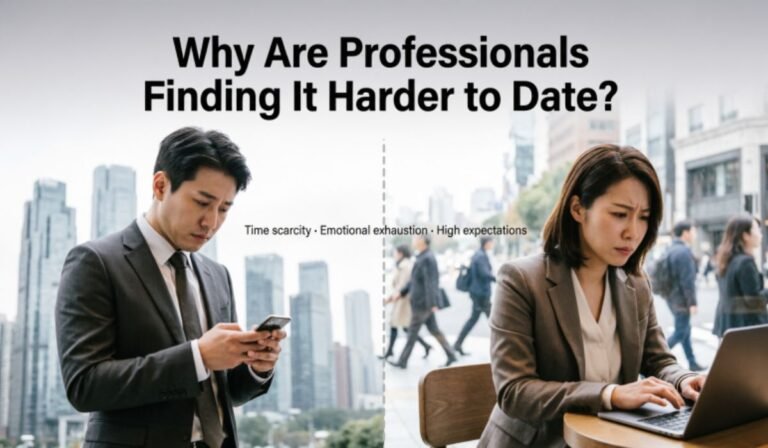
Something broke in the way working people form romantic connections, and it happened quietly enough that most of them blame themselves for it. A 35-year-old attorney cancels a Thursday dinner because a brief landed on her desk at 4 PM. A software engineer scrolls through profiles at 11 PM, half-asleep, swiping with the same mechanical attention he gave his last code review. A consultant flies home on Friday night and spends Saturday recovering from the week rather than meeting anyone new. None of these people lack interest in dating. They lack the hours, the energy, and the mental bandwidth to do it with any consistency. The pattern repeats across professions, age groups, and cities, and the data behind it tells a story that is hard to argue with.
When Work Takes Everything, and Dating Gets What Remains

Deloitte research shows 77% of professionals have burned out at their current job, and 83% of them say that burnout hurts their personal relationships. The Aflac 2025-2026 WorkForces Report puts the number at nearly 3 in 4 U.S. employees dealing with moderate to very high workplace stress. After long hours and constant pressure, most people have very little left to give a partner or even a first date. Many turn to dating apps for professionals hoping to streamline the search, but efficiency tools cannot fix a problem rooted in exhaustion.
A Forbes Health and OnePoll study found 78% of dating app users report burnout from the process itself, with 79% of Millennials and Gen Z saying it leaves them emotionally drained. So the fatigue compounds: work drains them, and the act of looking for someone drains them further. Cigna’s 2025 Loneliness in America survey found 57% of Americans are lonely, and Gallup reports one in five adults feel that way every single day. The energy gap between wanting connection and being able to pursue it keeps growing, and professionals sit right at the center of it.
The Calendar Problem Nobody Talks About
Professional schedules do not leave predictable openings for dating. Meetings run late. Deadlines appear without warning. Travel disrupts weeks at a time. The problem goes beyond being busy, because plenty of busy people managed to date in prior decades. What has changed is the expectation of availability. Employers reach people through Slack, email, and text at all hours, and the boundary between working and not working has dissolved for most salaried workers.
When someone finally gets a free evening, they face a choice between rest and effort. Dating requires effort. It requires getting dressed, showing up somewhere, being present, asking questions, listening to answers. For someone who has been performing all day at work, that kind of social output feels like a second shift. So they stay home. They order food. They tell themselves they will try next week.
Loneliness Keeps Getting Worse, Not Better
AARP’s 2025 study found that 4 in 10 adults aged 45 and older report feeling lonely, with men reporting higher rates than women at 42% compared to 37%. This matters because loneliness and dating difficulty feed into each other. Lonely people often withdraw from social situations, which reduces their chances of meeting someone, which deepens the loneliness. The cycle sustains itself without any outside force pushing it along.
Professional environments used to provide organic social mixing. Office parties, after-work drinks, industry conferences with open bars. Many of those settings have shrunk or disappeared. Remote work removed the daily physical proximity that once led to workplace relationships. Hybrid schedules mean that on any given day, half the team is somewhere else. The casual encounters that used to produce dates have become rare.
Dating Platforms Are Losing People, Too

Match Group reported its Q1 2025 revenue fell 3% year over year to $831 million, driven by a 5% drop in paying users down to 14.2 million. Tinder’s monthly active users declined 9% over the same period. People are leaving these platforms or refusing to pay for them, and the reasons tie back to the same fatigue already described. Swiping through hundreds of profiles after a 10-hour workday does not feel like progress. It feels like another task on a list that never ends.
The promise of app-based dating was speed and convenience. But professionals already spend their entire working lives on screens, managing notifications, responding to messages, and processing information. Adding another screen-based activity that demands attention and emotional investment does not reduce friction. It adds to it. Many professionals report that they would rather meet someone in person, but cannot find the time or setting to do so.
What Actually Gets in the Way
The barriers stack up in specific, concrete ways. First, professionals tend to have high standards shaped by their own achievement, which narrows the pool of people they consider compatible. Second, career ambition absorbs years that might otherwise go toward building relationships, pushing serious dating into the mid-30s or later when urgency and fatigue collide. Third, relocation for work pulls people away from established social networks where they might have met a partner through friends or community.
Financial stability, often assumed to make dating easier, introduces its own complications. High earners worry about being valued for their income. They screen for motivations. They hold back personal details. Trust takes longer to build when someone feels their success makes them a target rather than a person.
Smaller Circles, Fewer Chances
Professional life tends to sort people into narrow groups. Lawyers know lawyers. Doctors know doctors. Finance people socialize with finance people. These professional clusters limit the range of potential partners and create echo chambers where everyone shares the same complaints about work but nobody has time to act on a connection.
Community involvement has declined among working professionals as well. Fewer people attend religious services, join recreational leagues, or volunteer regularly. Each of those activities once served as a low-pressure way to meet someone with shared values. Without them, the entire burden of meeting new people falls on apps or chance.
The Real Cost of Waiting
Professionals often treat dating the way they treat career goals, assuming they can defer it and pick it up later when conditions improve. But conditions rarely improve on their own. Workloads increase with seniority. Responsibilities compound. The window of available time and energy tends to shrink rather than expand as careers progress.
The difficulty professionals face in dating is not a personal failure or a generational attitude problem. It is a structural outcome of how modern work consumes time, energy, and social capacity. Solving it requires more than better apps or scheduling hacks. It requires professionals to treat their personal lives with the same seriousness they give their careers, which, given everything listed above, remains the hardest part.
