
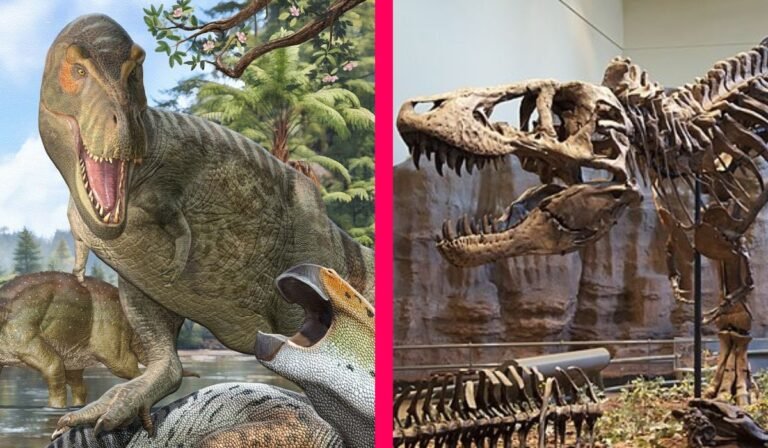
Few dinosaurs capture the imagination quite like Tyrannosaurus Rex. Known as the “King of the Dinosaurs,” this iconic predator has fascinated scientists, children, and dinosaur enthusiasts for generations. With its massive size, fearsome teeth, and powerful build, Tyrannosaurus, or T. Rex, dominates the story of prehistoric life. But there’s more to this giant than just its reputation as a ruthless predator. From its discovery in the late 19th century to modern scientific insights, T. Rex offers a window into the fascinating world of the Late Cretaceous period. In this article, we’ll explore everything about Tyrannosaurus, from fossils and anatomy to behavior, growth, and its lasting cultural impact.
Quick Bio Information
Scientific Name: Tyrannosaurus Rex
Common Name: T. Rex
Classification: Theropod Dinosaur
Family: Tyrannosauridae
Time Period: Late Cretaceous (69–66 Million Years Ago)
Diet: Carnivorous
Length: 40–43 Feet (12–13 Meters)
Height: 12–20 Feet at the Hip (3.7–6 Meters)
Weight: 9–14 Tons
Skull Length: Up to 5 Feet (1.5 Meters)
Bite Force: Up To 12,800 Pounds
Forelimbs: Short, Two-Fingered
Tail: Long and Heavy for Balance
Speed: Estimated 12–20 Miles Per Hour
Fossil Locations: North America (USA, Canada)
Notable Specimens: Sue, Stan, Scotty
Named By: Henry Fairfield Osborn in 1905
Primary Research Methods: Fossil Study, CT Scans, 3D Modeling
Extinct: 66 Million Years Ago
Cultural Impact: Movies, Books, Museums
Scientific Importance: Understanding Apex Predators of the Cretaceous
What Is Tyrannosaurus Rex? An Overview
Tyrannosaurus Rex, often simply called T. Rex, was one of the last and most powerful carnivorous dinosaurs before the mass extinction that ended the age of dinosaurs. Belonging to the theropod group, it is closely related to birds in the modern era. Its classification within the family Tyrannosauridae places it among large predators that dominated North America during the Late Cretaceous. T. Rex lived approximately 69 to 66 million years ago and occupied the roles of both predator and scavenger in its ecosystem. Its formidable size, combined with sharp teeth and keen senses, made it an apex predator, capable of hunting large herbivorous dinosaurs.
The History of Tyrannosaurus Discovery
The story of Tyrannosaurus began in the late 19th century when paleontologists began unearthing massive bones in North America. The first partial skeleton was discovered in 1900 by Barnum Brown, an American paleontologist. The species name, Tyrannosaurus Rex, meaning “Tyrant Lizard King,” was formally assigned by Henry Fairfield Osborn in 1905. Since then, numerous significant fossil discoveries have enhanced our understanding of this legendary dinosaur. Famous specimens like Sue, housed at the Field Museum in Chicago, and Stan, displayed in multiple institutions worldwide, continue to provide vital insights into T. Rex anatomy, growth, and behavior.
Tyrannosaurus Rex Fossils and Skeletons
Fossils of Tyrannosaurus Rex are some of the most studied dinosaur remains ever found. The preservation of bones allows scientists to reconstruct skeletons and understand the size, posture, and movement of this dinosaur. Fossils provide details about the skull, limbs, teeth, and even potential evidence of disease or injuries. Some exceptionally well-preserved skeletons, like Sue, reveal bone texture that offers clues about T. Rex’s growth patterns. Fossil analysis also suggests that these dinosaurs reached maturity relatively quickly, growing from hatchlings into giants in less than two decades.
Size and Appearance: How Big Was T. Rex?
Tyrannosaurus Rex was an impressive giant. Adult specimens typically measured 40 to 43 feet long, with heights of 12 to 20 feet at the hip. They weighed between 9 and 14 tons, making them heavier than many modern trucks. Its massive skull, often exceeding 5 feet in length, held teeth capable of crushing bone. Long, powerful legs and a balanced tail allowed T. Rex to move efficiently despite its enormous size. In comparison to humans, T. Rex was truly colossal, towering over almost any modern predator and inspiring awe in anyone who imagined it alive.
Skull and Teeth: The Bite of a King
The skull of Tyrannosaurus Rex was a marvel of natural engineering. Its teeth, sometimes reaching over 12 inches long, were designed to pierce and crush flesh and bone. Research estimates that its bite force could exceed 12,800 pounds, making it one of the most powerful bites of any terrestrial animal. The skull’s shape, including its robust jaw and forward-facing eyes, gave T. Rex excellent depth perception and targeting ability. Its U-shaped snout and large teeth suggest that it could tackle even the toughest prey, including armored dinosaurs like Triceratops.
Skeleton and Limbs: Walking, Running, and Hunting
T. Rex had a distinctive body plan. Its tiny forelimbs, though short, were muscular and ended in two sharp claws. These may have helped it hold prey while feeding. In contrast, its hind limbs were long and powerful, enabling T. Rex to walk and run efficiently. Estimates suggest it could reach speeds of 12 to 20 miles per hour, enough to chase down slow-moving prey. The long, heavy tail provided balance, helping it make quick turns while hunting or moving across varied terrain. This combination of strength and agility reinforced its status as a top predator.
Behavior and Diet: Predator or Scavenger?
For decades, scientists debated whether Tyrannosaurus Rex was primarily a hunter or a scavenger. Evidence now suggests it likely did both. Its sharp teeth and strong legs made it capable of hunting large herbivores like Hadrosaurs and Ceratopsians. Bite marks on fossilized bones provide direct evidence of predation. However, T. Rex may have also scavenged when opportunities arose, using its keen sense of smell to locate carrion. This versatility would have been crucial for survival in the competitive ecosystems of the Late Cretaceous.
Reproduction, Growth, and Life Span
Tyrannosaurus Rex grew rapidly, reaching full size in under twenty years. Studies of bone growth rings indicate that juveniles grew faster than modern reptiles and even some birds. Hatchlings were small, vulnerable, and likely stayed in protected areas until strong enough to survive. Adults may have lived 28 to 30 years in the wild, a lifespan impressive for such a massive predator. Bone analysis also suggests that T. Rex experienced periods of stress and injury, reflecting the challenges of life as a top predator in its ecosystem.
Species Variations and Controversies
Recent studies suggest that what we call Tyrannosaurus Rex may include multiple species. Proposals like Tyrannosaurus imperator and Tyrannosaurus regina are under scientific review, examining differences in skull shapes and skeletal features. Other debates focus on sexual dimorphism, questioning whether some differences between fossils reflect males and females rather than separate species. Comparing T. Rex with close relatives like Tarbosaurus and Albertosaurus also provides insights into its evolution and adaptation.
Tyrannosaurus in Popular Culture
Few dinosaurs have left a cultural footprint as large as Tyrannosaurus Rex. T. Rex has appeared in countless films, books, and museum exhibitions, most famously in Jurassic Park. Its iconic roar, massive size, and fearsome appearance make it a symbol of prehistoric power. Beyond entertainment, T. Rex inspires scientific curiosity, drawing people into museums, documentaries, and paleontology research. Its presence in culture reinforces its status as the ultimate dinosaur icon.
Fossil Research Today: What We’re Learning About T. Rex
Modern paleontology has transformed our understanding of Tyrannosaurus Rex. Advanced technologies like CT scans and 3D modeling allow scientists to examine fossils in unprecedented detail. Studies of soft tissue, bone microstructure, and biomechanics reveal how T. Rex moved, hunted, and grew. Fossil research continues to uncover new information, including potential evidence of feathers, injuries, and even diseases. These discoveries not only enhance our understanding of T. Rex but also shed light on the biology and behavior of other large theropods.
Conclusion: The Lasting Legacy of Tyrannosaurus Rex
Tyrannosaurus Rex remains the ultimate symbol of dinosaur might and evolutionary success. Its massive size, fearsome teeth, and powerful build make it one of the most impressive predators in Earth’s history. Beyond its physical traits, T. Rex represents the fascination humans have with prehistory and the natural world. From fossils and research to its lasting cultural impact, Tyrannosaurus continues to captivate, educate, and inspire curiosity. As paleontologists uncover new fossils and refine our understanding, the legacy of this king of the dinosaurs grows ever richer, reminding us of the wonders that prehistoric life still holds.
FAQs About Tyrannosaurus
What Did Tyrannosaurus Rex Eat?
T. Rex was carnivorous, feeding on large herbivorous dinosaurs like Hadrosaurs and Triceratops. Fossil evidence shows bite marks on prey bones, indicating hunting, though it may have scavenged when the opportunity arose.
How Big Was Tyrannosaurus Rex?
Adult T. Rex specimens measured 40 to 43 feet long, stood 12 to 20 feet tall at the hip, and weighed between 9 and 14 tons. Its skull alone could be over 5 feet long.
Could Tyrannosaurus Run Fast?
Estimates suggest T. Rex could reach speeds of 12 to 20 miles per hour. Its long legs and balanced tail allowed it to move efficiently despite its massive size.
When Did Tyrannosaurus Rex Live?
T. Rex lived during the Late Cretaceous period, approximately 69 to 66 million years ago, just before the mass extinction that wiped out the dinosaurs.
Who Discovered Tyrannosaurus Rex?
The first partial T. Rex fossils were discovered by Barnum Brown in 1900. The species was officially named by Henry Fairfield Osborn in 1905.
Did Tyrannosaurus Rex Have Feathers?
Some evidence suggests juvenile T. Rex may have had simple feather-like structures, though adults were likely mostly scaly. This remains an active area of research.
How Long Did Tyrannosaurus Rex Live?
T. Rex had an estimated lifespan of 28 to 30 years, growing rapidly in its first two decades to reach full size.
Are There Different Species of Tyrannosaurus?
Recent research proposes multiple species, such as T. imperator and T. regina, but these remain debated. Differences may reflect sex or individual variation rather than separate species.
Please Read Also: BBC iPlayer Growth Explained: Why It’s The UK’s Fastest-Growing Streaming Platform
