
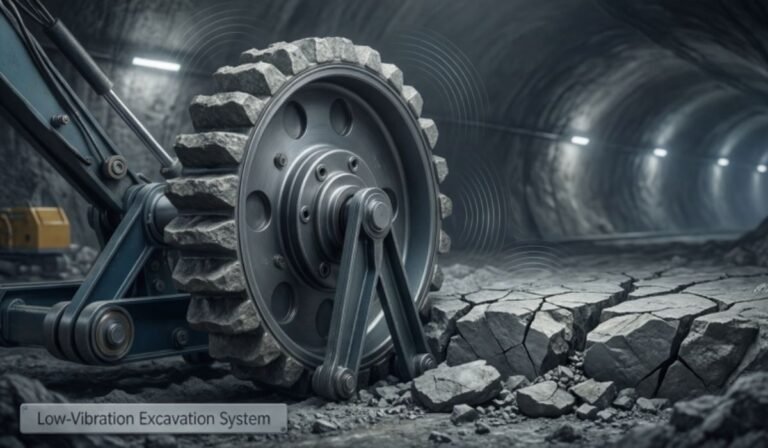
Low vibration excavation has become a necessary requirement in today’s construction, mining, and infrastructure development activities. Vibration can result in damage to the structure, impact the utilities, and also pose safety risks. It is at this point that a rock wheel becomes an important part of the system, as it ensures controlled excavation with minimal site disturbance and also ensures high levels of efficiency.
To understand the significance, it is necessary to discuss the technology, working benefits, and applications that make this process suitable for vibration-sensitive areas.
Requirements for Low-Vibration Excavation
Low-vibration excavation is all about reducing the mechanical shock and seismic impact of cutting, trenching, or surface preparation. Traditional methods such as hydraulic breakers or blasting impart high energy to the surrounding material, resulting in cracking, settlement, and noise generation. High-precision cutting tools allow the operator to approach foundations, pipelines, and roads without damaging the structure.
The requirement for modern excavation work demands equipment capable of cutting while also controlling vibrations, thus increasing the demand for advanced rotary cutting attachments.
How Rockwheel Technology Reduces Ground Vibration
A rock wheel functions through the use of a drum that rotates with hardened cutting tools fixed to it. The tools cut the material through grinding, as opposed to hammering. This ensures that shock loads are not transmitted to the ground. The cutting force is uniformly distributed, ensuring that the levels of vibration are kept low.
Another advantage of rock wheel technology is its accuracy, which enables control of the cutting direction and depth to avoid over-excavation and rework.
Skid Steer Rock Crusher Attachment in Precision Excavation
A skid steer rock crusher attachment is very useful in situations where access is limited or space is restricted. It is mounted on compact carriers, which enable precision excavation in close proximity to buildings, retaining walls, and underground utilities without creating excessive vibration.
The rock crusher attachments have both crushing and cutting capabilities. This can be used to crush hard rock, concrete, and reinforced surfaces while still producing smooth operational output. Their compact size and controlled cutting process make them ideal for urban redevelopment and demolition projects where vibration tolerance is low.
Advantages in Performance for Urban and Infrastructure Projects
In an urban environment, vibration control is no longer an option but a necessity. Vibration-exceeding equipment can lead to delays, fines, or damage to the structure. Rotary cutting equipment has several advantages because it satisfies the vibration criteria.
The rock wheel enables excavation of existing infrastructure such as bridges, railways, and historical structures because of the controlled cutting forces. This reduces the risks associated with the project and does not require additional stabilization.
Infrastructure projects are also rendered risk-free by reduced noise levels, smooth excavation surfaces, and better material quality, which ensures rapid installation of utilities and foundations.
Operational Efficiency and Safety Benefits
In addition to vibration control, these cutting systems offer safety and productivity benefits. Continuous cutting minimizes the generation of flying particles and uncontrolled material breakage, ensuring a safer operating environment. Machine operators enjoy better machine stability, visibility, and reduced wear on carrier machines.
A skid steer rock crusher attachment also boosts operational efficiency by integrating material processing and excavation in a single operation. Rather than excavating material for processing at a distant location, operators can crush and size material on site, reducing time and transportation expenses.
This efficiency is particularly beneficial in projects with tight schedules or environmental constraints.
Environmental and Structural Impact Reduction
Low-vibration excavation is also useful in sustainability efforts. This reduces disturbance to the soil, which in turn helps maintain the soil’s integrity. Controlled cutting also reduces unnecessary excavation, which consumes a lot of fuel and shortens the equipment’s lifespan.
The rock wheel enables contractors to achieve environmental compliance without compromising productivity. Low vibration also reduces the chances of microfractures in the adjacent rock formations.
Applications in Various Sectors
Low-vibration excavation equipment is currently being employed in various sectors like road construction, mining, laying utilities, and demolition. The equipment’s versatility enables the user to easily switch between rock cutting, trenching, and surface profiling.
The skid steer rock crusher attachment is very useful in renovation work where materials need to be excavated without affecting other structures in the area. The attachment’s accuracy and portability make it a popular choice for controlled excavation.
Conclusion
With the growing trend of construction and infrastructure projects being developed close to populated and sensitive areas, the demand for precision excavation solutions is only set to increase. The rock wheel provides the ideal blend of cutting power and vibration control, which is imperative in low-vibration excavation projects that focus on safety, compliance, and efficiency.
Find the latest low-vibration excavation solutions from Rockzone Americas.
