
H2:Introduction
In an era of persistent global supply chain volatility, manufacturers, especially SME and startups,
face significant hurdles when sourcing overseas Precision Manufacturing Services. Challenges extend beyond fluctuating material prices to encompass complex logistics, potential quality inconsistencies, and difficult-to-predict total costs of ownership. These uncertainties often lead to project delays, budget overruns, and compromised product competitiveness.The root cause frequently lies in information asymmetry, a lack of systematic cost assessment methods, and insufficient insight into a supplier’s technical capabilities and quality control systems. Simply selecting the supplier with the lowest quote can lead to substantial hidden expenses from rework, communication overhead, and logistical issues.
This article provides a strategic framework to help decision-makers manage their overseas CNC machining cost more intelligently in 2026. It will dissect the components of Total Cost of Ownership (TCO) and explore how to achieve significant savings without compromising quality through design optimization, selecting the right technology and partners, and implementing smart supply chain strategies.
H2: How to Define the True Total Cost of Ownership for Overseas Precision Manufacturing in 2026?
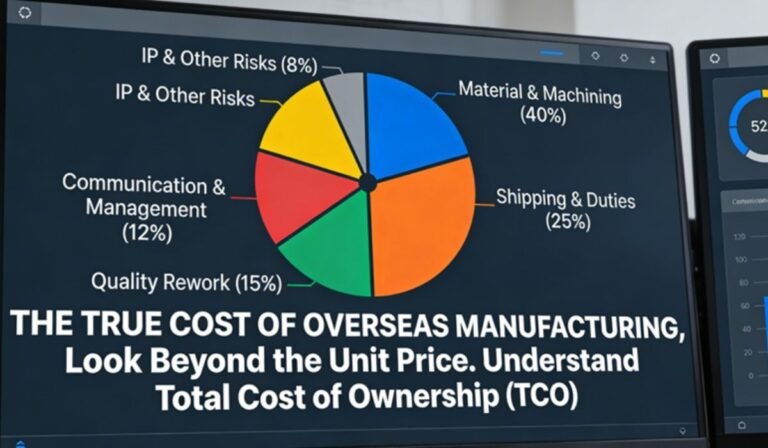
Effective budgeting for overseas projects begins with a holistic view of Total Cost of Ownership (TCO), which requires looking beyond the unit price on a quotation to encompass both visible and hidden elements. Direct costs form the baseline, covering raw materials, machine time for CNC machining, and secondary operations like anodizing or powder coating. However, the often- underestimated indirect and hidden costs—such as international shipping and duties, communication and project management hours compounded by time zones and language barriers, losses from quality failures necessitating rework or scrap, opportunity costs from production delays, and the long-term risk of inadequate intellectual property protection—can severely erode profits.
A whitepaper from the Manufacturing Leadership Council on hidden costs in global supply chains highlights that these can constitute over 20% of a project’s total cost, directly impacting final profitability, making the construction of this complete cost picture the essential first step toward sound sourcing decisions.
H2: How to Screen for Technically Capable and Reputable Partners from Numerous Suppliers?
H3: Evaluating Technical Capability and Equipment Advancement
A supplier’s prowess in CNC Machining Technology is fundamental, dictating the complexity and precision of parts it can reliably produce. Evaluation must assess the presence of advanced machinery like multi-axis machining centers, live tooling lathes, and in-process inspection systems. Equally important is proven experience with challenging materials such as high-strength alloys, titanium, or composites, which require specialized knowledge to machine effectively without compromising material integrity or tolerances
H3: Assessing Process Reliability and Collaborative Efficiency
Selecting a partner requires scrutinizing both their systemic quality foundations and their operational interface. This two-pronged assessment is critical for long-term project success.
● The Critical Role of Quality Management Systems and Certifications
Formal certifications are objective proof of standardized, reliable processes. Industry-specific credentials like IATF 16949 for automotive or AS9100D for aerospace signify that the supplier has established rigorous, audited systems for risk management, quality traceability, and continuous improvement. These are not just badges but vital safeguards against future quality issues and hidden expenses. For instance, a manufacturer like JS Precision, holding such certifications, is often considered a more reliable partner for clients in stringent sectors.
● Ensuring Communication Efficiency and Project Management
Beyond technical specs, evaluating the supplier’s interface is essential. This includes measuring response times, language proficiency, and the structured assignment of a dedicated project manager or point of contact. Clear, efficient, and proactive communication ensures design intent is accurately understood and maintained throughout production, preventing costly misinterpretations and revisions that can derail timelines and budgets.
H2: How to Reduce CNC Machining Expenses at the Source Through Design Optimization and Material Selection?
Superior custom CNC machining services start with collaboration at the design stage. Implementing Design for Manufacturability (DFM) principles can significantly reduce costs from the outset.
H3: Optimize Geometry to Reduce Machining Difficulty
Simplifying part geometry—by minimizing deep pockets, small internal corners, and unnecessary complex surfaces—can dramatically cut machining time and tool wear. Sometimes, assembling multiple simpler components is more cost-effective than a single, highly complex monolithic part.
H3: Set Tolerances Judiciously and Select Efficient Processes
● Tighter Tolerances Are Not Always Better
Unnecessarily tight tolerances increase machining time and cost exponentially. Collaborate with engineers to loosen tolerances on non-critical features where functionally permissible.
● Opt for Efficient, Standardized Processes
Understanding the characteristics and applications of different CNC machining tools is crucial for optimizing parameters and extending tool life. Selecting the most appropriate standard tools and strategies enhances efficiency.
H3: Select Materials and Stock Sizes Strategically
Where performance requirements for strength or corrosion resistance allow, evaluate more cost- effective material alternatives (e.g., aluminum alloy instead of stainless steel). Designing parts to fit the supplier’s inventory of standard bar or plate sizes can also drastically reduce material waste and procurement lead time.
H2: How to Use Logistics and Supply Chain Strategies to Avoid Hidden Cost Landmines?
The logistics phase is fraught with variables, but proactive planning can prevent budget overruns:Proactive logistics strategy is pivotal for cost control. Consolidating shipments and planning for volume leverages economies of scale, significantly reducing per-unit freight costs. Pre-emptively researching target market import regulations, tariffs, and certifications is essential to avoid costly customs delays or fines.
Furthermore, shifting value-added activities like simple assembly or pre-inspection to the supplier’s facility, while increasing the ex-factory price, often lowers total landed cost by reducing downstream labor and minimizing errors. As noted in The Economist‘s analysis of 2025-2026 supply chain resilience, treating logistics as a strategic cornerstone is key to building both cost competitiveness and operational resilience.
H2: How to Minimize the Cost of Quality Through Effective Quality Control?
For high precision CNC machining, investing in upfront quality control is the most effective way to avoid catastrophic rework and recall costs downstream.
H3: Establish Clear Quality Agreements
Before the order is placed, align with the supplier on clear inspection standards, sampling plans (e.g., AQL levels), measurement methods, and tools. A written quality agreement serves as the benchmark for all inspections, reducing disputes.
H3: Audit the Supplier’s Process Control Capability
● Process Control Trumps Final Inspection
A competent supplier should have robust in-process controls, such as first-article checks, in- process inspections, and statistical process control (SPC) to ensure consistency.
● Advanced Metrology is a Must
Verify that the supplier is equipped with devices like Coordinate Measuring Machines (CMM), roundness testers, and surface roughness testers to validate complex dimensions and geometric tolerances.
H3: Enforce Rigorous First Article Inspection
The First Article Inspection (FAI) report is the “green light” for production. It verifies that the part meets all design dimensions, material, and processing specifications. For complex components, an FAI is indispensable. Therefore, selecting a supplier with comprehensive inspection equipment and a mature quality control process is key to ensuring the outcome of high precision CNC machining services. Established quality management systems like ISO 9001 provide the essential process framework for this.
H2:Conclusion
Effectively managing overseas CNC machining costs is about much more than comparing quotes. It is a systematic project involving technical assessment, design collaboration, supply chain optimization, and quality risk management. In 2026, successful manufacturers will be those who can deeply collaborate with precision manufacturing partners possessing advanced technology, strict quality control systems, and transparent processes to optimize costs across the entire cycle from design to delivery.
Facing cost challenges in your next precision manufacturing project? Download our Precision Part Manufacturing Cost Optimization Checklist today, or contact our expert team for a personalized cost analysis of your design.
H2:Author Bio
This article was written by an industry consultant with over 15 years of experience in precision manufacturing and global supply chain management. He specializes in helping manufacturing enterprises optimize their outsourcing strategies to achieve the best balance of cost, quality, and speed. His insights have been featured in numerous industry publications.
H2:FAQs
Q: Besides unit price, what is the most important factor when selecting an overseas CNC machining supplier?
A: Quality management system certifications (like ISO 9001, IATF 16949) and technical communication capability are paramount. Certifications ensure process stability, while smooth communication guarantees accurate understanding of design intent, avoiding expensive misunderstandings and rework.
Q: How can I control CNC machining costs for small-batch orders?
A: The focus should be on design optimization and material selection. Apply Design for Manufacturability principles to simplify the part and choose materials that are more readily available and easier to machine. Negotiating with the supplier to use shared standard raw material blanks can also effectively reduce costs.
Q: How can I ensure the quality of parts produced overseas meets requirements?
A: Require a detailed inspection plan at the quotation stage and enforce a strict First Article Inspection. Choose suppliers that provide full-process quality documentation (inspection reports, material certificates) and consider third-party pre-shipment inspections.
Q: What does holding an AS9100D certification mean for an aerospace project?
A: AS9100D is an aerospace quality management system standard based on ISO 9001. It indicates the supplier has processes in place to meet the extreme rigor of the aerospace industry, including traceability, risk management, and control of special processes, significantly reducing project risk.
Q: Typically, how long does it take from initial inquiry to receiving the first batch of parts from overseas machining?
A: Timing depends on part complexity and order volume. Prototypes for simple components can take as little as 5-10 working days, including production and logistics. For complex parts or production runs, comprehensive DFM analysis and process planning may take 1-2 weeks, with an additional 2-4 weeks for production and shipping.
