
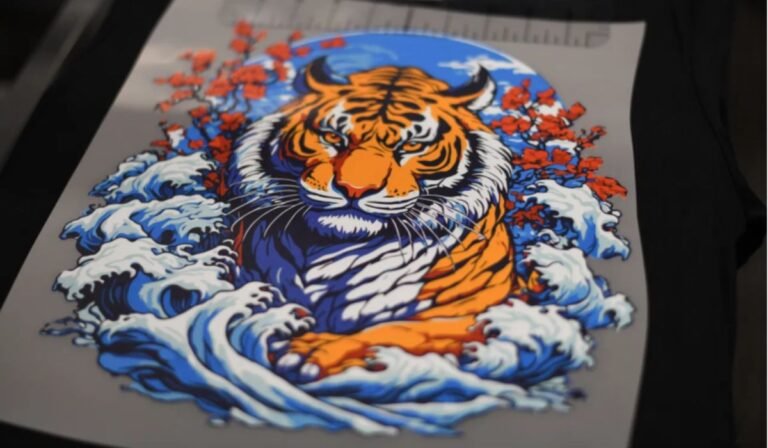
Custom apparel has become one of the most accessible business models for entrepreneurs in 2026. Low startup costs, no inventory requirements, and a growing market for personalized clothing have made it a viable entry point for first-time business owners and established print shops alike.
The technology driving most of this growth is Direct-to-Film printing — DTF. A design is printed onto a specialized film using CMYK and white inks, coated with a hot melt adhesive powder, and heat pressed onto a garment. The carrier film peels away, leaving a vivid, durable print permanently bonded to the fabric.
Why DTF Works for Small Businesses
DTF has three structural advantages over older methods like screen printing and DTG:
- No minimums.Screen printing requires significant setup per design, making small orders uneconomical. DTF has no setup process — a single transfer costs essentially the same per unit as a batch of 100.
- Fabric flexibility.DTF works on cotton, polyester, nylon, and blends in any color. No pretreatment, no fabric restrictions, no color limitations.
- Full-color accuracy.Complex gradients, photographic images, and fine detail reproduce accurately — something screen printing cannot match at small quantities.
Two Ways to Run the Business
In-house production makes sense once you consistently exceed 75–100 transfers per day. Entry-level desktop DTF setups start around $5,000–$8,000. The advantage is full control over turnaround and quality. The disadvantage is upfront capital and the maintenance responsibility that comes with running printing equipment.
Wholesale sourcing is the right model for most new businesses. You source finished transfers from a professional DTF supplier, apply them with a heat press, and focus entirely on design, marketing, and customer relationships. For operations under 75 transfers per day, outsourcing is more cost-effective than in-house production even after accounting for supplier markup.
The wholesale DTF market has matured significantly. Suppliers like dtfprintdepot.com now offer same-day printing and shipping on orders placed before 3 PM, local pickup available 7/24, no minimum order requirements, and free shipping on orders over $99 — a combination that makes the wholesale model viable even at low and variable volumes.
Pricing for Profit
Start with your actual cost per unit and work upward. A custom t-shirt using a sourced DTF transfer typically involves a blank garment at $4–$8, a transfer at $1.50–$3.50, and labor and overhead of $2–$5 per unit. At a 50–60% gross margin target, retail pricing on a custom t-shirt should sit in the $18–$40 range depending on garment quality and complexity.
What Actually Drives Long-Term Success
The businesses that sustain growth in custom apparel share three characteristics: they deliver on their turnaround promises consistently, they give customers clear file requirements upfront to avoid back-and-forth, and they treat quality consistency as non-negotiable across every order. In a market driven by referrals, reputation compounds quickly in both directions.
DTF infrastructure is more accessible than ever. For entrepreneurs focused on margins and execution, the opportunity is real.
