
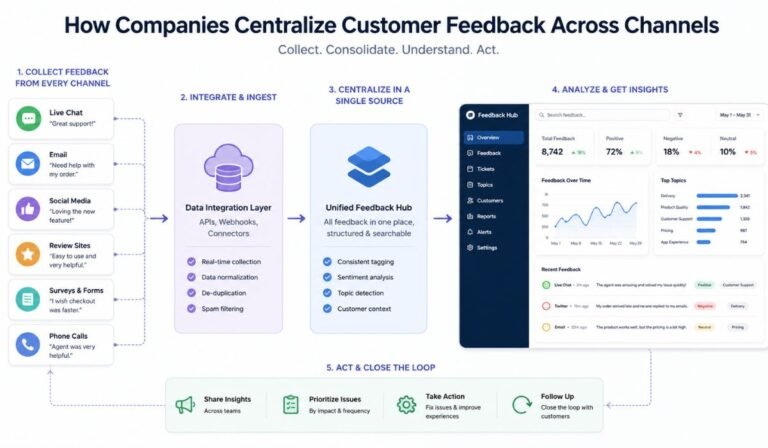
Customer feedback has turned out to be one of the most valuable assets for modern-day firms. Any interaction a customer has with a company, whether through emails, phone calls, surveys, social media, live chats, or online reviews, is a goldmine of information for firms. Companies can leverage this data to improve their products, services, and overall customer experience.
The problem is that, as the number of communication channels increases, the complexity of managing this data is also growing. Customers today interact with firms through numerous channels, and their feedback is distributed across various platforms. It is possible to miss out on valuable insights if this data is not properly leveraged.
To address this problem, many firms today are turning to centralized customer feedback management. By collecting data from various channels, firms can now get a comprehensive view of their customers’ experiences and make better, well-informed decisions.
Why centralizing customer feedback is important for companies
Generally, customers don’t interact with firms through a single channel. For example, a customer may send a complaint through email, share a review online, comment on social media, and later fill out a satisfaction survey. All of this contains valuable feedback for firms.
If this data is stored separately, firms may find it difficult to get a comprehensive view of their customers’ experiences. Different departments of a firm may end up working in silos, and valuable trends may go unnoticed.
Centralizing customer feedback helps firms to:
Gain a comprehensive view of their customers’ experiences
Recognize trends in their customers’ feedback
Improve collaboration between teams
Make data-driven decisions
Respond to customer concerns more efficiently
This is because a centralized approach ensures that feedback from all channels is used to build a broader understanding of the customer.
Key channels where customer feedback originates
Before centralizing the feedback, a business must first understand the various channels where the feedback originates. Some of these channels include:
Customer Support Interactions
Interactions in contact centers, emails, and support tickets usually carry detailed feedback about the product and the overall service quality. Businesses often integrate these interactions into a centralized customer feedback management tool so teams can track recurring issues and improve service delivery.
Surveys and Feedback Forms
Surveys, feedback forms, and post-interaction surveys help in obtaining feedback from the customers in a more structured way.
Social Media Platforms
Customers usually share feedback and opinions about the brand on social media platforms. This feedback is useful in obtaining insights into the expectations and needs of the customers.
Online Reviews and Ratings
Customers give direct feedback about the product and service quality on online review sites and e-commerce sites.
Website and App Feedback
Businesses can also obtain feedback from customers through the company’s website and mobile apps.
Leveraging advanced technologies for feedback analysis
Due to the increased volume of feedback, it is becoming difficult to manually analyze the feedback. To solve this problem, a number of organizations are leveraging advanced technologies to make the analysis process more efficient.
Natural Language Processing (NLP)
Natural language processing is a technology in which computers can understand and interpret the language spoken by humans. NLP is a powerful technology used in the analysis of unstructured feedback, including customer reviews, emails, and support tickets.
By using NLP, businesses are able to automatically detect:
Common themes and topics
Sentiment trends
Frequently mentioned product-related issues
Emerging customer concerns and complaints
This type of technology allows businesses to process customer feedback and gain insights that might otherwise be missed.
Sentiment Analysis
Sentiment analysis tools allow businesses to automatically classify customer feedback as having positive, negative, or neutral sentiment. Analyzing the sentiment of customer feedback allows businesses to quickly pinpoint areas where customers are having a positive experience and areas for improvement.
For instance, if a business uses sentiment analysis and determines that negative feedback is increasing regarding a particular product feature, the business may be able to address the problem and resolve it accordingly.
Sentiment analysis tools also help businesses accurately measure customer satisfaction and brand perception.
Machine Learning
Machine learning algorithms are another type of advanced technology that may be applied to the analysis of customer feedback, allowing it to become more accurate and precise as time goes by.
Additionally, machine learning algorithms may help businesses prioritize customer feedback by identifying which feedback is most critical for customers.
Benefits of centralizing customer feedback for businesses
By effectively centralizing and analyzing customer feedback, businesses may reap a number of significant business advantages.
Improved Customer Experience
By centralizing customer feedback, businesses may quickly pinpoint and resolve customer pain points, thereby creating a much more positive and seamless experience for customers.
Faster Business Decisions
Having access to all customer feedback in one place allows business leaders to quickly and effectively make decisions for the business.
Improved Product Development
Customer feedback may help businesses develop a much better understanding of what improvements may be made or what new features may be added to a product in the future.
Stronger Customer Relationships
Responding to feedback and demonstrating change is a powerful way to assure customers that their voice is being heard. It can build loyalty and trust.
Conclusion
With the expansion of customer interactions into a variety of different areas, managing feedback is now a major priority in today’s businesses. Customer feedback can be centralized, which will allow a business to combine different types of feedback, identify trends, and respond to its customers’ issues in a more efficient way.
With best practices such as centralizing feedback, segmenting customer feedback, using qualitative and quantitative research, and finally, closing the feedback loop, a business can convert its feedback into a valuable tool.
In addition, technology such as natural language processing, sentiment analysis, and machine learning can now allow businesses to analyze their customers’ feedback in a more in-depth way.
In conclusion, businesses that are successful in centralizing their customers’ feedback are more likely to enhance their customers’ experience, build stronger relationships, and ultimately, increase their business growth.
