
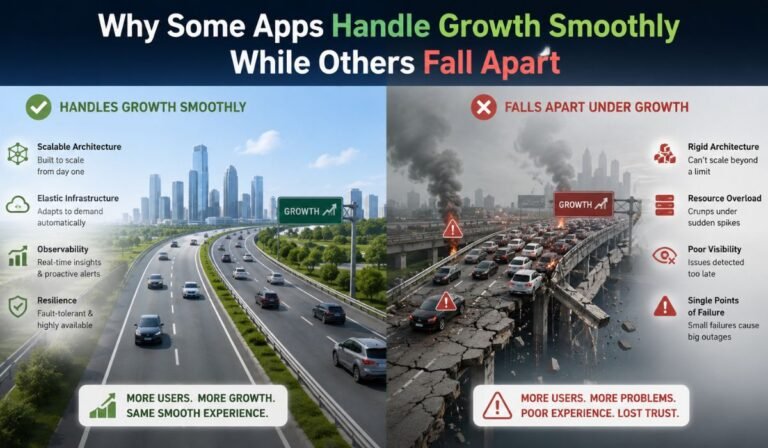
A lot of apps feel great when they first launch. Fast loading times. Clean interfaces. Few bugs. Everything works because honestly, only a small group of users touches the system at that stage.
Then growth happens.
Suddenly thousands of people start uploading files, sending requests, syncing accounts, streaming data, or refreshing dashboards all at once. And that’s usually when teams discover whether the app was actually built to scale or simply built to launch quickly.
The thing is, scalability sounds technical from the outside, but it affects almost every part of the user experience eventually. Slow checkout pages. Crashing notifications. Delayed syncing. Weird login problems. Most users never think, “This app has scaling issues.” They just think the product feels unreliable.
And honestly, unreliable apps lose users very quickly now.
Scalability starts long before traffic spikes happen
This is where teams often get caught off guard.
A lot of startups build products focused almost entirely on getting something functional into users’ hands fast. That makes sense early on. Shipping matters. Survival matters more than perfect infrastructure during the first stages.
But shortcuts pile up over time.
A system designed around one thousand users may struggle badly at fifty thousand if the underlying architecture never planned for growth. Databases slow down. Servers overload. Background tasks start backing up quietly until users notice delays everywhere.
And honestly, some scaling problems only appear suddenly under pressure. Everything works fine right until it really doesn’t.
That’s why experienced engineering teams think about scaling earlier than people expect, even if traffic numbers still seem small initially.
Modern apps depend heavily on invisible infrastructure
Users mostly judge apps by what appears on screens, but scalability often depends more on the systems nobody sees directly.
Servers. Databases. APIs. Caching layers. Queue systems. Background processing. All the invisible operational stuff quietly holding everything together underneath the interface.
And honestly, modern apps are much more interconnected now than people realize.
A single user action might trigger authentication checks, payment verification, analytics tracking, cloud storage updates, notifications, recommendation engines, and third-party integrations almost simultaneously. That complexity grows fast once usage increases.
Especially subscription-based products.
Apps built around subscription lifestyle management platforms, for example, often process recurring billing, account permissions, usage tracking, customer notifications, and personalized dashboards constantly behind the scenes. If one system slows down unexpectedly, the ripple effects spread everywhere pretty quickly.
That interconnectedness changes how scalability works entirely.
Good scalability often looks boring
This part feels important honestly.
People sometimes imagine scalable apps relying on flashy technology breakthroughs or complicated AI systems doing something futuristic. Usually the real answer is much less exciting.
Reliable scaling often comes from boring operational discipline.
Monitoring systems. Load balancing. Database optimization. Clear architecture decisions. Careful testing. Gradual rollouts instead of reckless launches. Teams catching small issues before they become giant outages later.
Not glamorous work.
And honestly, companies ignoring those boring operational details eventually pay for it once user growth speeds up faster than expected. The internet is full of products that went viral briefly then collapsed under their own traffic because nobody prepared infrastructure properly beforehand.
Users rarely give second chances after reliability problems either.
Teams build scalability differently now
Older apps often relied on giant centralized systems doing everything inside one massive codebase. Modern applications increasingly break functionality into smaller services communicating together across cloud infrastructure.
That helps teams scale parts of products independently instead of rebuilding entire systems every time traffic grows somewhere unexpectedly.
Makes sense honestly.
If messaging activity spikes dramatically, teams can scale messaging systems specifically without touching billing infrastructure or account management systems unnecessarily. Smaller components create more flexibility during growth.
Of course, distributed systems also introduce new complexity. Communication delays. Service failures. Dependency problems. Sometimes fixing one issue accidentally breaks something else entirely. That happens more than companies like admitting publicly.
Scaling always introduces tradeoffs somewhere.
User expectations keep getting higher
This may be the biggest challenge honestly.
People expect apps to feel instant now because the largest technology companies trained users to expect nearly flawless experiences constantly. Fast loading. Immediate syncing. Perfect uptime. Smooth onboarding. Stable notifications.
Even smaller startups get judged against those expectations immediately.
And users have very little patience for technical problems anymore because alternatives exist everywhere. If an app crashes repeatedly or feels slow during important moments, people move on surprisingly fast.
That pressure forces companies to prioritize scalability earlier than previous generations of startups did.
Sometimes maybe earlier than they can comfortably afford.
Still, modern apps need infrastructure flexible enough to support unpredictable growth because success itself creates operational stress quickly. A product going viral sounds exciting until engineers suddenly spend forty-eight straight hours trying to stop servers from collapsing under traffic spikes nobody anticipated properly.
That happens. Probably more often than users realize.
Scalable apps usually succeed because teams treat infrastructure like part of the product experience itself instead of background technical work nobody notices. Because eventually users always notice when the systems underneath stop keeping up.
