
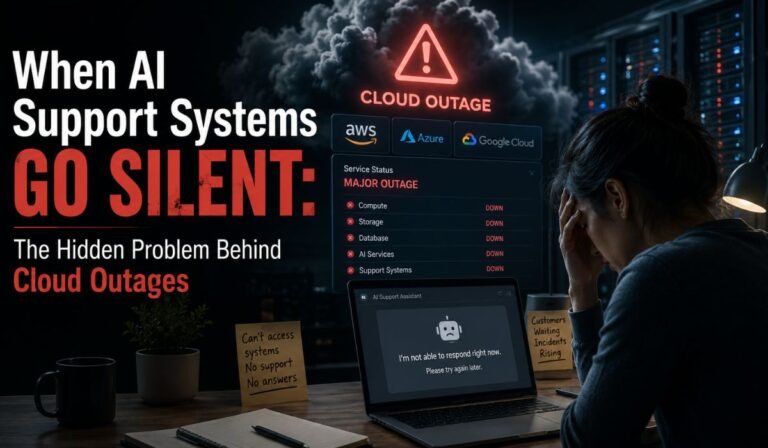
A lot of companies rely on AI support agents now without really thinking about what happens if those systems suddenly disappear for an hour. Or three hours. Or longer.
It feels stable right up until it doesn’t.
Customers open chat windows expecting instant answers, and instead they get frozen loading icons, error messages, or responses that make absolutely no sense because part of the infrastructure failed quietly somewhere in the background. Honestly, people lose patience fast during outages. Faster than companies expect sometimes.
And the thing is, outages rarely stay isolated anymore. One cloud issue can ripple across customer service, internal dashboards, ticket systems, and automated workflows almost immediately.
That’s where things get messy.
Most AI support systems depend on more services than people realize
This surprises people sometimes.
A support chatbot might look simple from the outside, but underneath it often relies on several connected systems at once. Language models, customer databases, authentication layers, routing systems, analytics tools, cloud hosting providers. A lot happening at the same time honestly.
If one part fails, the entire experience can start breaking apart in weird ways.
Maybe the AI still responds, but it no longer pulls account details correctly. Maybe support tickets stop syncing. Maybe conversations disappear halfway through because storage services become unavailable temporarily.
Customers usually do not care which technical component failed either. They just think the company stopped working properly.
Fair honestly.
Outages expose weak backup planning very quickly
Companies talk constantly about redundancy until something actually breaks. Then suddenly everybody realizes the backup plan was mostly theoretical.
You’ll notice more businesses discussing cross-cloud backup and recovery solutions because relying entirely on one provider started feeling risky after several high-profile outages over the past few years.
And honestly, even large companies get caught unprepared sometimes.
One cloud region fails and support teams scramble manually answering requests through email because the AI systems they depended on completely stopped functioning. Some companies still keep emergency spreadsheets for situations like this. Which feels kind of funny until you realize why they exist.
People improvise fast during outages.
Very fast.
AI support agents still need human fallback systems
This part matters probably more than companies admit publicly.
There’s a growing assumption that AI support can fully replace human escalation systems during high-volume situations. Sometimes that works. Sometimes it really does help reduce pressure dramatically.
But outages change the equation immediately.
When automated systems fail, customers usually become more emotional, more impatient, and honestly less forgiving overall. That’s exactly when businesses need human communication most.
Simple status updates help a lot during these moments. Honest messaging helps too. Customers handle delays better when they feel informed instead of ignored by broken automation loops repeating the same useless message over and over again.
Everybody hates that experience honestly.
Testing matters more than flashy AI features
Companies love demo environments. Perfect workflows. Clean presentations showing AI systems answering questions beautifully in controlled settings.
Real outages are uglier.
That’s why some organizations now invest more heavily in chat agent testing under failure conditions instead of focusing entirely on response quality during normal operations. They want understanding of how systems behave during downtime, partial outages, missing data access, or overloaded traffic spikes.
Because weird things happen during failures.
Really weird sometimes.
AI agents may hallucinate missing information once backend systems disconnect. Routing logic may fail unpredictably. Escalation systems might stop assigning human agents correctly. Small technical weaknesses become very visible very quickly under stress conditions.
Kind of like people honestly.
Customers judge reliability more than innovation
This feels important.
Businesses often compete aggressively over smarter AI features, faster automation, or more advanced conversational experiences. But during outages, none of those features matter much anymore.
Reliability becomes the entire product for a while.
People simply want updates, transparency, and reassurance that somebody still controls the situation. That emotional trust matters more than fancy automation once systems become unstable.
And honestly, customers usually forgive occasional outages. What they struggle forgiving is confusion. Silence. Endless error loops. Companies pretending nothing is wrong while users clearly see everything breaking around them.
That part damages trust much faster.
AI support systems honestly do help companies scale customer service in ways that were difficult a few years ago. But outages reveal something important underneath all the automation hype: businesses still need resilience, fallback communication, and humans capable of stepping in when systems stop cooperating. Technology matters obviously. Stable recovery planning matters just as much.
